
Why Cursor IDE Remote Jobs represent the Future of Development
Finding the right Cursor IDE remote jobs in July 2026 is all about matching your skills with companies that value fast, AI-assisted development. If you want a quick summary of what the current market looks like, here is what you need to know:
- Top Remote Roles: AI Adoption Engineer, Forward Deployed Engineer, Bugbot Software Engineer, and AI-Driven Development Specialists.
- Key Technical Stack: Strong proficiency in Python, TypeScript/JavaScript, and legacy systems like Java/Spring.
- Essential AI Skills: Multi-file reasoning, prompt engineering, agentic workflows, and the ability to audit AI-generated code.
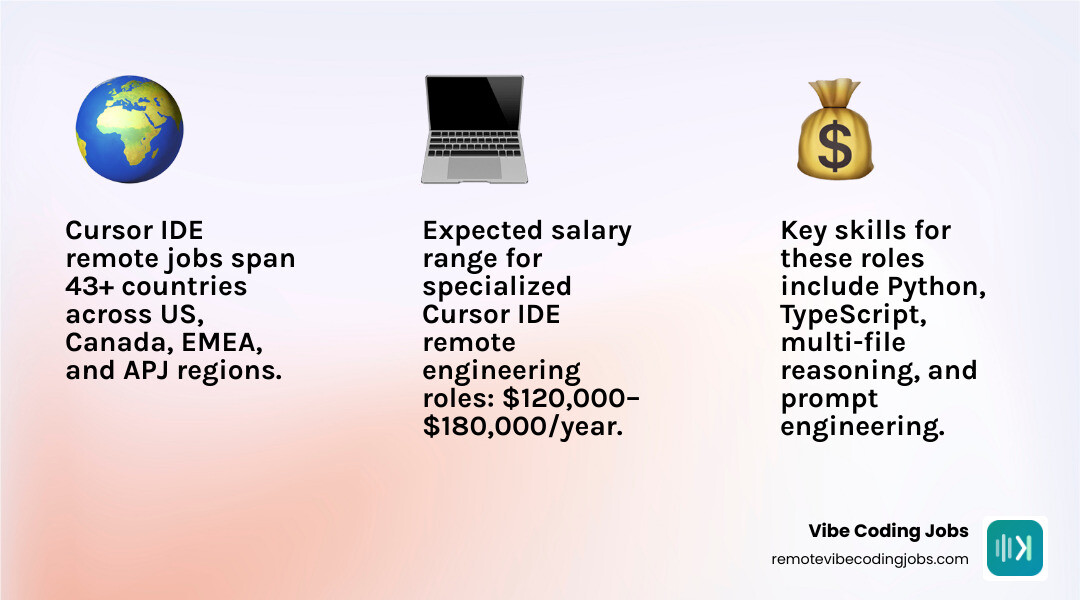
- Expected Salary Range: $120,000 to $180,000 per year for specialized engineering positions.
- Workforce Distribution: Highly global, with open roles supported across the US, Canada, EMEA, and APJ regions.
The software engineering landscape has shifted. Today, writing code is no longer about typing every line by hand. It is about acting as a mission control for autonomous agents.
Companies are no longer just allowing AI tools—they are actively hiring developers who know how to use them to ship software faster and with fewer bugs.
I am Di Su, a software engineer with over 10 years of experience building web apps and optimizing dev workflows. I closely track the market for Cursor IDE remote jobs to help developers transition into highly productive, AI-assisted engineering roles.
Let’s explore the top remote opportunities available right now and the exact workflows you need to master to land them.
Top 5 High-Demand Cursor IDE Remote Jobs in 2026
The demand for developers who can leverage AI-native tools has skyrocketed. In July 2026, companies are moving away from treating AI as a simple autocomplete helper. Instead, they are looking for engineers who treat AI as a core partner in their development cycle.
If you want to position yourself at the forefront of this shift, you need to know which roles are actively hiring and what skills they require. For a deep dive into the broader market trends, you can explore our guide on Cursor & Copilot Developer Jobs: Remote Openings, Skills & Career.
Let’s break down the five most in-demand remote positions available today for developers who specialize in using Cursor.
1. Forward Deployed Engineer
A Forward Deployed Engineer (FDE) at Cursor acts as a highly technical consultant who works directly with enterprise clients. Unlike traditional backend developers who work in isolation, FDEs are on the front lines of customer discovery and workflow design.
Your primary mission in this role is to sit down with a client’s engineering leadership, understand their existing development bottlenecks, and design custom AI-assisted workflows to solve them. This might involve building automated pull request review loops, setting up incident-to-fix pipelines, or creating massive codebase migration scripts.
Because you are working inside the client’s actual repositories, you must own the production reliability of the workflows you build. You are also the primary feedback loop back to the core product team, helping them understand how real-world developers use the editor.
If you are interested in this specific career path, you can read more about general opportunities in our breakdown of Cursor & Copilot Developer Jobs: Remote Opportunities.
2. AI Adoption Engineer
Buying an AI tool is incredibly easy; getting a 5,000-person engineering organization to actually change their daily coding habits is incredibly hard. This is the exact problem that an AI Adoption Engineer solves.
As an AI Adoption Engineer, your job is less about writing raw product features and more about driving deep behavioral change across large teams. You will spend your days running internal hackathons, organizing immersive “Customer Developer Days,” and working side-by-side with skeptical senior developers to prove the value of AI-assisted engineering.
You need to have strong technical credibility because you will be troubleshooting real-world code in real-time with enterprise architects. However, you also need excellent empathy and communication skills to guide teams through the cultural shift of adopting AI as core infrastructure.
To learn more about how this role is shaping the industry, read our analysis on Cursor & Copilot Developer Jobs: Remote AI Growth.
3. Software Engineer, Bugbot
If you want to work directly on the core AI agents that power the next generation of code reviews, the Bugbot team is where you want to be. Bugbot is Cursor’s AI-powered agent designed to automatically review pull requests, catch complex bugs, and suggest architectural improvements before code is merged.
As an engineer on this team, you will fluidly move between the model layer (prompting, model routing, context selection) and the product layer (UI, integrations, and developer workflows).
The biggest challenge in this role is noise reduction. An AI reviewer that posts unhelpful or noisy comments is worse than having no assistant at all because it quickly erodes developer trust. You will spend a significant amount of time designing and running rigorous evaluation harnesses (evals) to ensure Bugbot’s suggestions are consistently accurate and valuable.
You can view the official job specifications for this role directly on the Cursor · Software Engineer, Bugbot careers page.
4. Senior Staff GTM Systems Engineer
As Cursor scales its enterprise footprint, its internal business systems must keep pace with its rapid growth. The Senior Staff Go-To-Market (GTM) Systems Engineer is a critical remote role within the Revenue Operations department.
In this position, you are responsible for designing, building, and maintaining the global systems that support the sales, marketing, and customer success teams. This involves integrating complex enterprise tools, setting up robust data pipelines, and automating workflows to ensure the sales team can seamlessly move clients from initial contact to structured Proof of Value (POV) evaluations.
This role requires a unique blend of backend engineering skills and a deep understanding of enterprise SaaS business models. You will be responsible for building systems that manage admin policies, audit logs, identity management, and security reviews for global clients.
If you are a systems-level engineer who loves optimizing business infrastructure, you can look for these specialized roles on modern remote job platforms that support AI-driven engineering teams.
5. Cursor Developer / AI-Driven Development Specialist
Many forward-thinking companies are now hiring dedicated specialists to integrate and optimize Cursor workflows across their existing engineering teams. This is where the role of a Cursor Developer or AI-Driven Development Specialist comes in.
Your mission in this role is to act as an engineering multiplier. Instead of just using Cursor for your own tasks, you are responsible for standardizing how the entire company uses AI. This includes:
- Building and maintaining custom prompt libraries, templates, and macros for recurring engineering tasks.
- Integrating Cursor and other AI-native tools directly into the team’s CI/CD pipelines and automated testing suites.
- Auditing AI-generated code to ensure it meets strict company standards for security, performance, and architecture.
- Mentoring and training traditional developers on how to transition into highly productive “vibe coders.”
This role bridges the gap between raw AI capabilities and structured enterprise development practices. You can learn more about how companies are hiring for this specialty on the Trafilea – Cursor Developer / AI-Driven Development Specialist job page and read our comprehensive overview of the market at Cursor & Copilot Developer Jobs.
Core Responsibilities and Compensation for Remote Roles
To help you decide which path fits your career goals, let’s compare the core responsibilities, typical compensation, and geographic expectations for the two primary customer-facing engineering roles at Cursor.
| Feature / Role | Forward Deployed Engineer | AI Adoption Engineer |
|---|---|---|
| Primary Focus | Technical integration, custom workflow design, and production reliability. | Behavioral change, developer advocacy, and driving tool adoption. |
| Key Activities | Writing migration scripts, building PR review loops, debugging model failures. | Running internal hackathons, organizing Developer Days, mentoring teams. |
| Typical Target Audience | Staff+ Engineers, Platform Architects, and Devops leads. | Skeptical developers, engineering managers, and VPs of Engineering. |
| Estimated Salary Range | $120,000 – $180,000 | $110,000 – $160,000 |
| Supported Regions | Australia, Singapore, Japan, EMEA, and Americas. | Worldwide Remote (with regional timezone alignments). |
To better understand how these roles fit into the overall enterprise software lifecycle, let’s look at the process of moving an organization from purchasing the tool to achieving true behavioral change:
For a deeper look into how remote developers are building communities and growing their careers around these roles, visit our article on Cursor & Copilot Developer Jobs: Remote Community & Career.
Key Skills Required for Cursor IDE Remote Jobs
If you want to land a remote role at Cursor or a company that officially supports Cursor-driven development, you need a specific blend of traditional software engineering fundamentals and modern AI-native skills.
- Multi-File Reasoning: You must be highly proficient in guiding AI agents to make cohesive changes across complex, multi-file codebases. This means knowing how to structure your repository context and use tools like
.cursorrulesto guide the AI’s understanding. - Advanced Prompt Engineering: Writing simple prompts is not enough. You need to know how to write highly specific, context-rich instructions that produce secure, maintainable, and structured code on the first run.
- Core Languages: Strong backend expertise in Python and TypeScript/JavaScript is almost always mandatory, as these make up the bulk of Cursor’s internal and client-facing codebases.
- Code Hardening and Auditing: You must be able to spot subtle bugs, security vulnerabilities, and performance regressions in AI-generated code. Traditional computer science fundamentals (data structures, algorithms, and system design) are still critical for this step.
For a great example of how these skills are formally structured in academic and professional settings, check out the Cursor Engineer – Career Center | Calvin University career guide.
Compensation and Geographic Distribution
Cursor (Anysphere) is a highly distributed company with a rapidly growing global footprint. As of July 2026, the company’s workforce has scaled to 829 employees distributed across 43 countries, including the United States, United Kingdom, Canada, Germany, and Australia.
The active job postings have shown massive growth, with a monthly trend increase of +50.7% and a quarterly growth of +54.9%. While 69% of the workforce (686 employees) remains based in the United States, the company is actively hiring across EMEA (Europe, Middle East, and Africa) and APJ (Asia-Pacific and Japan) to support its global enterprise clients.
Typical compensation for remote engineering roles ranges from $120,000 to $180,000, depending on your experience level, location, and the specific technical requirements of the role.
Inside Cursor’s Remote Work Culture and Hiring Process
Working at Cursor means joining a highly ambitious, talent-dense startup environment. The company describes its culture as a “haven for self-motivated individual contributors” and claims to “obsess over talent to an unusual degree.”
We have analyzed employee feedback and hiring patterns to give you a clear, unbiased look at what it is actually like to apply and work here. For a balanced view of employee reviews and alternative opportunities, take a look at Cursor & Copilot Developer Jobs: Reviews & Alternatives.
How to Apply and Interview for Cursor IDE Remote Jobs
Cursor’s application and interview process is highly technical and designed to filter for individuals who are comfortable with ambiguity and rapid execution.
- The Application: When you apply, Cursor asks for standard documents like a resume and LinkedIn profile. However, they also require a link to your GitHub profile and a short, written note about a technical project you are exceptionally proud of. This applies even to non-engineering roles, such as sales and account management, highlighting the deeply technical nature of the company.
- The Interview Loop: Candidates should prepare for a relatively flat and sometimes unstructured interview process. You will move quickly from initial screening into deep technical discussions directly with engineering managers and core team members. There are rarely dedicated recruiters guiding you through every step, so proactive communication is key.
- The Practical Assessment: Be prepared to demonstrate your AI-assisted development workflows. You may be asked to solve a complex coding problem or refactor a legacy repository live, using Cursor to showcase your speed, prompt engineering, and code-validation skills.
Culture Challenges and Onboarding Realities
While working at a hyper-growth AI startup is exciting, it also comes with distinct challenges that remote candidates should carefully consider before applying.
- Unstructured Onboarding: Because the team is growing so quickly (with a monthly workforce growth rate of +9.2%), formal onboarding processes can sometimes be disorganized. New hires are often expected to jump straight into production codebases and client-facing workflows with minimal hand-holding.
- High-Pressure Expectations: The company values rapid execution and “spirited debate.” This means you must be highly self-directed and comfortable defending your architectural decisions in a environment.
- Async Communication Mastery: With team members spread across 43 countries, mastering asynchronous communication is vital. You must be comfortable documenting your work clearly, managing your own schedule, and collaborating across wildly different timezones without constant supervision.
Daily Workflows: How Cursor Engineers Use Their Own Tools
One of the coolest parts of working at Cursor is “dogfooding”—using the very product you are building to manage your daily tasks. Cursor engineers don’t just write code in the editor; they use advanced, asynchronous workflows to automate their entire development lifecycle.
For a detailed look at how these tools integrate into modern, secure corporate environments, explore our guide on Cursor & Copilot Developer Jobs: Integration & Security.
Asynchronous Agentic Workflows
Cursor has expanded far beyond the desktop editor with the release of Cursor Agents on web and mobile. This allows remote engineers to manage their codebases and trigger complex tasks without being tied to a desk.
- Asynchronous Background Tasks: A remote developer can launch a complex bug-fix agent or feature-scaffolding task directly from their mobile phone while away from their computer.
- Web-Based PR Reviews: Once the background agent completes the task, the developer can review the generated pull requests and visual diffs directly from a web browser.
- Slack Integration: By integrating Cursor with team Slack channels, engineers can receive notifications when background agent tasks are completed, or even trigger new agent runs directly in a chat thread using the
@Cursorcommand.
Combining Cursor with Terminal Agents
To build the ultimate “vibe coding” environment, many remote engineers combine the visual interface of Cursor with powerful, terminal-native AI agents like Claude Code and Aider.
- Cursor: Used for rapid inline completions, visual diff reviews, and image-based UI editing.
- Claude Code & Aider: Run directly inside Cursor’s integrated terminal to handle complex, multi-file refactoring tasks and autonomous test-driven development.
- Local Models: Engineers can also leverage Aider with local models via Ollama to run completely free, offline development environments.
To see how these different tools compare and how to combine them for maximum productivity, check out our deep-dive comparison, Cursor vs Copilot vs Claude.
Frequently Asked Questions about Cursor IDE Remote Jobs
Does Cursor hire remote workers globally?
Yes, Cursor is a highly distributed company. While a large portion of the team is based in the United States, they support remote employees across 43 different countries in regions including EMEA, Canada, Australia, and APJ. However, you should always check the specific timezone and regional requirements listed on individual job postings, as some roles require close collaboration with local enterprise clients.
What is the difference between a Forward Deployed Engineer and a traditional Software Engineer at Cursor?
A traditional Software Engineer at Cursor focuses primarily on building the core editor, training internal coding models, and scaling the infrastructure. A Forward Deployed Engineer (FDE) works directly with enterprise clients. FDEs perform customer discovery, design custom AI-assisted workflows inside client repositories, and act as a bridge between real-world developer feedback and the core product team.
What is the typical salary for remote engineering roles at Cursor?
Highly specialized remote engineering roles, such as Forward Deployed Engineers, typically command an estimated salary range of $120,000 to $180,000 per year. This compensation is highly competitive and reflects the high demand for developers who combine deep software engineering fundamentals with expert-level AI workflow mastery.
Conclusion
The “vibe coding” revolution is here, and it is completely reshaping how we think about remote software engineering. Landing one of the highly coveted Cursor IDE remote jobs in 2026 requires more than just knowing how to write code—it requires mastering the art of collaborating with AI agents to build, test, and ship software at unprecedented speeds.
At RemoteVibeCodingJobs, we are dedicated to helping developers navigate this exciting transition. We aggregate the best remote “vibe coding” opportunities at async-first companies, offering curated daily listings filtered by culture, tech stack, and AI tool preferences.
Ready to take the next step in your career and find a company that officially supports and funds your AI-native workflow? Find remote vibe coding jobs on our platform today and join the future of software development!