
Why the Async Remote Software Engineer is the Most In-Demand Dev Role of 2026
Becoming an async remote software engineer means working without fixed hours, skipping most meetings, and shipping code on your own schedule — from anywhere in the world.
Here’s what that looks like in practice:
- No mandatory standups. You communicate through written updates, not calls.
- Timezone freedom. You work when you’re sharpest, not when a calendar says so.
- Results over presence. Companies care what you ship, not when you log in.
- AI-first workflows. Tools like Cursor, Claude, and Copilot replace a lot of back-and-forth.
- High pay. Async-first staff engineer roles currently range from $100K to $350K/year.
This is different from regular remote work. “Remote-friendly” often just means working from home on someone else’s schedule. Async-first means the entire company is built around written communication, documentation, and deep focus time.
The demand is real. There are currently over 300 async-first staff engineer roles in the US alone, with companies like Zapier and Grafana Labs leading the charge. And as AI tools accelerate how fast good engineers can ship, the async model is becoming the default — not the exception.
We cover this space every day. As RVCJ Editorial, our team specializes in tracking AI-assisted development, async hiring trends, and remote career paths for engineers building with tools like Cursor, Claude, and Replit — making us your go-to source for navigating the async remote software engineer job market. Let’s break down exactly how to master this lifestyle and land the role you want.
What is an Async Remote Software Engineer?

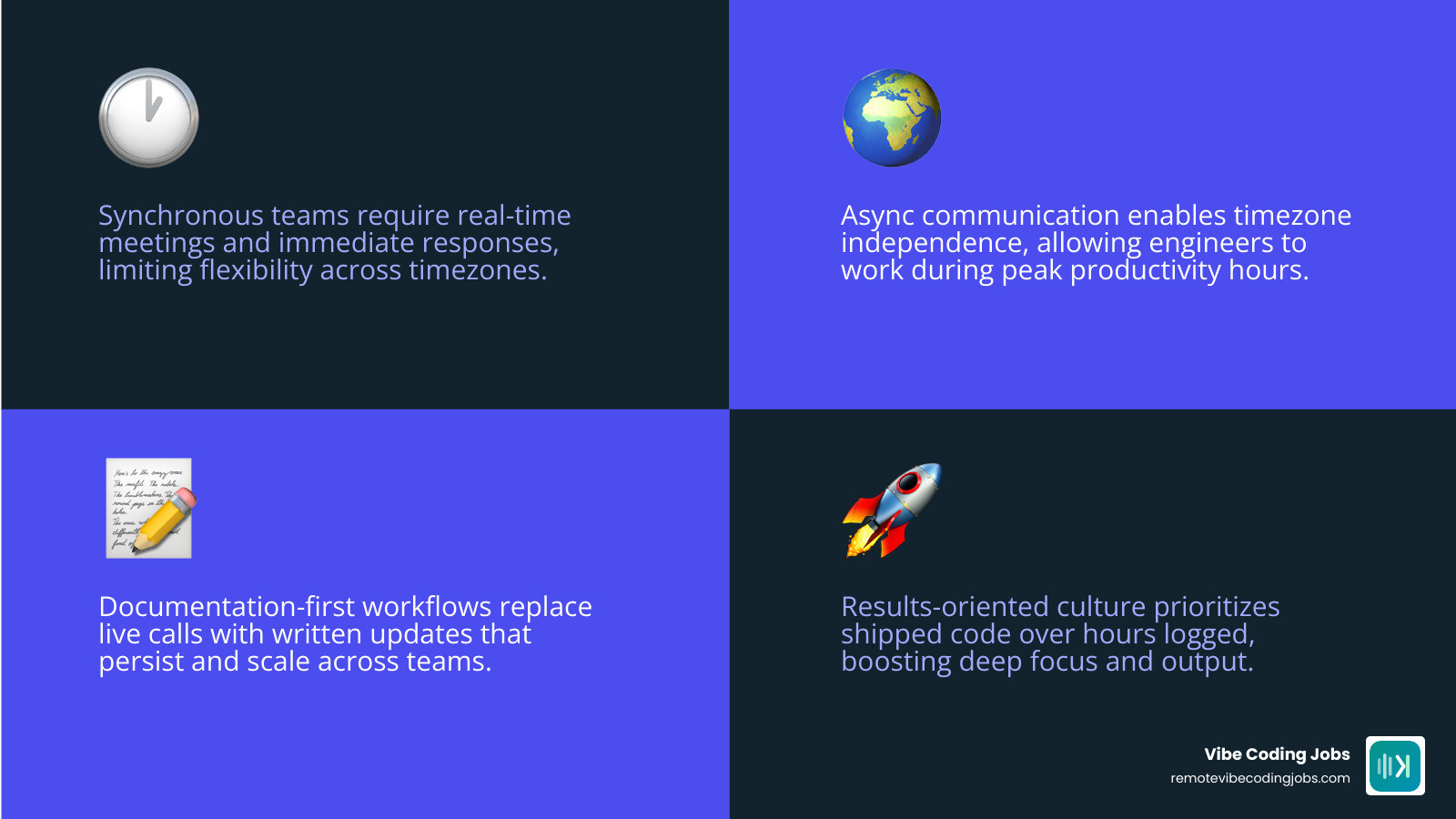
To understand the async remote software engineer, we have to look past the standard “work from home” label. In a traditional remote setting, you might still be tethered to a 9-to-5 schedule, expected to jump on a Zoom call at a moment’s notice. In an async-first environment, timezone independence is the core feature, not a bug.
This role is defined by a documentation-first mindset. Because your teammates might be sleeping while you’re coding, every decision, PR description, and architectural plan must be written down clearly. This creates a culture of autonomy where you are the CEO of your own tasks. You aren’t waiting for permission in a meeting; you’re moving forward based on the shared documentation.
Being an async remote software engineer is inherently results-oriented. When managers can’t see you sitting in a chair, the only metric that matters is the quality and velocity of your output. This shift allows for a much higher degree of professional freedom. If you want to learn more about how this differs from the standard grind, check out our Async First Remote Work Guide or explore the breakdown of Remote Work vs Office Developers.
What defines a successful async remote software engineer?
Success in this field isn’t just about how well you code; it’s about how well you manage yourself. Successful async engineers are “meeting-light” by choice. They push for “vibe updates” in Slack or Notion rather than 30-minute syncs. This requires a high level of trust-based collaboration. You trust your team to do their jobs, and they trust you to ship without being micromanaged.
| Feature | Synchronous Model | Asynchronous Model |
|---|---|---|
| Primary Tool | Zoom / Google Meet | Notion / GitHub / Slack |
| Response Time | Immediate (Expected) | Delayed (Intentional) |
| Schedule | Fixed / Overlapping | Flexible / Timezone-agnostic |
| Focus | Fragmented by meetings | Deep Work / Flow State |
| Documentation | Often verbal/lost | Written / Permanent |
Essential Skills for the Modern async remote software engineer
The tech stack for an async remote software engineer in 2026 is evolving. While foundational languages like Python, Go, and TypeScript remain dominant, the way we use them has changed. Python is frequently used for building AI-powered backends and data pipelines, while Go powers the highly-concurrency architectures required for global, distributed systems.
Modern roles also demand a deep understanding of cloud services and containerization. You aren’t just writing code; you’re often responsible for how it runs. Proficiency in Docker and Kubernetes is no longer optional for Senior Software Engineer Roles. If you specialize in the “engine room” of applications, you’ll find plenty of opportunities in Backend Developer Remote Jobs.
Mastering Asynchronous Programming and Distributed Systems
In async work, your code often mimics your workflow. We see a massive demand for engineers who understand event-driven architectures and microservices. When building systems for companies like Axelar or PowerLoom, you need to handle high-concurrency and scalability. This means mastering RESTful APIs and asynchronous programming patterns (like Promises, Async/Await, or message queues) to ensure that services can talk to each other without waiting for a “synchronous” response.
Communication and Documentation Excellence
We cannot overstate this: your writing is your most important tool. In an async-first culture, your ability to explain a complex technical trade-off in a Notion page or a GitHub issue is just as important as the code itself. You must be proactive in knowledge sharing. If it isn’t documented, it didn’t happen. For a deeper dive into how top teams handle this, read about Async First Remote Developer Jobs Culture Workflow Communication.
The Vibe Coder Toolkit: AI and Workflow Optimization

The term “vibe coding” has taken the industry by storm in 2026. It refers to a workflow where the engineer focuses on the “vibe” — the architecture, the logic, and the user experience — while AI handles the manual syntax. For the async remote software engineer, this is a superpower.
Our favorite tools for this lifestyle include:
- Cursor: The AI-native IDE that understands your entire codebase.
- Claude & Copilot: For generating complex functions and debugging on the fly.
- Bolt & Lovable: For rapid prototyping of full-stack applications.
- Replit: For instant deployment and collaborative “vibe” sessions.
To maximize these, check out our Remote Developer Productivity Tips Tools Boost Your Output.
Leveraging AI as Your Primary Pair Programmer
In 2026, we don’t code alone. AI has become the primary pair programmer. This shift values velocity over syntax. If you can describe a feature through expert prompt engineering, you can ship in hours what used to take days. This allows for rapid prototyping, which is essential in the high-growth startups we track. This “flow state” is the heart of a Deep Work Culture Developer Jobs Finding Focus Flow.
High-Velocity Engineering without the Burnout
The “vibe coder” lifestyle is about autonomous building. With AI doing the heavy lifting, you can take full ownership of a feature from database schema design to final deployment with zero hand-offs. This reduces the frustration of waiting on other departments. However, because you can work anytime, you must be careful. We recommend following our guide on How to Avoid Burnout as a Remote Developer to keep your velocity sustainable.
Finding and Landing High-Paying Async Roles
The market for the async remote software engineer is incredibly lucrative. Staff Engineer roles in the United States are currently fetching between $100K and $350K per year. Even mid-level roles frequently start at $150K, especially at AI-first companies that value high-velocity builders. You can Browse High-Paying Async Remote Jobs on our platform to see the latest listings.
Top Companies Hiring for the async remote software engineer Role
Several trailblazing companies have moved beyond “remote-friendly” to “async-first.” These include:
- Zapier: A pioneer in remote work that powers billions of automated tasks.
- Grafana Labs: Builders of observability tools used by over 25 million people.
- PowerLoom & Axelar: Leading the way in decentralized data and cross-chain communication.
These companies often provide stipends for home offices and wellness, recognizing that their engineers are their most valuable distributed assets. See more Async First Companies Hiring Developers.
Navigating the Async Interview Process
Forget the eight-hour “whiteboard” interview. Async-first companies care about “Proof of Work.” They want to see launched projects and public repositories. They are looking for technical generalists — people who can use AI to bridge the gap between frontend, backend, and DevOps. During the interview, focus on your portfolio and your ability to work autonomously. Show them that you don’t need a manager to tell you what to do next.
Frequently Asked Questions about Async Engineering
What are the biggest challenges of async work?
The most common hurdles are isolation and “over-documentation” fatigue. Without a physical office, you have to be intentional about social interaction. Timezone alignment can also be tricky if a “quick question” takes 12 hours to get an answer. This is why mastering Remote Work Deep Focus Productivity is vital.
Do I need specific certifications for async roles?
While practical experience is king, certifications in Azure, AWS, or Kubernetes can help, especially for senior roles at large firms like Optum or Motorola Solutions. However, for “vibe coding” roles, your ability to build and ship is your best certification.
How does AI change the daily routine of an async engineer?
AI automates the “boring” parts of the job — unit tests, boilerplate, and documentation. This leaves the async remote software engineer free to focus on high-level architecture and creative problem-solving. It’s one of the biggest Async First Remote Developer Jobs Productivity Benefits we see in the current market.
Conclusion
The era of the office-bound dev is over. Mastering the async remote software engineer lifestyle is about more than just finding a job; it’s about reclaiming your time and focusing on what you love: building great software. With the right toolkit of AI IDEs like Cursor and a documentation-first mindset, you can achieve a level of career growth and work-life balance that was once impossible.
At RemoteVibeCodingJobs, we are dedicated to helping you find these elite opportunities. Whether you are looking for your first “vibe coding” role or a $300K staff engineer position, we’ve got the curated listings and culture filters you need.
Ready to find your next async role? Explore the latest async remote software engineering jobs at RemoteVibeCodingJobs.com