
The Remote Software Engineering Job Market in 2026
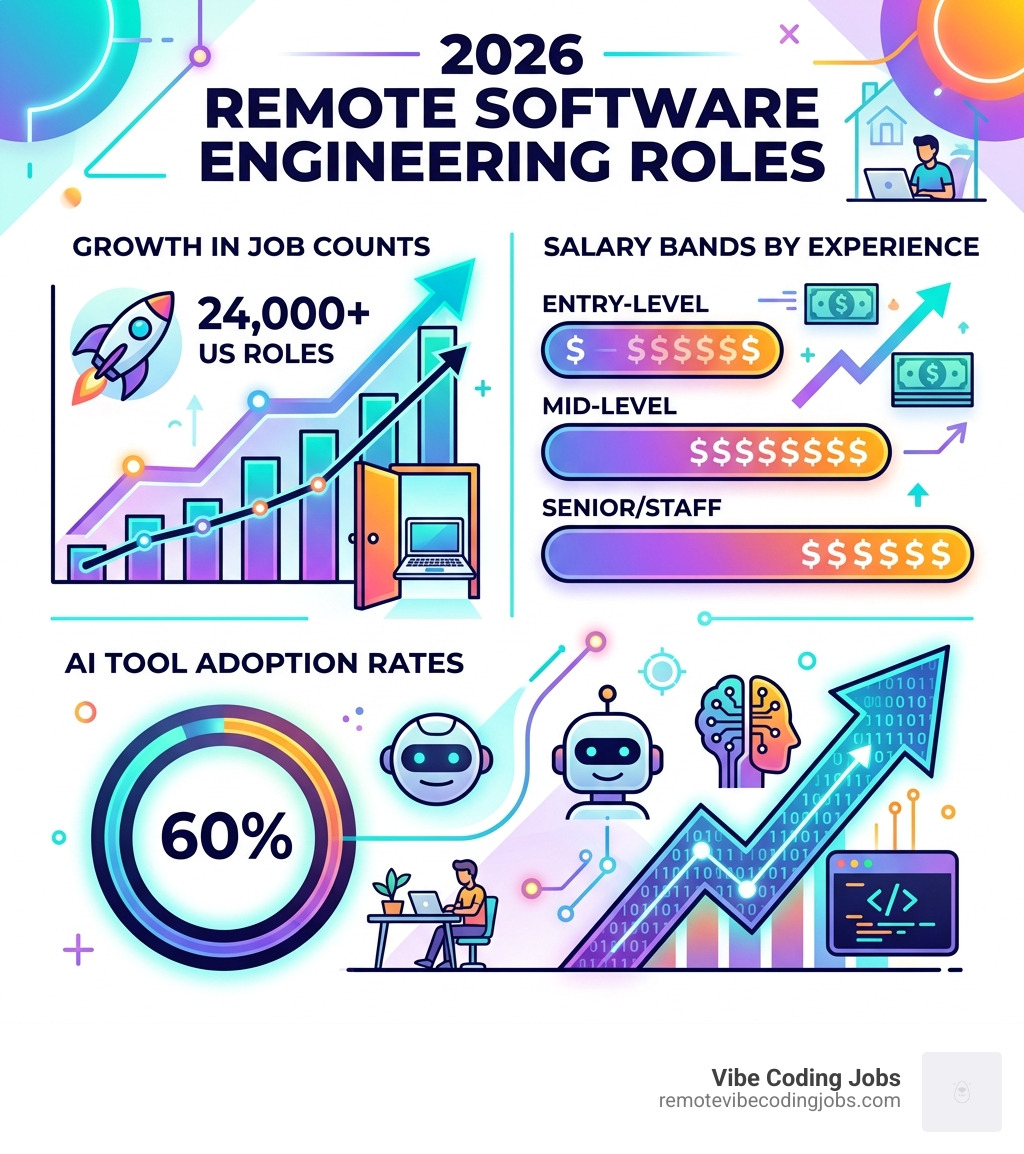
Remote software engineer jobs work from home are more plentiful than ever — with over 24,000 open roles in the US alone as of May 2026.
To find the best roles, developers are increasingly moving away from noisy general platforms and toward specialized communities. Vibe Coding Jobs focuses on AI-native and async-first roles, providing daily updates and curated listings for the modern engineer who values speed and autonomy.
Salaries range widely by level:
- Entry-level: $55,000 – $100,000/yr
- Mid-level: $100,000 – $160,000/yr
- Senior/Staff: $160,000 – $300,000/yr
Most full-time roles include equity, unlimited PTO, and home office stipends. Many now also offer an AI tools budget for editors like Cursor and Claude Code. The adoption of these tools is tracked by industry leaders like GitHub, which continues to see a massive surge in AI-assisted commits.
The market has shifted fast. AI-assisted development — sometimes called “vibe coding” — is no longer optional at top remote companies. Roles increasingly expect you to ship faster using tools like GitHub Copilot and Claude, not just write traditional syntax line by line.
I’m the RVCJ Editorial team at Vibe Coding Jobs, covering remote software engineering careers, AI-assisted development trends, and remote software engineer jobs work from home for a community of 3,000+ AI-fluent developers. We curate and update remote roles daily so you don’t have to dig through noise to find the right fit.
How to Secure Remote Software Engineer Jobs Work From Home in 2026
Securing a role in today’s market requires more than just knowing how to write a function. As we move through 2026, the landscape of remote software engineer jobs work from home has diversified into several specialized paths. Whether you are building the core infrastructure of a SaaS platform or training the next generation of Large Language Models (LLMs), the “how” has changed.
First, identify your niche. The most common remote roles currently available include:
- Full-Stack Engineers: These remain the “Swiss Army Knives” of the remote world. Companies love hiring full-stack developers because they can own a feature from the database to the UI.
- Backend Specialists: Focused on scalability, API design, and data integrity. These roles often command higher salaries in fintech and healthcare.
- AI Trainers and Evaluators: A massive emerging sector. Companies like DataAnnotation are hiring engineers to evaluate AI-generated code, paying between $40 and $60 per hour with total schedule flexibility.
- AI/Machine Learning Engineers: These roles involve building agentic workflows and integrating LLMs into existing products.
To stand out, your portfolio should demonstrate “shipping velocity.” In 2026, employers aren’t just looking for clean code; they want to see that you can use modern tools to build complex applications quickly.
If you are looking to specialize, check out these dedicated categories:
- AI Engineer Jobs
- Data Scientist Jobs
- Machine Learning Engineer Jobs
- Python Developer Jobs
- Next.js Developer Jobs

Salary Expectations and Benefits for Remote Developers
One of the biggest perks of remote software engineer jobs work from home is the decoupling of location from income. In 2026, many top-tier remote companies have moved toward U.S.-benchmarked compensation, meaning you can earn a San Francisco-level salary while living in a much more affordable area.
| Level | Salary Range (USD) | Common Equity Offer |
|---|---|---|
| Junior / Entry-Level | $55,000 – $100,000 | 0.01% – 0.05% |
| Mid-Level | $103,000 – $155,000 | 0.05% – 0.15% |
| Senior / Staff | $140,000 – $300,000 | 0.1% – 0.5% |
Beyond the base salary, the benefits packages for remote roles have become incredibly competitive. We are seeing a surge in “lifestyle benefits” designed to prevent burnout and support a healthy home-work boundary:
- Unlimited or High-Cap PTO: Many companies now offer a minimum of 30-35 days of PTO annually to ensure employees actually take time off.
- 4-Day Work Weeks: A growing number of engineering teams are adopting 32-hour work weeks for 100% pay, citing improved focus and retention.
- Home Office & AI Stipends: It’s common to receive $1,000 – $3,000 for your initial setup, plus monthly credits for AI tools like Cursor, Claude, and ChatGPT Plus.
- Global Offsites: Fully remote teams often fly their entire staff to locations like Portugal, Mexico, or Italy twice a year to build the “human” connection that Zoom can’t replace.
For those aiming for the top of the pay scale, Senior Full-Stack Developer Jobs often provide the best balance of high base pay and significant equity.
High-Paying Remote Software Engineer Jobs Work From Home by Experience
Experience levels in 2026 are measured not just in years, but in the complexity of the systems you’ve managed remotely.
For senior individual contributors, roles like the Senior Software Engineer, Enterprise Engineering at Revecore demonstrate the high demand for engineers who can handle complex business logic in a distributed environment.
If you’ve transitioned into leadership, the Senior Engineering Manager, Corporate Engineering at Grafana Labs is a prime example of a role that requires balancing technical oversight with the nuances of managing a global, async team. Staff-level roles at companies like Circle or Grafana Labs can frequently exceed $200,000 in base salary, especially when they involve mission-critical infrastructure like Kubernetes or cloud observability.
Essential Skills and Modern Tech Stacks
The tech stack for remote software engineer jobs work from home has consolidated around a few powerhouses. While the “best” language is always the one that solves the problem, certain technologies dominate the remote job boards in 2026.
Frontend: React remains king, but the ecosystem has shifted heavily toward Next.js and TypeScript. Tailwind CSS is the industry standard for styling, allowing for rapid, consistent UI development.
Backend: Node.js (TypeScript), Python (FastAPI), and Go are the most requested. Ruby on Rails is seeing a massive resurgence in the startup world due to its focus on developer productivity and “convention over configuration.”
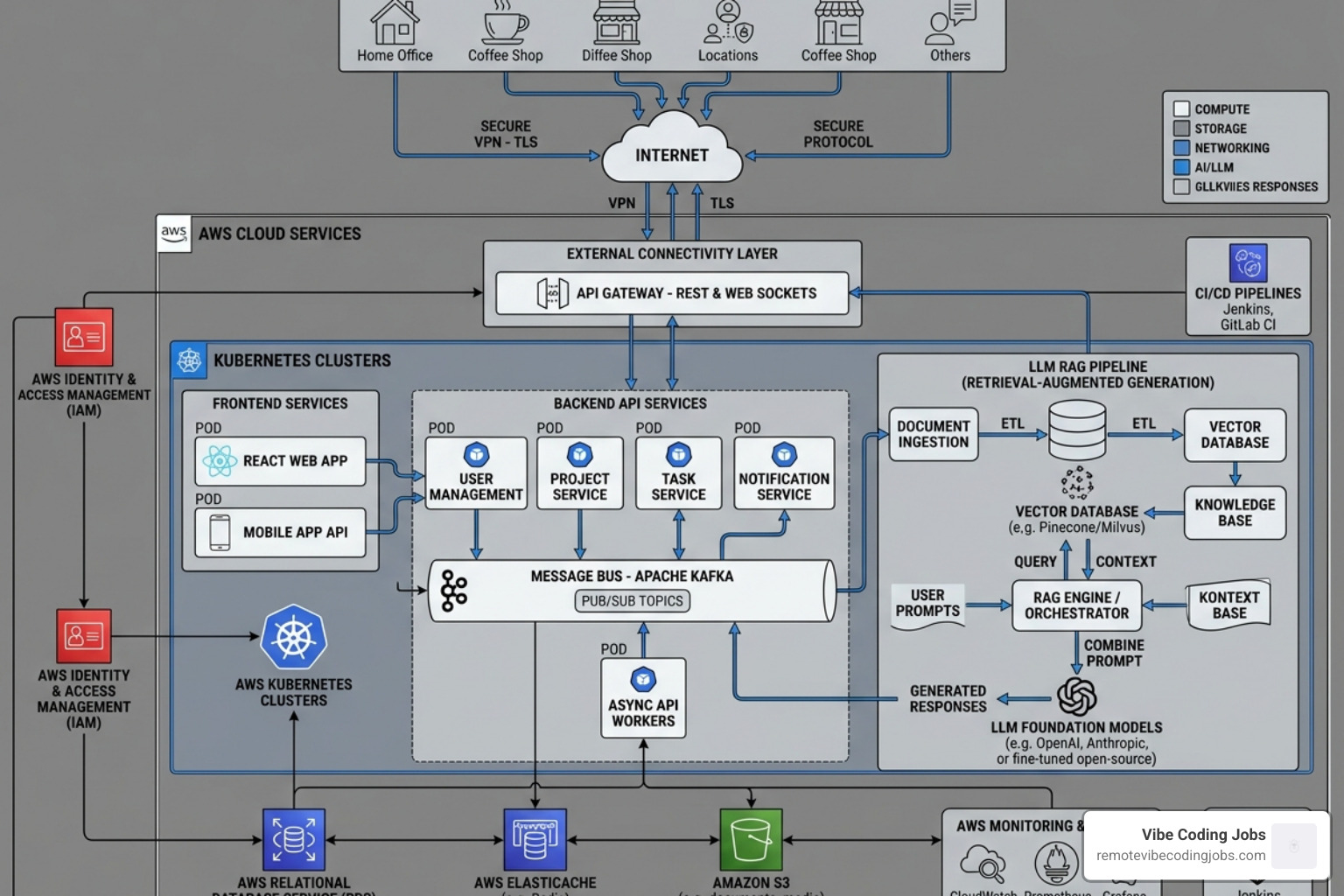
Infrastructure: Knowledge of AWS or GCP is expected, but the real demand is in “Infrastructure as Code” using Terraform or Pulumi.
We are also seeing a rise in roles that bridge the gap between traditional engineering and AI, such as the AI Engineer at Pulsora. Furthermore, roles involving AI/ML Software Engineer, LLM RAG Automation at Navitas Partners highlight the need for engineers who understand Retrieval-Augmented Generation (RAG) and how to automate LLM workflows.
Mastering AI-Assisted Development for Remote Software Engineer Jobs Work From Home
If 2023 was the year of “trying” AI, 2026 is the year of “mastering” it. At Vibe Coding Jobs, we focus on what we call vibe coding. This isn’t about being lazy; it’s about shifting your focus from “how do I write this loop?” to “how should this system behave?”
Remote employers are actively seeking “AI-native” developers. This means:
- Editor Fluency: Being a power user of Cursor or Windsurf, using AI to refactor entire modules in seconds.
- Prompt Engineering: The ability to provide high-context instructions to models like Claude 3.5 or GPT-4o to generate production-ready code.
- Code Reviewing AI: The skill of “auditing” AI output for security vulnerabilities and architectural fit.
Roles like the Remote Staff AI Engineer / AI Creator are perfect for those who have embraced this new way of working. These positions treat AI as a collaborator, allowing a single engineer to do the work that previously required a small team.
Top Platforms and Companies for Remote Engineering
Finding remote software engineer jobs work from home can feel like looking for a needle in a haystack if you’re using the wrong tools. General job boards are often flooded with “ghost jobs” or roles that claim to be remote but actually require a hybrid schedule.
For a more targeted search, we recommend:
- Browse All Remote Software Engineering Jobs – Vibe Coding Jobs: We specifically curate for companies that “get” remote work—those with async cultures and AI-forward mindsets.
- Remote Full-Stack Developer Roles: Perfect for those who want to work across the entire stack.
- Remote Backend Engineering Roles: Ideal for engineers who love systems, databases, and APIs.
Top Companies Actively Hiring Remote Talent
Several companies have become “remote-first” icons, consistently hiring across the globe with high standards and great perks.
Grafana Labs is a standout, frequently hiring for deeply technical roles. Recent openings include:
- Staff Software Engineer, Grafana Cloud Observability Kubernetes at Grafana Labs
- Staff Software Engineer, Data Sources & Core Services at Grafana Labs
Circle and Rebuy are also leaders in the space. Circle offers a unique “async-first” culture with no hour tracking, focusing entirely on outcomes. Rebuy is notable for being one of the first companies to explicitly provide an “AI tools budget” for every developer, encouraging the use of Cursor and Claude for daily tasks.
Frequently Asked Questions about Remote Software Engineering
What are the geographic restrictions for remote roles?
While many remote software engineer jobs work from home allow you to work from “anywhere,” there are often legal or operational constraints.
- US-Only: Many US-based companies require employees to be in the country for tax purposes or security clearances.
- Timezone Alignment: Some companies require a 4-hour overlap with a specific timezone (like Eastern Time).
- International-Friendly: Companies like Circle and Grafana Labs hire globally, often using “Employers of Record” (EORs) to handle local payroll and benefits.
For example, the Backend Engineer, Mimir at Grafana Labs is part of a team that balances global distribution with clear communication protocols.
How does the interview process work for remote software engineers?
The remote interview process has become more streamlined but also more rigorous. You can typically expect:
- Discovery Call: A 30-minute chat with a recruiter or hiring manager to check for “vibe” and basic alignment.
- Technical Assessment: This might be a live coding session, but many remote-first companies prefer a “take-home” project or a paid 3-hour trial to see how you work in a real-world, async environment.
- Leadership/Architecture Challenge: A deep dive into how you design systems and lead projects, such as the process used for the Staff Backend Engineer, Databases (Pyroscope) at Grafana Labs.
- Culture/Founder Fit: A final check to ensure you can thrive in a high-autonomy, high-documentation culture.
Are there entry-level remote software engineer opportunities?
Yes! While “Senior” roles are more common, entry-level opportunities are growing, particularly in AI training and data analysis. Companies are realizing that junior engineers who are “AI-native” can often be as productive as mid-level engineers who are stuck in old workflows.
Roles like the People Analytics Analyst at Grafana Labs or junior AI trainer positions are excellent entry points for those looking to start their remote career.
Conclusion
The world of remote software engineer jobs work from home is no longer a “perk”—it is a sophisticated, global industry. To succeed in 2026, you need to be more than just a coder; you need to be a “vibe coder” who can leverage AI to ship faster, document better, and communicate clearly across timezones.
At Vibe Coding Jobs, we are here to help you navigate this transition. Whether you are looking for an async-first startup or a high-scale engineering role at a company like Grafana Labs, our curated listings focus on the culture and tools that matter most.
Ready to find your next role? Browse the latest opportunities at remotevibecodingjobs.com and join the future of software development today.