
The Job Market for AI-Assisted Developers Is Exploding Right Now
Cursor AI job matches are multiplying fast — and if you want to know where to look, here’s a quick map:
| Job Type | Typical Salary Range | Key Tools Required |
|---|---|---|
| Full-Stack / Product Engineer | $130K–$275K | Cursor, Claude, TypeScript |
| ML Engineer | $220K–$380K | Cursor, PyTorch, LLM fine-tuning |
| Senior AI Platform Engineer | $159K–$301K | Cursor, Claude Code, MCP |
| AI Deployment Manager | Not listed | Cursor, enterprise CS skills |
| Contract Cursor Developer | Not listed | Cursor IDE, Python, Go, CI/CD |
| Web Designer (AI-augmented) | $80K–$100K | Cursor, Figma AI, Shopify |
The way companies hire developers is changing fast. In May 2026, Cursor — the AI-native code editor built on VS Code — is no longer just a productivity tool. It’s becoming a hiring signal. Major employers like Adobe, Salesforce, and Deloitte are now listing Cursor and Claude Code as required or preferred skills in senior engineering job descriptions. Over 25 active postings across New York, San Francisco, and Austin explicitly name it. Salaries for these roles stretch from $130K all the way to $301K at the top end.
At the same time, AI-native companies like Cursor itself have flipped the traditional hiring playbook. Instead of posting a job and waiting, they identify talented builders on social media and in public communities — then move fast. Candidates can go from first contact to starting on a Monday.
The result? Developers who know how to work with AI tools — not just alongside them — are landing better-paying remote roles, faster.
I’m RVCJ Editorial, the team behind Remote Vibe Coding Jobs, where we cover AI-assisted development, remote hiring trends, and career guidance for developers building with tools like Cursor, Copilot, and Claude — including curating cursor ai job matches across async-first, AI-native teams globally. This guide breaks down exactly where the best opportunities are and how to position yourself to get them.
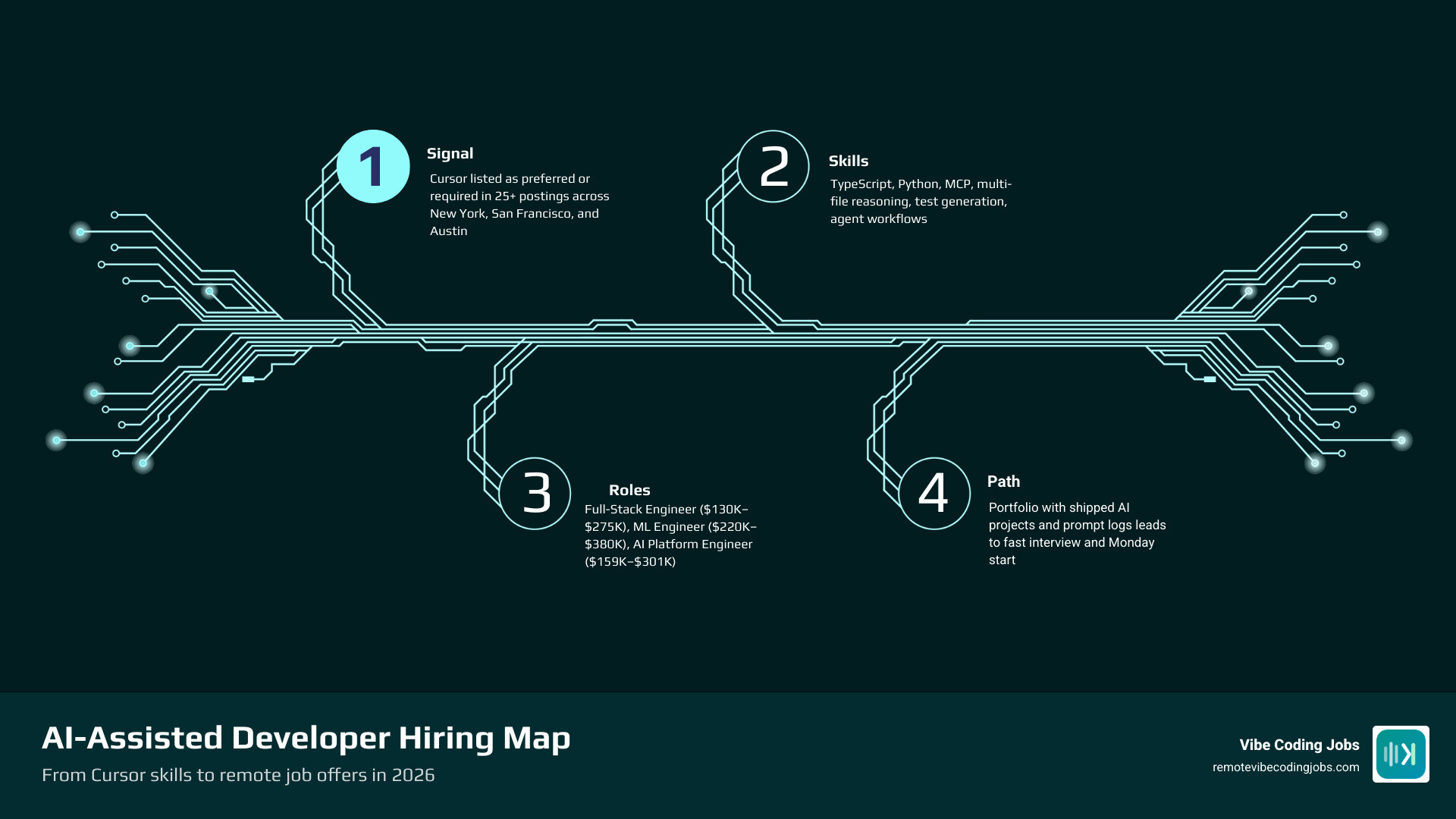
Cursor ai job matches terms you need:
1) Why cursor ai job matches are growing fast in 2026
The surge in cursor ai job matches isn’t just a trend; it’s a fundamental shift in how software is built. By May 2026, the industry has moved past the “AI is a toy” phase. Enterprises now realize that a developer proficient in Cursor isn’t just slightly faster—they are often 2x to 5x more productive. This efficiency has led to a hiring boom in major tech hubs like New York and San Francisco, but the real magic is happening in the remote market.
Companies are no longer just looking for “Software Engineers.” They are looking for AI-fluent professionals who can leverage the latest LLMs to ship production-grade code at record speeds. With over 25 active high-level job postings across major US cities and hundreds more in the remote space, the demand for these skills has pushed salary ranges for senior roles between $130K and $301K.
What Cursor AI is and why employers now care
Cursor AI is an AI-native code editor, built as a fork of Visual Studio Code. Unlike traditional editors that added AI as a plugin, Cursor was designed with large language models (LLMs) like GPT-4 and Claude as first-class citizens. It offers features like codebase-wide Q&A, multi-file refactoring, and “Background Agents” (sometimes called BugBots) that can autonomously work on GitHub issues.
Employers care because Cursor collapses the time between “idea” and “deployment.” When an engineer can use natural language to scaffold a project or fix a complex bug across five different files simultaneously, the business wins. We’ve seen companies like Adobe champion these tools because they allow teams to maintain massive systems—sometimes handling a billion events per day—without the traditional “technical debt” slowdown.
How AI-native companies hire differently than traditional teams
The most dynamic AI companies have thrown out the old HR playbook. Instead of a three-month interview cycle, they use “person-first” hiring. As seen in How Cursor recruits the best talent in the AI era – LinkedIn, the process often starts in internal Slack channels. Team members post names of impressive creators they find on social media or GitHub, and if there’s a consensus, they “swarm” the candidate with a personalized approach.
In this new era, your “job spec” might not even exist until you join. These companies look for mission-aligned individuals first, then figure out the specific role later. It’s not uncommon for a candidate to have their first chat on a Tuesday and be shipping code by the following Monday.
2) The best remote jobs for developers using Cursor and Copilot
The remote landscape for cursor ai job matches is diverse, ranging from core product engineering to specialized ML roles. Whether you’re a full-stack wizard or a platform specialist, there’s a high-paying seat at the table for those who master AI-assisted workflows.
Remote cursor ai job matches for software and product engineers
Product Engineers are the new rockstars of the AI era. These roles require a blend of TypeScript, React, and deep AI tool fluency. Companies are looking for people who can build “AI-native” experiences—not just adding a chatbot to a website, but rethinking how users interact with software.
Common responsibilities include:
- Designing and refactoring production-grade codebases using Cursor’s multi-file reasoning.
- Using Electron to build desktop applications that integrate AI features.
- Collaborating with product owners to turn natural language requirements into functional microservices.
For those looking to dive deeper into these roles, check out Cursor Copilot Developer Jobs Opportunities for a detailed breakdown of what’s currently on the market.

Remote cursor ai job matches for ML, platform, and AI deployment roles
If you prefer the “engine room” over the “dashboard,” there is massive demand for ML and Platform Engineers. Roles like the ML Engineer — Code Generation at Cursor offer staggering salaries between $220k and $380k. These positions focus on fine-tuning LLMs for program synthesis and building the evaluation pipelines that make AI coding possible.
Additionally, the role of AI Deployment Manager has emerged. As seen in the Cursor hiring for AI Deployment Manager posting, these professionals act as the “connective tissue” between enterprise customers and the product team. They guide CTO-level stakeholders on prompt strategy, context configuration, and internal AI enablement.
3) Skills employers want most in Cursor-related job postings
To land the best cursor ai job matches, you need more than just a “vibe.” You need a specific technical stack combined with an “agentic-first” mindset. Employers are looking for developers who treat manual, repetitive tasks as technical debt that should be automated by AI agents.
The technical stack showing up most often
While Cursor supports almost any language, most high-paying remote roles focus on:
- Languages: TypeScript/JavaScript, Python, Go, and C#.
- Infrastructure: AWS, Azure, GCP, Docker, and Kubernetes.
- Data: Kafka, Apache Spark, and Lakehouse architectures.
- Protocols: Model Context Protocol (MCP) for building tool servers that AI agents can actually use.
The AI workflow skills that make candidates stand out
It’s not just about what you code, but how you code. Standing out means proving you can handle “end-to-end ownership.” This might mean being the person who responds to a 2 AM incident and uses AI to trace the bug across a billion-event system in minutes.
| Traditional Coding Skills | AI-Native Workflow Skills |
|---|---|
| Manual Unit Testing | AI-Generated Test Suites & Edge Case Detection |
| Reading Documentation | Using Codebase Q&A to understand context instantly |
| Manual Refactoring | Multi-file reasoning to migrate entire patterns |
| Writing Boilerplate | Prompting for scaffolding and agentic automation |
| Standard Debugging | Using “Shadow Pipelines” to test data migrations |
4) Salary ranges, job titles, and where demand is strongest
The compensation for cursor ai job matches is among the highest in the tech industry today. Because these tools increase output so significantly, companies are willing to pay a premium for “10x” developers who have mastered the AI workflow.
Common titles and typical pay bands
Salary transparency has become the norm for these roles. Here is what we are seeing in the May 2026 market:
- Senior AI Platform Engineer: $159,200 – $301,600.
- Senior Software Engineer (Applied AI): $225,000 – $275,000.
- Staff Software Engineer: $185,000 – $200,000.
- Web Designer (AI-fluent): $80,000 – $100,000.
- AI Automation Intern: $30 – $38 per hour.
Senior positions at legacy tech giants like Adobe are reaching the $300k+ cap, specifically for those who can architect “agent-ready” data environments.
Where cursor ai job matches are concentrated by industry and location
While New York and San Francisco remain the primary hubs for on-site and hybrid roles, the remote-first market is exploding. You can find more details on this in Cursor Copilot Developer Jobs Remote Market Career Path.
Industries leading the charge include:
- Enterprise Software: Building the next generation of AI-native SaaS.
- Consulting: Firms like Deloitte and PwC are hiring AI-fluent engineers to accelerate client deliveries.
- Creative Tech: Companies using AI for web design and Shopify optimization.
- Finance & Defense: High-stakes environments where reliability and “2 AM ownership” are critical.
5) How to get hired for AI-assisted coding roles faster
Getting hired in the AI era requires a different kind of proof. A standard resume is no longer enough; you need to demonstrate that you can work with the machine.
Build a portfolio that proves AI-native engineering ability
Your portfolio should show not just the final product, but the process. Include:
- Before-and-after refactors: Show how you used Cursor to clean up a legacy codebase.
- Prompt logs: Demonstrate how you guide the AI to solve complex architectural problems.
- MCP Servers: Show that you can build tool servers that allow AI agents to interact with real-world data.
- Test Coverage: Prove that your AI-assisted code is more reliable, not just faster.
Use AI in the job search without hurting credibility
You can use Cursor to help you find jobs, but you must do it ethically. For example, you can use the Cursor Forward Deployed Engineer 23748253 listing as a template to understand what high-end roles require.
We recommend creating a “Job Search Workspace” in Cursor. Use a base-resume.md as your single source of truth and a RUNBOOK.md to manage your daily batch of applications. While AI can tailor your resume to a job description, never submit without a human review. You want to move at machine speed for preparation, but human speed for the final decision. For more tips on this, see Cursor Copilot Developer Jobs Opportunities Descriptions Salary.
Frequently Asked Questions about cursor ai job matches
Are companies really listing Cursor experience as required or preferred?
Yes. It is no longer a “secret” tool. Major tech companies are explicitly naming Cursor, Claude Code, and GitHub Copilot in their job descriptions. They see it as a signal that the candidate is forward-thinking and highly productive.
Are AI tools allowed during interviews for these roles?
This varies. While the job requires these tools, many companies like Adobe still restrict the use of AI or recording tools during live interviews unless specifically approved. Always ask for the company’s “AI Interview Policy” before your technical assessment.
What is MCP and why does it matter for hiring?
The Model Context Protocol (MCP) is an open standard that lets AI agents call real tools and APIs. Knowing how to build MCP-compatible servers is a huge hiring advantage because it proves you can make enterprise data “discoverable” and “actionable” for autonomous agents.
Conclusion
The future of software development isn’t about the AI replacing the developer; it’s about the AI-fluent developer replacing the one who refuses to adapt. Cursor AI job matches represent the most exciting, high-paying, and flexible opportunities in the current market.
Whether you are looking for a $300k senior role or a remote contract position, the key is to master the “agentic-first” mindset. At Remote Vibe Coding Jobs, we are here to help you navigate this transition with curated listings and an async-first focus.
Ready to find your next role? Check out Cursor Copilot Developer Jobs Remote and start building your AI-native career today.