
Why Hiring a Cursor AI Developer Remote Is the Smartest Engineering Move in 2026
Quick answer: What to know about hiring a Cursor AI developer remotely
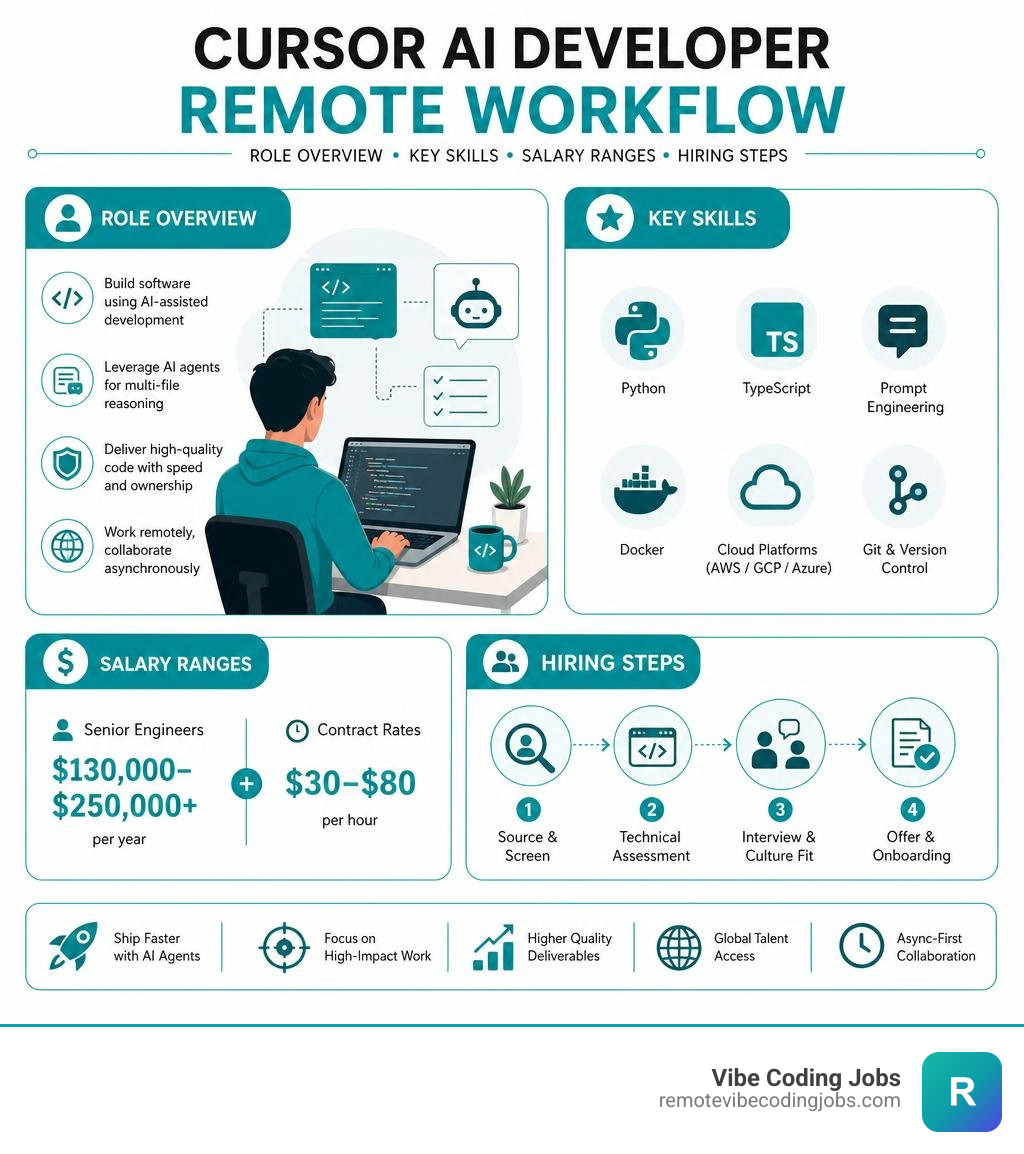
| Topic | Key Facts |
|---|---|
| What they do | Build software using Cursor IDE with AI agents, prompt engineering, and multi-file reasoning |
| Where to find them | 4,648+ fully remote Cursor-related roles listed globally as of June 2026 |
| Salary range | $130,000–$250,000+ for senior engineers; contract rates from $30–$80/hour |
| Top skills | Python, TypeScript, prompt engineering, Docker, cloud platforms (AWS/GCP/Azure) |
| Why they’re different | Ship faster than traditional engineers by delegating to AI agents while owning code quality |
| How to verify experience | Ask for GitHub commits, portfolio projects, or proof of Cursor usage |
The demand for Cursor AI developer remote roles has exploded in 2026. Over 12,000 Cursor-related jobs are listed worldwide right now, with nearly 4,700 marked fully remote. Companies are no longer treating AI-assisted development as a perk — they’re making it a hard requirement in job descriptions.
The numbers back this up. More than 30% of pull requests merged internally at Cursor are now created autonomously by AI agents. When Cursor announced remote agents in April 2026, the announcement drew nearly 600,000 views in under 24 hours. Developers are paying attention. So are hiring managers.
This guide is built for teams that want to hire remote engineers who can actually use Cursor — not just list it on a resume.
We are RVCJ Editorial, the team behind Remote Vibe Coding Jobs, where we track global hiring trends for AI-assisted development roles including every major shift in the Cursor AI developer remote job market. Our coverage spans async-first hiring, vibe coding workflows, and practical career guidance for engineers building with tools like Cursor, Claude Code, and Copilot.
Defining the Cursor AI Developer Remote Role
A Cursor AI developer remote is a software engineer who uses Cursor: The best coding agent as their primary development environment to accelerate code delivery, automate repetitive tasks, and design complex software architectures.
Unlike developers who occasionally use AI for basic autocompletion, Cursor AI developers build their entire workflow around agentic coding. They treat the AI as an active engineering partner rather than a simple text predictor. This approach is often referred to as “vibe coding” — a workflow where the human acts as the architect, strategist, and reviewer, while the AI agent handles the heavy lifting of writing boilerplate, generating tests, and executing multi-file refactors.
How They Differ from Traditional Software Engineers
Traditional software engineers spend a massive portion of their day writing boilerplate code, looking up API syntax, and manually writing unit tests. A remote Cursor AI developer shifts their focus from writing code to orchestrating code.
Here is how the roles differ:
- Syntactic Writing vs. Prompt Engineering: While traditional developers spend hours typing out syntax, Cursor developers write structured prompts, manage context windows, and guide AI models to generate entire features.
- Manual Debugging vs. Code Validation: Instead of spending hours tracing stack overflows, Cursor developers use multi-file reasoning to let the AI locate bugs, while they focus on validating, hardening, and productionizing the output.
- Isolated Focus vs. System Design: Because the boilerplate is automated, Cursor developers can spend more time thinking about system architecture, data flow, and product requirements.
To explore how these roles are reshaping the remote job market, check out our insights on cursor copilot developer jobs remote.
Day-to-Day Tasks of a Cursor AI Developer Remote
What does a typical day look like for a remote developer operating at this speed? Their schedule is highly focused on high-leverage activities:
- Defining Specifications: Writing clear markdown-based project plans, blueprints, and database schemas to serve as “guardrails” for the AI.
- Agent Orchestration: Using Cursor’s Agent Mode to kick off multi-file refactors or feature creations.
- Context Management: Curating reference files, docs, and codebase context to ensure the AI has the exact information it needs to produce high-quality code.
- Validating Pull Requests: Reviewing AI-generated code for security, performance, and compliance with team standards before merging.
- Running Remote Agents: Using CLI tools like
agent worker startto run heavy processes on dedicated developer boxes while monitoring progress from other devices.
This highly collaborative, end-to-end ownership model is similar to what you see in specialized roles, such as the Cursor · Forward Deployed Engineer position, where engineers embed directly with teams to implement production-ready AI workflows.
Essential Technical Skills and Tools for a Cursor AI Developer Remote

To succeed as a Cursor AI developer remote, an engineer needs a strong foundation in modern software engineering alongside specialized AI-assisted skills. Simply knowing how to prompt is not enough; without traditional coding fundamentals, a developer cannot judge if the AI-generated code is secure, scalable, or performant.
Key skills in high demand include:
- Modern Languages: Strong proficiency in TypeScript, JavaScript, Python, Go, or Rust.
- Context Window Management: Knowing how to compact context windows, set project boundaries, and leverage MCP (Model Context Protocol) servers to limit token usage while maintaining high-quality outputs.
- LLM Literacy: Understanding the strengths and weaknesses of different models (such as Claude 3.5 Sonnet, GPT-4o, or Gemini Pro) and choosing the right model for the task.
For a deeper look at how these skills fit into the broader job market, see our guide on remote developer skills in demand 2026 future proof your career.
Core Tech Stack and AI Tool Integrations
Modern teams hiring remote Cursor developers generally look for experience in a modern, cloud-native stack. A typical developer profile includes:
- Frontend & Backend: Next.js, React, Node.js, and Prisma.
- Databases & Auth: PostgreSQL (often via Supabase) and secure authentication systems.
- Infrastructure & DevOps: Docker, Docker Compose, GitHub Actions, and cloud platforms (AWS, GCP, or Azure).
- AI Ecosystem Tools: Integration with MCP servers, which extend Cursor’s capabilities with external APIs and databases.
If you are evaluating different setups for your team, you might also want to compare these workflows against the best cursor alternatives for remote developers in 2026.
Gaining Practical Experience and Building a Portfolio
For developers looking to break into this market, proving your ability to build with AI is crucial. Companies hiring for these roles want to see practical execution.
- Build and Document Side Projects: Build a complete SaaS MVP from scratch using Cursor. Document your workflow, including the prompts, context strategies, and speed gains.
- Provide Proof of Cursor Usage: Many modern employers ask for proof of Cursor usage, such as detailed GitHub commit histories or screen recordings of your agent workflows.
- Leverage Freelance Opportunities: Platforms like the Full-Stack Developer (Cursor + AI SaaS Projects) 1465596 – OnlineJobs.ph listing show that startups are actively seeking part-time or contract developers who can use Cursor to rapidly prototype and ship SaaS integrations.
How Modern Teams Leverage Cursor AI Workflows

Hiring a Cursor AI developer remote allows companies to redesign their entire engineering workflow. Instead of long sprint cycles with heavy developer friction, modern teams are moving toward rapid, agent-driven execution loops.
Productivity Gains and Quality Expectations
Teams that successfully integrate Cursor developers report massive productivity gains:
- Rapid Prototyping: Building a functional MVP in days instead of months.
- Automated Test Generation: Letting Cursor analyze a new endpoint and generate comprehensive unit and integration tests instantly.
- Seamless Code Refactoring: Using multi-file reasoning to modernize legacy codebases without manual search-and-replace errors.
To understand how Cursor stacks up against other AI code editors in real-world team environments, read our comparison on cursor vs windsurf for developers in 2026 which is best.
Overcoming Remote Collaboration and Security Challenges
While agentic workflows are highly efficient, they also introduce unique security and collaboration challenges that remote teams must address:
- Secret Management: AI tools need access to codebases, but they should never access production secrets. Teams must enforce strict secret management using tools like Doppler, Infisical, or Vault.
- Context Drift: AI agents can sometimes lose track of project boundaries. Developers must keep context windows clean by using rules files (like
.cursorrules) to define strict architectural boundaries. - Data Privacy: Enterprise teams must ensure that their code is not used to train public LLM models. Using enterprise-tier subscriptions with opt-out data policies is critical.
These security practices are vital to protect proprietary codebases while scaling up remote engineering capacity. To find out more about how companies handle these workflows at scale, take a look at the Cursor · Careers page.
Salary and Career Growth for a Cursor AI Developer Remote
Because Cursor developers act as force multipliers, they command premium salaries. They replace the output of multiple traditional developers, making them highly cost-effective hires for lean teams.
| Role | Traditional Developer Output | Cursor AI Developer Output | Average Salary Range (2026) |
|---|---|---|---|
| Junior / Mid-Level | Baseline feature delivery | Rapid prototyping & test coverage | $80,000 – $130,000 |
| Senior Engineer | Core architecture & mentoring | End-to-end system design & agent automation | $130,000 – $250,000+ |
| Contract / Freelance | $30 – $50 / hour | $60 – $120+ / hour (due to rapid shipping) | Varies |
For a broader look at how compensation is shifting across the remote landscape, check out our remote developer salary guide 2026 and plan your professional progression with our remote developer career path junior to senior guide 2026.
Frequently Asked Questions about Cursor AI Developers
Do companies actually hire specifically for Cursor AI experience?
Yes, absolutely. In 2026, companies are explicitly listing “Cursor IDE” or “Vibe Coding” as mandatory requirements. It signals to hiring managers that the candidate is comfortable with high-velocity development and knows how to use AI to multiply their output.
For example, academic and enterprise job boards alike, such as the Cursor Engineer – Career Center | Calvin University listing, highlight that teams are actively seeking engineers who can validate, harden, and productionize AI-generated code while maintaining high standards.
What is the difference between Cursor cloud agents and remote agents?
- Cursor Cloud Agents: These run on Cursor’s own virtual machines in isolated cloud environments. They are great for quick tasks but cost cloud credits.
- Cursor Remote Agents: These run locally on your own devbox or server, using your own CPU and files, but can be controlled remotely from any device (including your phone via
cursor.com/agents). This is ideal for running long refactors or test suites while away from your desk.
How does vibe coding impact code quality and security?
Vibe coding can actually improve code quality if done correctly. Because the developer is freed from typing boilerplate, they have more energy to review architecture, write robust test cases, and perform security reviews. However, it requires a “human-in-the-loop” model — developers must never blindly accept AI suggestions without validating the output.
Conclusion
Hiring a Cursor AI developer remote is no longer just a trend — it is a competitive necessity for modern, fast-moving teams in 2026. By combining traditional engineering fundamentals with agentic workflows, these developers help teams ship software faster, write better tests, and build complex architectures with minimal friction.
Whether you are looking to hire a top-tier agentic developer or find your next remote role, we can help. Find Remote AI Engineer Jobs on our platform today and join the future of software development.