
The Rise of Claude Remote Dev Roles: What Developers Need to Know
Remote Dev Roles Where Claude Does the Heavy Lifting

Claude remote dev roles are a fast-growing category of remote jobs where developers use Anthropic’s Claude — especially Claude Code — as their primary tool to build, ship, and automate production software.
Here’s a quick snapshot of what’s available right now:
| Role Type | Experience Required | Pay Range | Work Style |
|---|---|---|---|
| Agentic Builder | 3+ years with Claude Code | $10,000+/month (per-project) | Fully remote, async |
| AI Engineer (Full-Stack) | 4+ years software engineering | Competitive USD | 100% remote |
| Senior Claude Developer | 7+ years software development | Competitive USD | Remote (global) |
| Claude AI Agent Developer | Mid-senior level | Competitive USD | Remote |
| Remote Software Engineer | Mid-level | ~$88K/year | Remote |
The market is real and growing, with hundreds of open positions currently listed across dedicated AI-native platforms and remote work boards. Roles span startups, financial services, healthcare tech, and consulting firms — with pay structures ranging from full-time salaries to uncapped per-project rates.
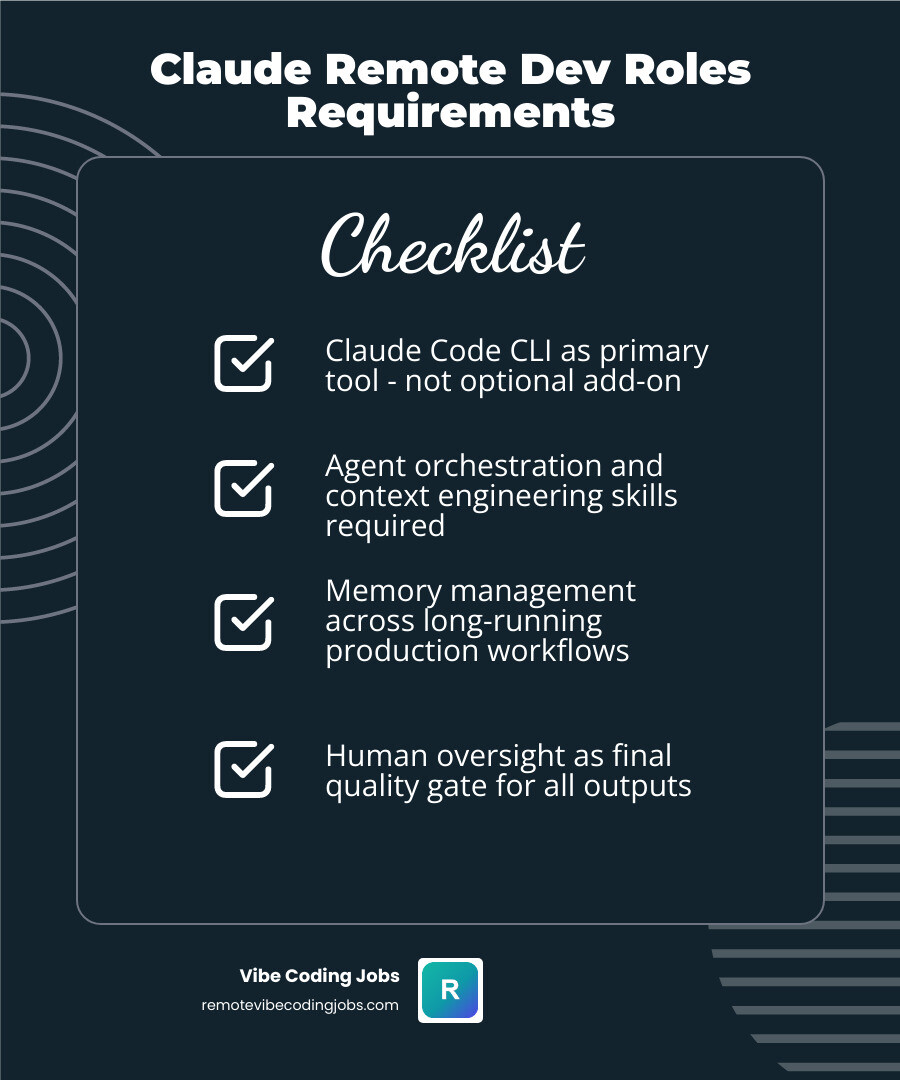
What makes these roles different from standard dev jobs? The expectation has shifted. Claude Code isn’t an optional add-on here — it’s the primary development tool. One job posting put it plainly: developers in these roles won’t write much code by hand. They orchestrate agents, engineer context, manage memory, and act as the final quality gate.
I’m RVCJ Editorial, the team behind Remote Vibe Coding Jobs — we cover AI-assisted development, remote hiring trends, and career guidance for developers building with tools like Claude Code, Cursor, Copilot, and Windsurf. Our editorial work focuses specifically on helping developers find and land claude remote dev roles at async-first companies that match their stack and experience level.
What is Claude Code and How Does It Power Agentic Workflows?
To understand why claude remote dev roles are taking off in May 2026, we first need to look at the tool itself. Claude Code is a command-line interface (CLI) tool and agentic coding assistant built directly by Anthropic.
Unlike traditional autocompletion extensions or standard chat interfaces, Claude Code operates as an active agent inside your local development environment. It can search your codebase, edit files directly, execute terminal commands, run tests, and manage git workflows autonomously.
Here is how Claude Code differs from other popular AI coding assistants:
- GitHub Copilot / Amazon Q: These function primarily as inline autocomplete engines and sidebar chat assistants. They suggest the next line or block of code, but they do not execute terminal commands or run your test suites autonomously.
- Cursor / Windsurf: These are fully-fledged IDEs (forked from VS Code) that provide deep codebase indexing and multi-file editing. While highly powerful, they are visual-first. Claude Code is terminal-first, allowing developers to run agentic loops directly from their CLI.
- Devin: Devin is designed as a fully autonomous, browser-based software engineer platform. Claude Code is a lighter, highly integrated terminal agent designed to run locally alongside your existing editor and workflow.
In professional environments, developers use Claude Code to drive agentic workflows. Instead of writing code line-by-line, you write high-level prompts instructing the agent to implement a feature, refactor a module, or fix a bug.
To keep these workflows running smoothly, developers must master two critical practices:
- Context Engineering: This involves curating the exact files, documentation, and token limits the AI needs to solve a problem. In agentic development, bloating the context window with irrelevant files wastes tokens and increases hallucinations.
- Memory Management: Managing state across long-running tasks. This is often done using standardized system instructions, step-by-step verification patterns, and tools like Continue local sessions from any device with Remote Control to maintain operational continuity.
By mastering these skills, developers can build incredibly fast. For a deeper dive into how these systems interact, check out our guide on the Remote Developer Jobs Ai Tools Workflow.
Navigating the Market for Claude Remote Dev Roles
If you are looking to land a remote role where you can build with Claude, you will find a highly diverse job market. Companies across multiple industries are shifting from manual development to agentic workflows.
We are seeing significant hiring activity in several key sectors:
- Financial Services & Enterprise Tech: Large institutions are using Claude Code to modernize massive legacy codebases (such as migrating Java or .NET 8 microservices). These roles often require strong backend experience combined with AI orchestration.
- Startups & Scaleups: Early-stage companies are hiring “Agentic Builders” or “AI Developers” as their first engineering hires. These developers are expected to own the entire AI agent chain, shipping MVPs and full-stack applications in a fraction of the traditional time.
- Digital Agencies & Operations: Hybrid roles combine web development (Next.js, WordPress) with workflow automation (n8n, Make.com, Zapier) to build automated client pipelines and custom web applications.
These roles are distributed across different employment structures. You will find standard full-time employee (FTE) positions offering competitive salaries and benefits, alongside per-project contract arrangements where high-performing builders can earn uncapped revenue based on their output.
To explore open opportunities, you can search the latest listings on Claude Remote Dev Jobs on Vibe Coding Jobs. For more context on how the market is evolving, see our analysis of Ai Coding Jobs Remote Opportunities and find out which Companies Hiring Vibe Coders Remote Ai Coding are currently leading the pack.
Key Skills Required for Claude Remote Dev Roles
While Claude Code does a massive amount of the heavy lifting, employers do not hire “prompt-only” developers. They look for strong software engineering fundamentals paired with AI tool mastery.
To stand out in the application pool, you should focus on the following technical stack:
- Programming Languages: Fluency in TypeScript and Python is highly requested, as these are the primary languages used to write custom AI agents, tools, and backend integrations.
- Frameworks & Infrastructure: Experience with Next.js, Node.js, Vercel, and cloud databases (PostgreSQL, Supabase) is standard for full-stack roles.
- The CLAUDE.md File: This is a localized markdown file placed in the root of your project directory. It acts as the “source of truth” for the AI agent, containing build commands, test patterns, styling guides, and code styling rules. Knowing how to structure a
CLAUDE.mdfile is a major green flag for employers. - Test-Driven Development (TDD) with Agents: Writing tests before instructing Claude to write code. This gives the AI agent a clear, programmatic feedback loop to verify if its code actually works before submitting a pull request.
Having these skills ensures you can confidently integrate AI tools into existing enterprise environments. Learn more about combining modern frameworks with AI in our resource on Remote Developer Jobs Ai Tools Stack Integration Benefits.
Typical Compensation for Claude Remote Dev Roles
Compensation for claude remote dev roles is highly competitive, reflecting the massive productivity gains that AI-proficient developers bring to a team.
Because an experienced developer leveraging Claude Code can often do the work of a small team, employers are willing to pay top-tier rates. Compensation models generally fall into two categories: traditional salaried roles and per-project contract rates.
| Position Type | Typical Compensation | Key Characteristics |
|---|---|---|
| Senior Claude / AI Engineer (Full-Time) | $130,000 – $242,000 / year | Stable income, equity options, benefits, structured sprints, and enterprise-scale projects. |
| Agentic Builder (Per-Project Contract) | $10,000+ / month | Paid upon milestone delivery, uncapped upside for fast builders, high autonomy, and async-first. |
| Mid-Level AI Developer / Generalist | $80,000 – $120,000 / year | Focuses on building web applications, maintaining automations, and assisting operations. |
For a deeper dive into current market rates and salary trends, check out our guide on Remote Ai Developer Jobs Tools Salary.
How Employers Evaluate Candidates and Manage Production Risks
Because anyone can claim to be an “AI developer” by typing basic prompts into a chat window, employers have designed highly practical evaluation processes to filter out low-skill applicants.
During the hiring process, you can expect:
- The “Agentic” Take-Home Challenge: Instead of a traditional whiteboard algorithm test, you may be asked to build a functional feature using Claude Code or Cursor. Employers will review your git commit history to see how you directed the AI, how you handled errors, and how you verified the output.
- The Project Case Study: You might be asked to submit a real, live project where AI agents wrote the majority of the code under your direction. You will need to explain what the agent got right, what it got wrong, how you debugged it, and how you managed the codebase’s architecture.
- The Resume Score: Many modern AI-first companies use automated scoring systems to evaluate whether your resume highlights practical experience with agentic workflows, LLM APIs, and TDD.
Once you land the role, your job will also involve managing the risks of running AI-generated code in live production environments. Employers look for developers who understand how to implement:
- Production Guardrails & Fallbacks: Designing validation layers to ensure AI-generated outputs do not break backend services.
- Monitoring & Observability: Setting up logging to track agent behavior, API response times, and system errors.
- Token Optimization: Structuring prompts and managing context efficiently to prevent runaway API costs.
To prepare yourself for these technical evaluations, take a look at the resources on Evaluating Agentic Workflows and Claude Code Skills and read up on best practices in Remote Developer Jobs Ai Tools Security Automation.
Frequently Asked Questions about Claude Development
Are Claude remote dev roles sustainable as AI models improve?
Yes, absolutely. As AI models become more capable, the role of the developer shifts from syntax writer to system architect and quality assurance lead.
Instead of writing boilerplate code, your value lies in understanding system design, security protocols, database indexing, and business logic. The human-in-the-loop remains essential to guide, verify, and deploy what the AI builds.
Do I need a machine learning background to apply for these roles?
No. In fact, even at Anthropic, about half of the technical staff had no prior machine learning experience.
These roles are focused on software engineering, product building, and workflow orchestration. If you are a great software engineer who knows how to build clean systems, you can easily transition into a Claude-native developer role. You can learn more about their team philosophy directly on the Careers – Anthropic page.
What is the difference between vibe coding and traditional software engineering?
“Vibe coding” is a term used to describe the , highly creative process of prototyping software entirely through natural language prompts.
While vibe coding is fantastic for spinning up MVPs, traditional software engineering is still required to make those applications production-ready. A successful professional developer knows how to transition from “vibe coding” a prototype to structuring, testing, and securing a production system.
Conclusion
The software development landscape is changing rapidly. Rather than replacing developers, AI tools like Claude Code are supercharging those who know how to orchestrate them. Landing one of the many claude remote dev roles available in May 2026 is a fantastic way to future-proof your career, increase your productivity, and enjoy the freedom of async-first remote work.
If you are ready to take the next step in your career and start working with companies that actively embrace AI-assisted development, we can help. Find your next role on Vibe Coding Jobs today and join the future of software engineering.