Async Vibe Coding Jobs Are Reshaping How Developers Work in 2026
Async vibe coding jobs are remote developer roles where you build AI-powered features, prototypes, and automations — using tools like Cursor, Claude, and v0 — on your own schedule, with no standups and no micromanagement.
Here’s a quick snapshot of what they look like:
| Feature | Async Vibe Coding Jobs |
|---|---|
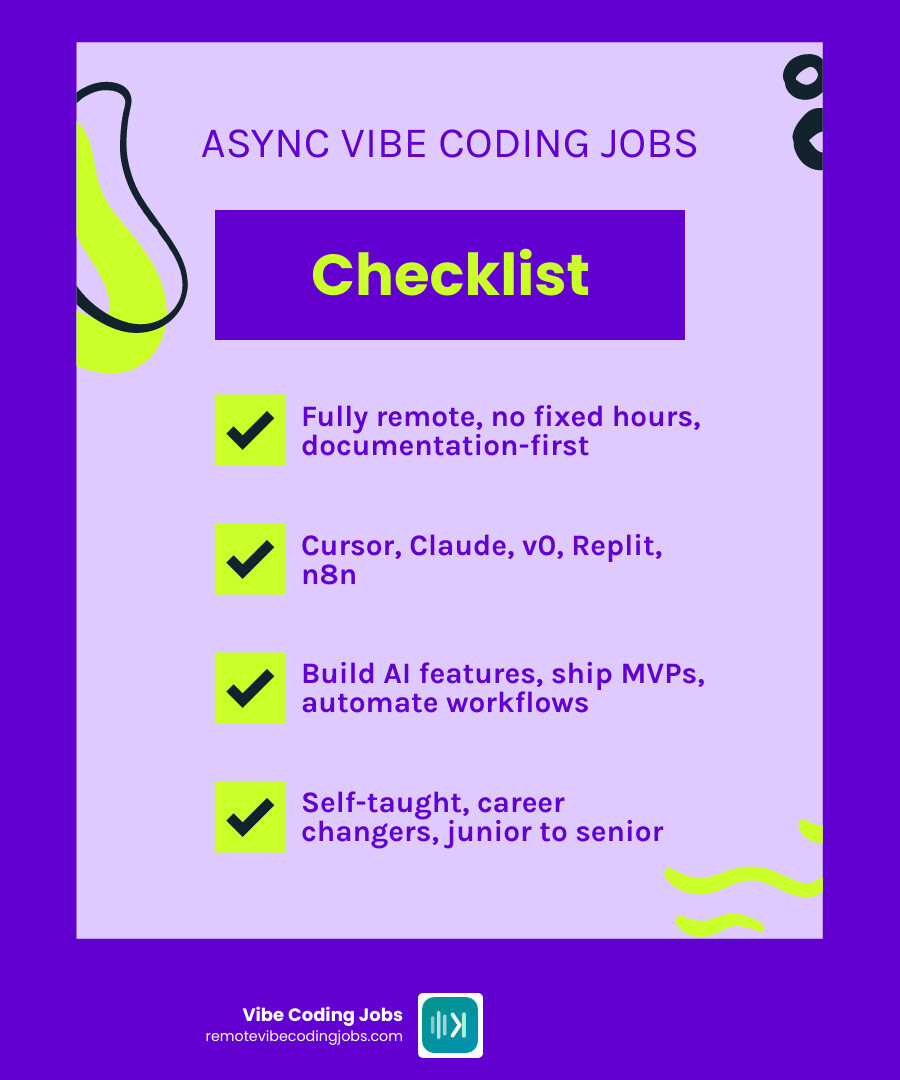
| Work style | Fully remote, no fixed hours, documentation-first |
| Core tools | Cursor, Claude, v0, Replit, n8n |
| Main tasks | Build AI features, ship MVPs, automate workflows |
| Who gets hired | Self-taught, career changers, junior to senior |
| Salary range | $45K entry-level to $265K+ for senior roles |
| Key skill | Prompting + shipping fast, not manual syntax |
The way software gets built is changing fast. Developers are no longer expected to grind through every line of code by hand. Instead, they orchestrate AI tools to prototype, ship, and iterate — often across time zones, without a single standup call. In May 2026, there are at least 157 verified remote vibe coding roles open globally, spanning industries from fintech and healthcare to climate tech and SEO automation. And with AI-assisted workflows delivering up to 4x faster development speeds, it’s no surprise that async-first startups and even enterprise companies are actively restructuring their hiring around this new model.
This isn’t a niche trend. It’s a genuine shift in how product teams are built.
I’m RVCJ Editorial, the team behind Remote Vibe Coding Jobs — we cover AI-assisted development, async hiring trends, and career guidance for developers navigating the growing market of async vibe coding jobs. We’ve reviewed hundreds of job listings, tech stacks, and hiring signals so you don’t have to.
What Async Vibe Coding Jobs Actually Mean
In the current landscape of May 2026, the term “vibe coding” has moved from a Twitter meme to a legitimate job category. At its core, it represents a shift from manual syntax labor to high-level orchestration. When we talk about async vibe coding jobs, we are describing roles that prioritize shipping functional products over the “grind” of writing every bracket and semicolon by hand.
What is vibe coding and how is it different from traditional software development?
Traditional software development is often a slow, methodical process focused on manual coding, deep algorithmic knowledge, and extensive boilerplate. Vibe coding, by contrast, relies on natural-language prompting and AI-native tools. Instead of spending three days debugging a CSS layout, a vibe coder uses tools like Cursor or Claude to generate the layout in seconds, then “vibes” with the output—iterating, refining, and guiding the AI until the product feels right.
The difference lies in the focus:
- Traditional: Focuses on how to write the code (syntax, memory management, manual optimization).
- Vibe Coding: Focuses on what to build (architecture, user experience, and rapid prototyping).
While traditional roles might prioritize LeetCode skills, vibe coding roles prioritize your ability to navigate complex AI workflows and maintain a high shipping velocity.
What makes async vibe coding jobs different from normal remote developer roles?
Most remote jobs are just “office jobs at home,” complete with grueling 9 AM standups and endless Zoom meetings. Async vibe coding jobs are built on a “documentation-first” philosophy. In these roles, you won’t find tickets or daily status calls. Instead, you’ll find clear documentation, recorded Loom walkthroughs, and decision logs.
This environment favors “deep work.” Because the communication is asynchronous, you have the freedom to set your own hours across different continents. You are judged on your output—the “magic” you ship—rather than the hours you spend sitting in a virtual meeting room. For more on this culture, check out our guide on async-first remote work.
Why async vibe coding jobs are growing so fast in 2026
The explosion of these roles is driven by a simple reality: speed. AI-driven development using tools like Cursor’s latest models can enhance coding speed by an impressive fourfold. Startups in 2026 can no longer afford to wait months for an MVP when a vibe coder can ship a functional app with over two dozen screens in a fraction of the time.
Currently, there are at least 157 remote vibe coding positions available for developers seeking location freedom. Companies are realizing that by hiring “high-agency builders” who can leverage AI agents, they can achieve more with a team of five than they previously could with a team of fifty.
The Skills, Tools, and Tech Stacks Employers Want
The most common tools in async vibe coding jobs
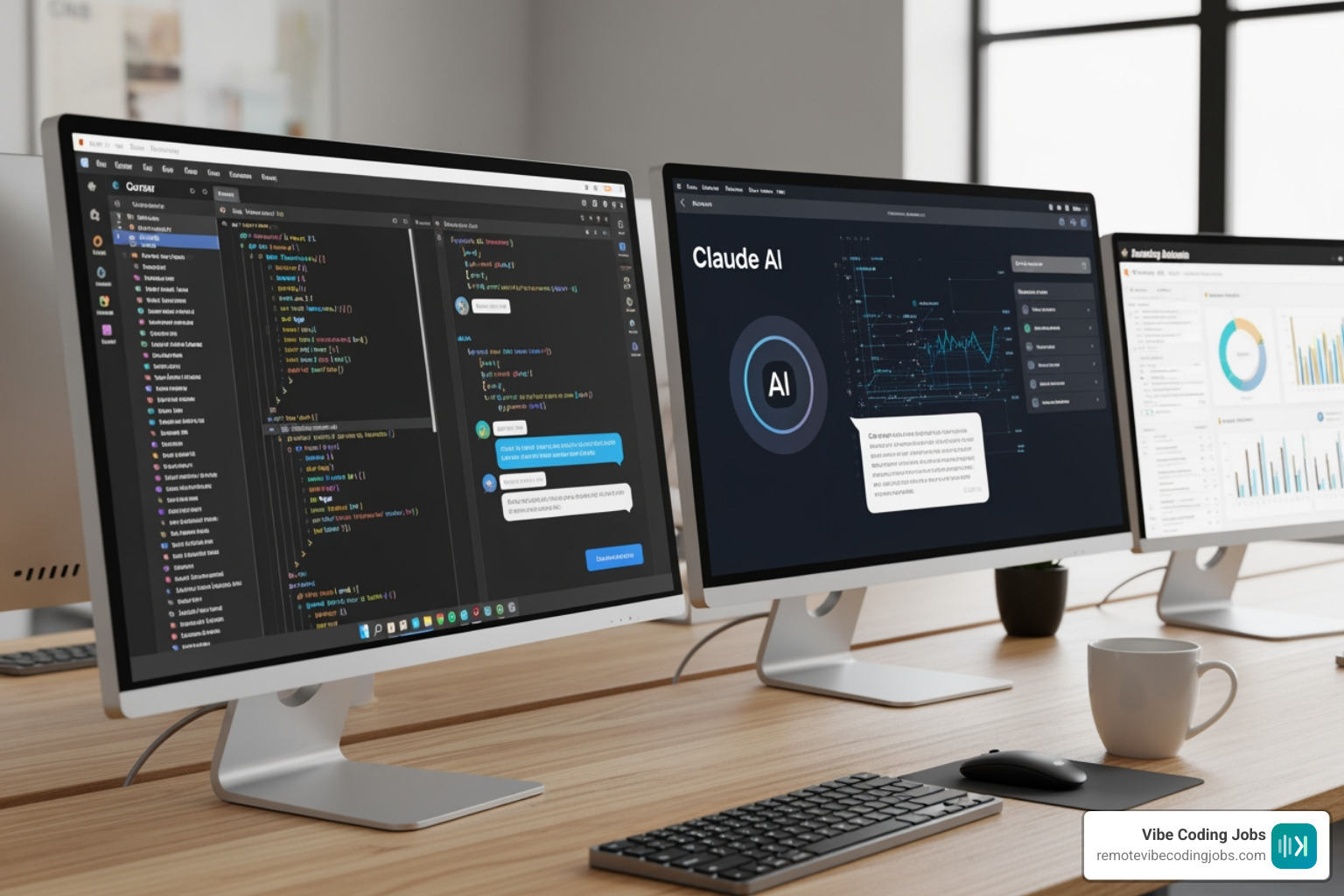
If you want to land one of these roles, you need to master the AI-native stack. Employers are no longer just looking for “JavaScript experience”; they want to see that you can orchestrate a multi-agent workflow. The most frequently cited tools in job descriptions include:
- Cursor & Claude Code: The primary partners for code generation and debugging.
- v0 & Lovable: For rapid frontend prototyping and turning design concepts into functional code.
- Replit & Windsurf: For browser-based development and instant deployment.
- n8n & Make.com: For building autonomous agents and complex backend automations.
The tech stacks showing up most often in async vibe coding jobs
While the AI writes much of the code, you still need to understand the underlying architecture. The modern “vibe stack” typically involves:
- Frontend: React, Next.js, and TypeScript.
- Backend: Python (specifically FastAPI) and Node.js.
- Database/Infrastructure: Firebase, Supabase, PostgreSQL, and GraphQL.
Employers value developers who can jump between these layers quickly, using AI to bridge the gap between a frontend UI and a Python-based LLM feature.
What employers prioritize: junior potential, senior judgment, or self-taught proof?
Interestingly, async vibe coding jobs are becoming a haven for self-taught developers and career changers. Because the barrier to entry for writing functional code has dropped, employers are prioritizing ownership mentality and curiosity over formal CS degrees.
A “senior” in this field isn’t necessarily someone with 10 years of C++ experience; it’s someone with the judgment to catch security flaws in AI-generated code and the ability to architect complex systems. Whether you are a junior or a senior, your “proof of work”—usually a GitHub portfolio or a Loom demo of a shipped project—is your strongest currency.
9 Things You’ll Actually Do in Async Vibe Coding Jobs
What does a typical Tuesday look like when you aren’t stuck in meetings?
- Build MVPs and prototypes fast: You’ll use AI frameworks to turn a “vibe” (a concept) into a functional digital product in hours, not weeks.
- Create automations and agents: You might build an AI agent that monitors SEO data and automatically updates content via a Python FastAPI backend.
- Add AI-powered features: This involves prompt engineering and integrating LLMs to create “magical” user experiences, like RAG-based search or automated analytics.
- Write clear documentation: Since you work asynchronously, your primary “meeting” is a well-written doc or a Loom walkthrough.
- Audit AI code for security: You’ll be the human-in-the-loop, checking for the vulnerabilities that appear in roughly 10% of AI-generated projects.
- Rapid context switching: You might jump from a React frontend issue to a SQL query optimization in the same hour, guided by your AI assistant.
- Experiment with new tools: Part of the job is staying on the “bleeding edge” of AI tools like Cursor 2.0 or new Claude models.
- Orchestrate integrations: Connecting various APIs (CRM, Slack, Payment gateways) using AI-generated scaffolds.
- Maintain technical debt: Ensuring that the fast-shipped code remains maintainable and clean for the long term.
Salaries, Benefits, and Hiring Companies to Watch
The compensation for async vibe coding jobs is competitive, reflecting the high productivity of AI-native developers.
What remote async vibe coding jobs pay in 2026
Salary ranges vary significantly based on ownership and impact:
- Entry-level (AI Developer): $45,000 to $75,000 per year.
- Mid-to-Senior Vibe Coder: $90,000 to $160,000.
- High-level Product/Staff Roles: Can reach up to $265,000 per year, especially in specialized fields like fintech or healthcare.
Benefits that make these roles attractive
Companies hiring for these roles often offer world-class remote-first benefits:
- Radical Flexibility: Set your own hours across three continents.
- Generous PTO: Some organizations offer up to 28 days of Paid Time Off.
- Equipment Budgets: Dedicated funds for the latest hardware and AI tool subscriptions (Cursor, Claude Pro, etc.).
- Mentorship: Opportunities to learn from “maestros” of AI-assisted development.
Which industries and companies are hiring for vibe coding roles
We are seeing a massive surge in hiring across:
- SEO & Marketing: Companies like Adaptify SEO are hiring “Vibe Coders” to build autonomous SEO agents.
- Fintech & AI-Native Ops: Genesis and Aleph are looking for builders who can prototype financial tools with AI.
- Healthcare & Climate Tech: Using AI to rapidly prototype solutions for patient data or environmental impact.
How to Land Async Vibe Coding Jobs Without a Traditional Background
How to build a portfolio that proves AI-native execution
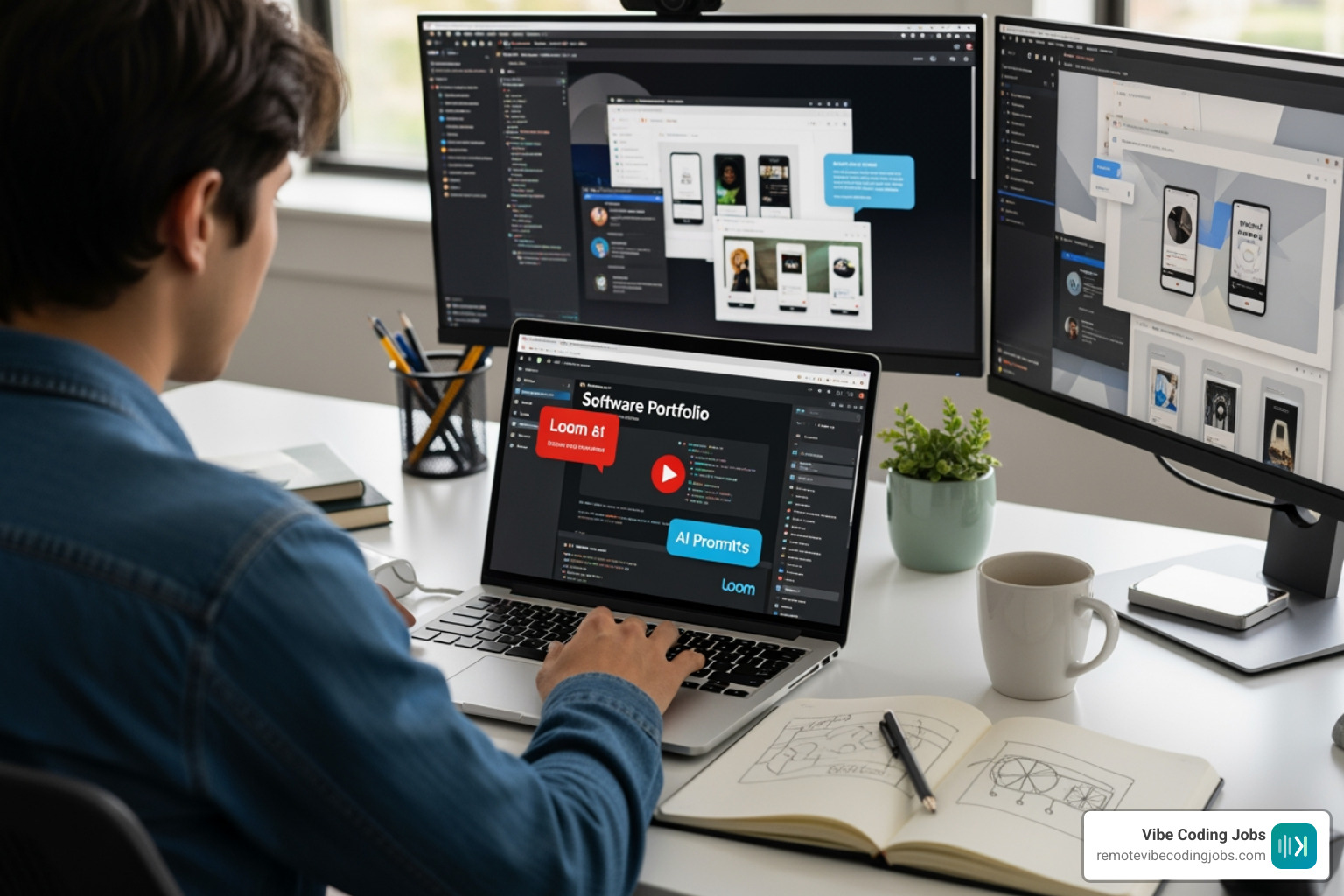
To get hired, skip the resume and show the “magic.” Build a portfolio of functional apps. Use a tool like Loom to record yourself explaining how you used AI to solve a specific problem. Show the “before and after” of your prompts and the resulting architecture.
What the interview process looks like
The interview process for async vibe coding jobs is usually as async as the job itself. You can expect:
- Paid Test Projects: A small project where you are paid to ship a feature using your own AI stack.
- Loom Walkthroughs: Explaining your logic and your “vibe” via video.
- No LeetCode: Most companies favor real-world shipping ability over inverted binary trees.
Common criticisms and how to address them
Critics argue that vibe coding leads to “brittle” code or a lack of fundamentals. To stand out, you should address these concerns head-on by demonstrating your knowledge of testing and security.
| Traditional Dev | Vibe Coding |
|---|---|
| Deep syntax knowledge | Deep prompting & architecture knowledge |
| Manual debugging | AI-assisted debugging + human auditing |
| Slow, stable release cycles | Rapid prototyping + iterative shipping |
| Synchronous (Standups) | Asynchronous (Docs/Loom) |
Future outlook for async vibe coding jobs
As we look toward the rest of 2026 and beyond, we expect the rise of multi-agent systems where vibe coders manage entire fleets of AI agents. The job market is expanding from just “developers” to “AI-native builders” in marketing, design, and operations. You can find the latest companies hiring for these roles here.
Frequently Asked Questions about Async Vibe Coding Jobs
Are async vibe coding jobs real opportunities or just a trend?
They are very real. Enterprise-level organizations like Gartner are now formalizing standards for “agentic and AI-native development.” It is a structural shift in how software is produced.
Can self-taught developers and career changers get async vibe coding jobs?
Yes! In fact, many companies prefer them because they lack the “old habits” of manual coding and are often more open to the rapid experimentation required in a vibe-heavy environment.
Do you still need software fundamentals if AI writes part of the code?
Absolutely. You need to understand systems thinking, security, and how to debug when the AI gets stuck. You don’t need to memorize syntax, but you do need to understand how the pieces fit together.
Conclusion
The era of manual, synchronous coding isn’t over, but it’s no longer the only path to a high-paying, fulfilling career. Async vibe coding jobs offer a future where creativity and shipping speed are valued above all else. Whether you’re a seasoned engineer looking to escape the meeting grind or a self-taught builder ready to make your mark, the AI-native development landscape is waiting for you.
At RemoteVibeCodingJobs, we curate daily listings at async-first companies that actually “get” the vibe. If you’re ready to find your next AI engineer role, we’re here to help you skip the manual grind and start shipping.