
Why Every Coder Needs an AI Playbook in 2026
An AI playbook for coders is a structured set of workflows, prompting patterns, context files, and governance rules that helps developers consistently get high-quality output from AI coding tools — saving up to 10 hours every week.
Quick answer: What an AI playbook for coders includes:
- Context files — CLAUDE.md, AGENTS.md, .cursorrules that tell AI tools your standards
- Prompting patterns — Tested templates for testing, debugging, refactoring, and code review
- Workflow rules — When to use AI, when to review manually, and how to catch errors
- Governance guardrails — Security checks, hallucination controls, and CI/CD gates
- Feedback loops — Self-correcting commands and versioned context to prevent drift
Right now, 90% of engineering teams use AI coding tools. GitHub Copilot alone generates nearly half of all code written by its users. Yet 75% of developers still manually review every single line of AI output before merging.
That gap — between using AI and trusting AI — is exactly where a playbook pays off.
Without one, you get inconsistent output, security gaps, and time lost fixing code that looked right but wasn’t. With one, you shift from writing code line by line to orchestrating AI agents that follow your team’s exact standards.
As one widely-cited framing puts it: the developer role is evolving from executor to orchestrator. The playbook is what makes that shift practical rather than theoretical.
The RVCJ Editorial team covers AI-assisted development workflows and remote developer career strategy — including hands-on guidance on building an AI playbook for coders using tools like Cursor, Claude, Copilot, and Windsurf. We’ve tracked how async-first engineering teams are adopting these workflows to ship faster without sacrificing quality.
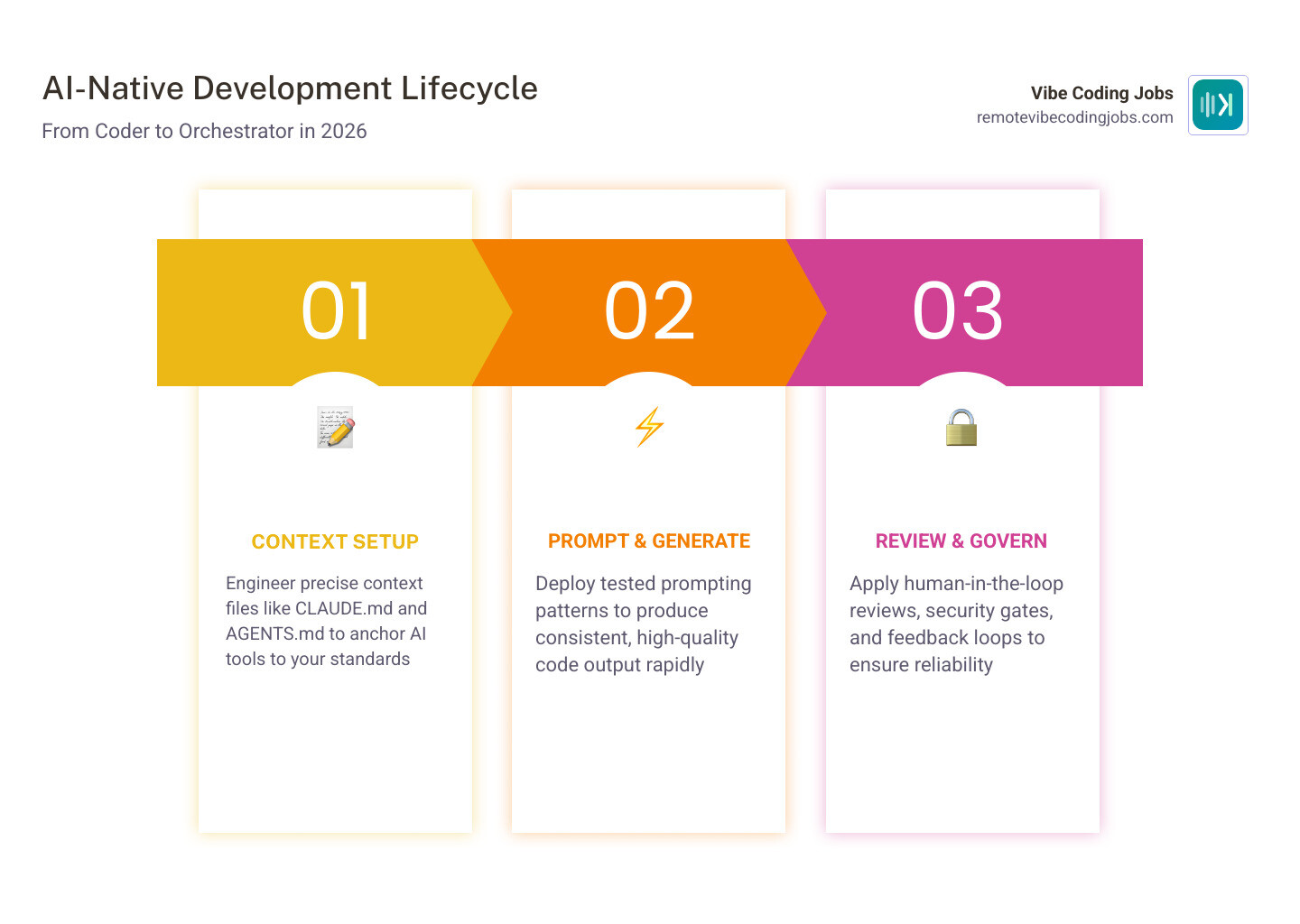
The Evolution of AI-Assisted Programming in 2026
By May 2026, the landscape of software engineering has fundamentally transformed. We no longer view AI as a “fancy autocomplete” but as a junior partner that requires clear instructions and a disciplined environment. The shift from Coder to Orchestrator is the defining characteristic of this era.
Recent statistics highlight the magnitude of this shift:
- 90% of engineering teams now use AI coding tools, a massive jump from just 61% a year ago.
- GitHub Copilot has been adopted by 90% of Fortune 100 companies.
- Developers using these tools are completing tasks 55% faster.
- McKinsey research shows a 50% reduction in documentation time and significantly accelerated refactoring cycles.
In this new reality, How AI-Assisted Programming Is Rewriting the Developer Playbook isn’t just a headline; it’s a daily operational reality. The “Orchestrator” doesn’t spend eight hours a day typing syntax. Instead, they spend their time defining system architecture, reviewing AI-generated logic, and managing the “context” that feeds the models.
This evolution has given rise to new, specialized roles that we track daily at Vibe Coding Jobs:
- AI Systems Architect: Focuses on how LLMs integrate into the software stack.
- Context Engineer: Specializes in structuring organizational knowledge for AI consumption.
- Product Engineer: A hybrid role using AI to prototype and ship features in days rather than weeks.
- Vibe Coder: An elite operator who manages high-level intent and “vibe” while delegating implementation to agents.
Core Components of a High-Performance AI Playbook for Coders
A high-performance ai playbook for coders is built on the realization that “prompt engineering” is no longer enough. In 2026, we focus on Context Engineering. This is the architectural shift from coaching an AI before every single task to defining a persistent system that knows your codebase, your linting rules, and your architectural preferences.
The Best AI Coding Tools 2026 like Cursor and Windsurf allow us to embed these instructions directly into the repository. By using system prompts and files like .cursorrules, we ensure that the AI doesn’t just guess how to write code—it follows a pre-defined standard.
| Feature | Manual Workflow (Pre-AI) | AI-Native Workflow (2026) |
|---|---|---|
| Boilerplate | Manual typing or snippets | 100% AI-generated via context |
| Documentation | Hand-written (often skipped) | AI-generated from code changes |
| Testing | Written after logic | Spec-first, AI-generated tests |
| Code Review | Human-only, slow cycles | AI-pre-review + Human audit |
| Bug Fixing | Grep and manual tracing | AI-agent root cause analysis |
Mastering the AI Playbook for Coders: Testing and Debugging
The most effective playbooks prioritize verification over generation. One of our core rules is: Never give an agent a task without a failing test. This test defines “done” and prevents the AI from hallucinating a solution that doesn’t actually work.
When it comes to Cursor vs Copilot vs Claude, each tool has strengths in the debugging cycle. Cursor, for instance, can “see” your terminal output and stack traces, allowing it to self-correct. A robust playbook includes commands that allow AI to run a test, see the failure, and iterate on the fix automatically.
Pro-tip for Debugging: Use the “Trio” approach. Assign the AI a role:
- The Researcher: Finds documentation and similar issues.
- The Mentor: Challenges your implementation plan and looks for flaws.
- The Builder: Writes the actual fix once the plan is solid.
Context Management and the “Harness” Framework
To scale AI usage without creating technical debt, we use what the AI-Assisted Development Playbook | The GitLab Handbook refers to as the “Harness.” This is a loop of context, constraints, and automated cleanup.
Key files in your harness include:
- CLAUDE.md: Contains high-level project rules, tech stack details, and “always/never” instructions.
- AGENTS.md: Defines the specific commands agents can run (e.g.,
npm test,lint). - .cursorrules: Scopes rules to specific file types (e.g., “Always use functional components for .tsx files”).
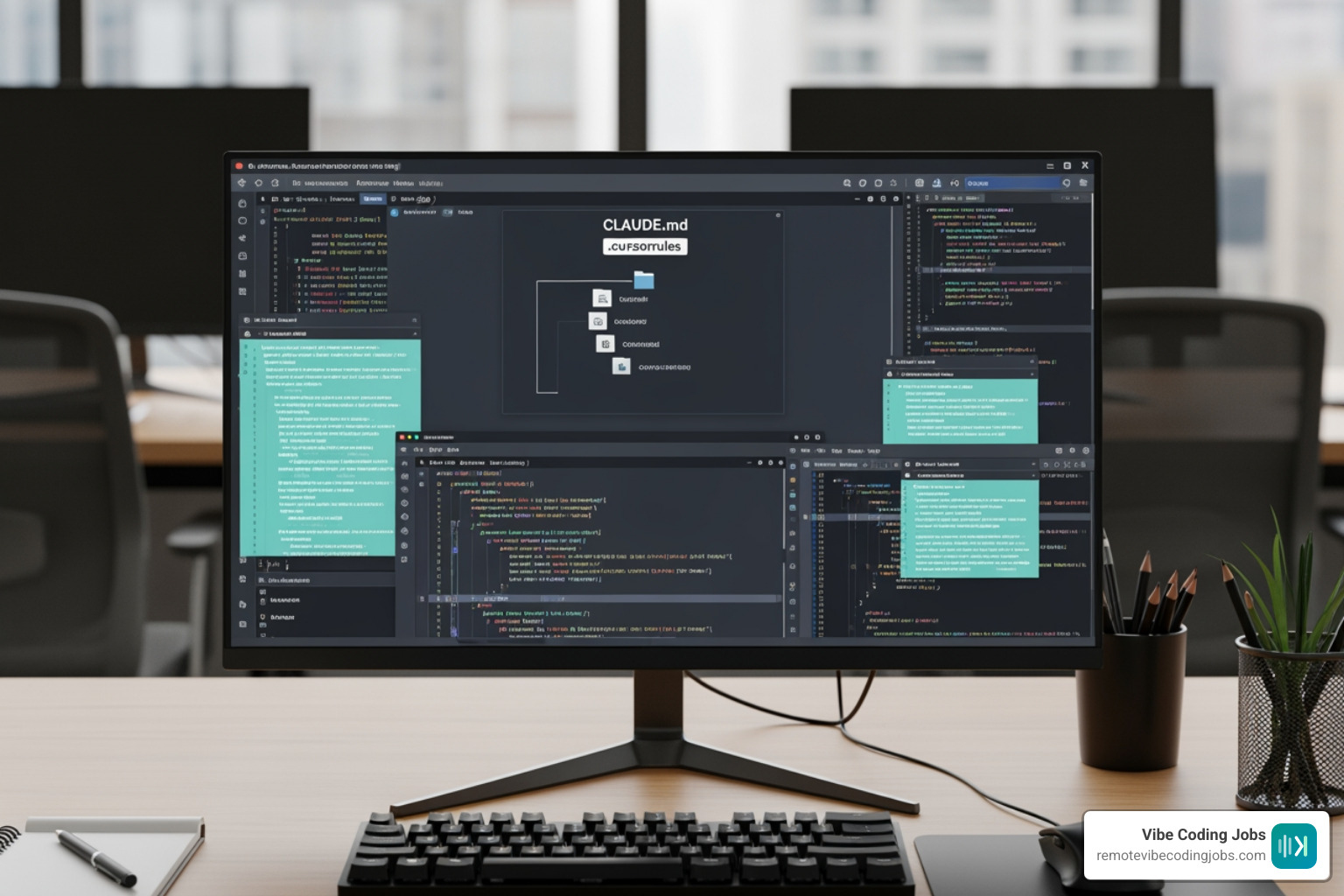
This framework ensures token efficiency. Instead of dumping your whole codebase into a prompt, you “anchor” the context to only the relevant files, reducing latency and cost while improving accuracy.
Advanced Workflows: From Vibe Coding to ContextOps
As you move beyond basic task completion, you enter the realm of What Is Vibe Coding. This isn’t about being lazy; it’s about being high-leverage. Vibe coding is intent-driven logic where the developer maintains the “vibe” (the architectural integrity and user value) while the AI handles the mechanical syntax.
However, high-speed development leads to a new problem: Context Drift. This occurs when your codebase evolves—perhaps you switched from Jest to Vitest—but your AI instruction files remain static. Research shows that incremental context updates can reduce drift and latency by up to 86%.
Proven Prompting Patterns for your Playbook:
- Chain of Thought: Asking the AI to “think step-by-step” before writing code.
- Spec-First: Providing a markdown specification and asking for implementation.
- Context Anchoring: Explicitly telling the AI which files are the “source of truth” for a task.
- Rubber Ducking: Using the AI to explain a complex block of code back to you to ensure you both understand it.
Scaling Your AI Playbook for Coders Across Engineering Teams
For teams, the challenge is moving from “artisanal” individual prompts to “industrial” organizational infrastructure. This is known as ContextOps. Just as DevOps governs how code is deployed, ContextOps governs how AI context is distributed and versioned.
In Remote AI Developer Jobs Requirements, we’ve seen a surge in companies looking for engineers who can capture “tribal knowledge”—those unwritten rules about how the team builds software—and formalize them into AI-readable standards. This ensures that a junior developer using an AI agent gets the same architectural guidance that a senior engineer would provide in a PR review.
Mitigating Risks: Security and Hallucination Guardrails
We must address the elephant in the room: AI is not perfect. In fact, research indicates that 29.1% of Python code generated by AI assistants contains potential security vulnerabilities. Furthermore, 79% of organizations deploying agents lack formal security policies.
Your ai playbook for coders must include a security layer. This is where the AI playbook – Microsoft Learn approach is invaluable, emphasizing responsible AI and “GenAI Gateways” that handle PII redaction and secret scanning before a prompt even reaches the model.
Hallucination Management Strategies:
- Human-in-the-loop: Never auto-merge. Every line must be reviewed by a human.
- The 3-Iteration Rule: If the AI hasn’t fixed a bug in three tries, stop. Step back, research manually, and provide more context.
- Characterization Tests: Before letting an AI refactor old code, have it generate tests that “lock in” the current behavior. If the tests pass before and after the refactor, the logic is likely sound.
Frequently Asked Questions about AI Playbooks
What is context drift in AI coding?
Context drift is the “silent killer” of AI productivity. It happens when your codebase changes (new libraries, different patterns, updated APIs) but your system prompts (like CLAUDE.md) stay the same. The AI starts suggesting outdated code, which you then have to manually fix, negating the time savings.
How do I structure a CLAUDE.md file?
A great CLAUDE.md should be hierarchical. Start with the Project Mission, followed by the Tech Stack, then Coding Standards (use action verbs like “Prefer,” “Avoid,” “Use”), and finally Common Commands. Keep rules short—ideally under 25 words—and include one positive and one negative code example for clarity.
Can AI playbooks replace senior engineers?
No. If anything, they make senior engineers more valuable. AI excels at syntax (the “grammar” of coding) but struggles with the “story” (the logic and system design). A senior engineer’s job shifts from writing the grammar to directing the story and ensuring the AI doesn’t introduce subtle architectural flaws or security holes.
Conclusion
The era of the “syntax typist” is ending, but the era of the AI-Native Engineer is just beginning. By implementing a structured ai playbook for coders, you aren’t just saving 10 hours a week—you’re future-proofing your career in a market that increasingly rewards orchestration over execution.
At Vibe Coding Jobs, we specialize in connecting AI-fluent professionals with async-first companies that value these modern workflows. Whether you are a seasoned architect or a “vibe coder” building the next big thing, the right playbook is your competitive edge.
Ready to put your playbook to work? Find your next remote AI-assisted role and join the ranks of developers shipping faster and smarter in 2026.