Why Every Developer Is Searching for a Remote AI Vibe Developer Role Right Now
A remote AI vibe developer uses AI tools like Cursor, Claude Code, and GitHub Copilot to build software through natural language intent — describing what they want, iterating with AI agents, and focusing on architecture instead of manual syntax.
Here’s what you need to know at a glance:
| What | Details |
|---|---|
| What it is | AI-assisted development using tools like Cursor, Claude, and GitHub Copilot |
| Who it’s for | Developers, designers, PMs, and marketers who build with AI |
| Where to find jobs | Async-first companies on dedicated vibe coding job boards |
| Salary range | $70k entry-level up to $250k+ for senior AI-first roles |
| Productivity gain | 2-5x faster within the first month; up to 10x for experienced engineers |
| Key skills | Prompt engineering, product thinking, system architecture |
The term “vibe coding” was coined by AI researcher Andrej Karpathy in 2025. It describes a shift in how developers work — from typing every line of code by hand to directing AI with clear intent and letting agents handle the rest.
By May 2026, this shift has gone from a niche experiment to a full job category. There are over 1,600 verified remote roles live right now across 270+ companies — from early-stage startups to enterprises like Binance and Illumina — all explicitly hiring for AI-assisted development skills.
The opportunity is real. But finding the right role — one that matches your stack, respects async culture, and doesn’t waste your time with algorithm puzzles — is a different challenge entirely.
That’s exactly what this guide is here to solve.
Written by RVCJ Editorial — the Remote Vibe Coding Jobs team covers AI-assisted development, remote hiring trends, and career strategy for engineers building with tools like Cursor, Claude, Copilot, and Windsurf. We track the remote AI vibe developer job market daily so you don’t have to. Here’s a full breakdown of how to find, land, and thrive in these roles.
The Rise of the Remote AI Vibe Developer
The landscape of software engineering has fundamentally shifted. As of May 2026, we are no longer just “writers of code”; we are architects of intent. The remote ai vibe developer represents a new breed of professional who treats Large Language Models (LLMs) as primary coworkers rather than simple autocomplete plugins.
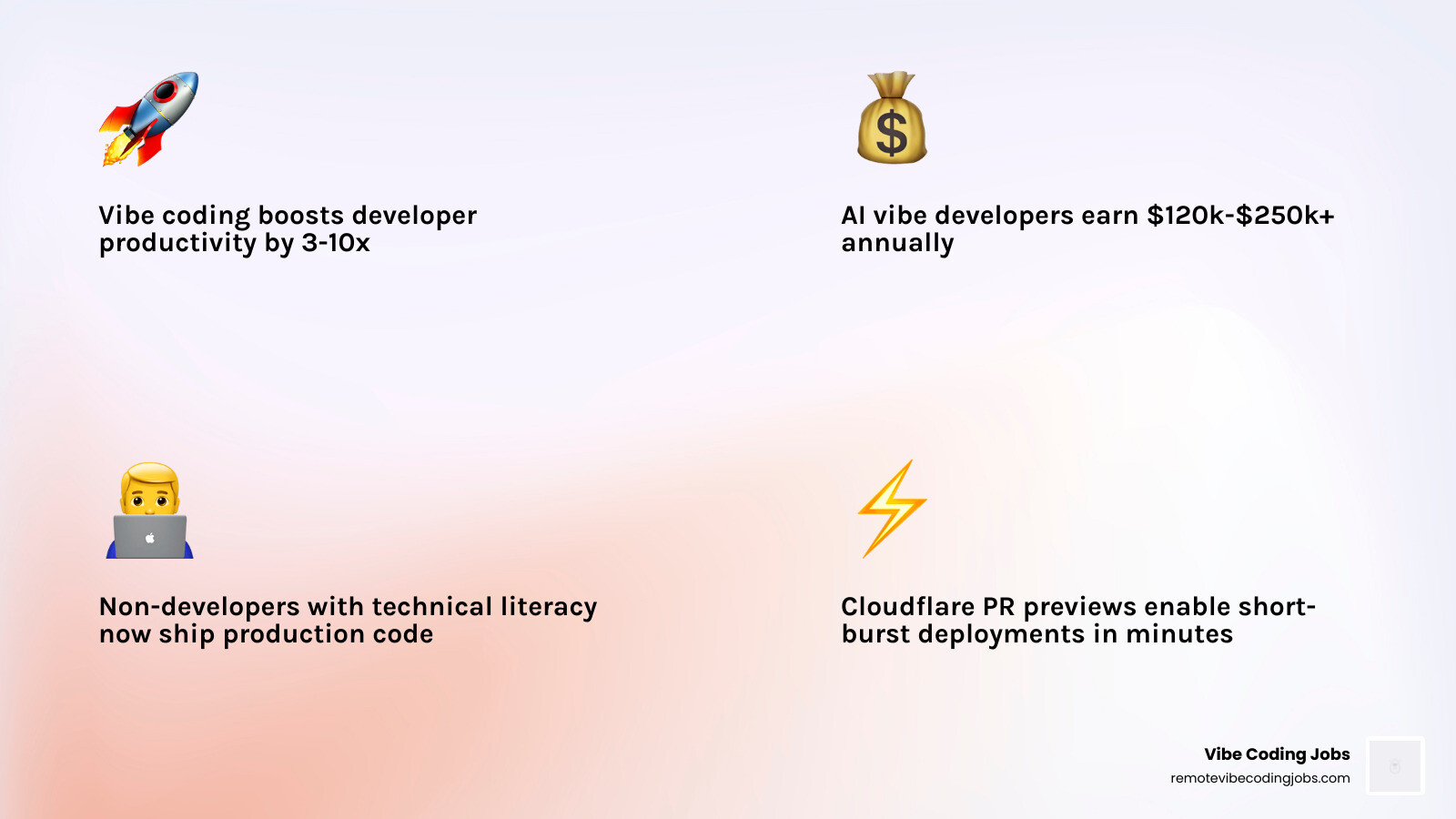
This evolution is driven by massive productivity multipliers. Research shows that developers using AI-native workflows report 2-5x productivity increases within the first month of consistent practice. For senior engineers, this acceleration can reach 10x, allowing projects that once took weeks to be shipped in a matter of days.
But it’s not just about speed; it’s about the “vibe.” Vibe coding prioritizes high-level creative and architectural processes over the manual labor of typing syntax. We focus on the user experience and the “vibe” of the final product, leaving the boilerplate and repetitive logic to our AI agents. This shift has opened the door for “Product Engineers” and “Creative Technologists” who bridge the gap between design and implementation.
To support this deep-focus work, many developers are turning to tools like VibeScape – Orchestrate Your Workspace with AI for Optimal Developer Flow. to optimize their physical and digital environments. In a remote setting, where interruptions are common, having an AI-orchestrated workspace that manages notifications and adjusts lighting for flow state is becoming a standard part of the vibe developer’s toolkit.

Essential Tools for a Mobile-First Vibe Workflow
To be a successful remote ai vibe developer, your toolkit must be as mobile and flexible as your lifestyle. The traditional “chained to a desk” 9-to-5 is being replaced by short-burst, high-impact sessions that can happen anywhere.
The AI-Native IDE Suite
The core of this workflow revolves around three heavy hitters:
- Cursor: Often cited as the gold standard for AI-native development, it provides a seamless interface for iterating on codebases with LLM assistance.
- Claude Code: Anthropic’s agentic tool that can execute real shell commands, allowing for complex refactoring and terminal-based tasks directly through natural language.
- GitHub Copilot Agent Mode: This allows agents to run in the cloud, handling long-running tasks without blocking your local machine.
Cloud vs. Local Development
For many, the “vibe” is killed by maintenance. Local development environments often require constant updates and troubleshooting. We are seeing a massive trend toward zero-maintenance, cloud-based setups.
| Feature | Local Development | Cloud-Based AI Agents |
|---|---|---|
| Maintenance | High (Updates, dependencies) | Zero (Managed by provider) |
| Mobile Access | Difficult (Requires SSH/RDP) | Native (GitHub/Web-based) |
| Background Tasks | Blocks local machine | Runs in cloud while you sleep |
| Collaboration | Manual PR cycles | Integrated AI-human reviews |
For those who need to code from a couch, a park, or an airport lounge, Btelo Coding — Code from anywhere has emerged as a professional-grade mobile tool. It uses NAT traversal and end-to-end encryption to turn your smartphone into a workstation. By using voice-to-code and session persistence, you can dictate high-level intent and let the AI execute it on your home or office machine without the “reconnect dance” traditional remote desktops require.
Mastering the GitHub-Cloudflare Pipeline for Busy Parents
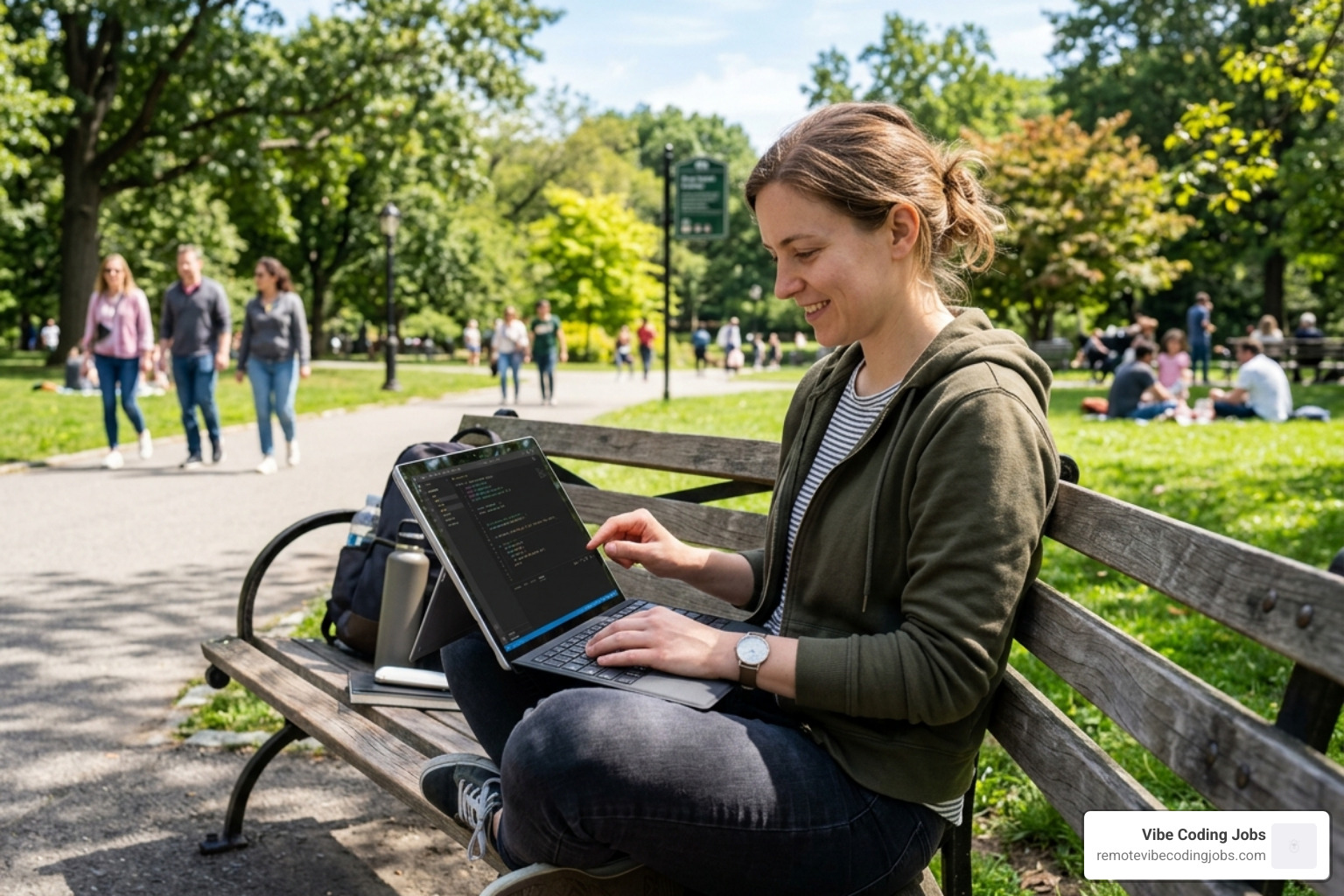
One of the most transformative use cases for remote vibe coding is for busy parents or workers with limited time. If you only have 5-10 minute bursts between childcare or meetings, the traditional “open IDE, wait for build, write code” cycle is impossible.
The solution is the GitHub-Cloudflare Pipeline. This workflow allows you to make steady progress using only your phone:
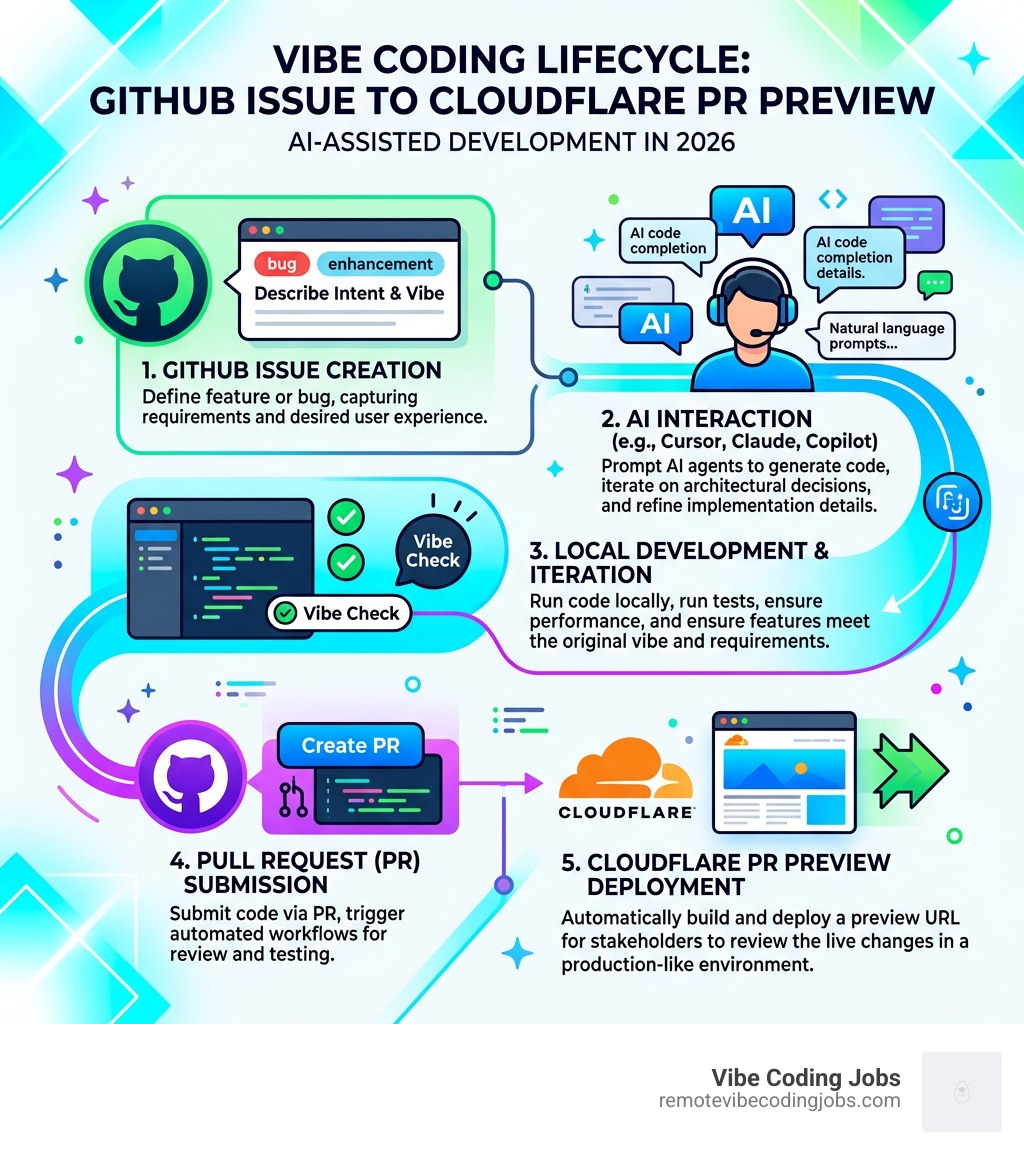
- Issue Creation: When an idea strikes, use text-to-speech to dump it into a GitHub Issue. Be precise with bullet points for features and acceptance criteria.
- Agent Assignment: Assign the issue to an AI agent (like Copilot Pro). The agent works in the background on GitHub’s cloud infrastructure, creating a Pull Request (PR) while you attend to your family or other tasks.
- Automatic PR Previews: Integrate Cloudflare Pages to automatically deploy a preview of every PR. Cloudflare will post a comment on the PR with a unique URL.
- Mobile Verification: From your phone, click the preview link to see the live changes. If the “vibe” is off, leave an inline comment on the PR. The AI agent reads your feedback and iterates on the code.
- Merge: Once the preview looks perfect, merge the PR directly from the GitHub mobile app.
This “hands-off” background coding ensures your projects keep moving even when you aren’t at your desk.
Navigating the Job Market for a Remote AI Vibe Developer
The demand for AI-fluent developers is exploding. As of May 2026, our job board shows 1,696 active roles from over 270 companies. These companies aren’t just looking for “coders”; they are looking for remote ai vibe developers who can ship products 3-10x faster than traditional methods.
When browsing roles, look for a high “Vibe Score.” This metric, used by forward-thinking companies, rates a job based on its support for AI tools, async-first culture, and deep-work environments. These companies value output over hours and often “skip the LeetCode” in favor of paid test projects that evaluate how well you steer AI agents.
Salary Ranges and Titles for the Remote AI Vibe Developer
The market recognizes the value of accelerated delivery. Here are the common titles and salary ranges we are seeing in 2026:
- Vibe Coder / AI Pilot: $70k – $120k (Entry to Mid)
- AI-First Developer / Agentic Engineer: $120k – $180k (Mid to Senior)
- Creative Technologist / AI Systems Architect: $180k – $250k+ (Staff+)
- Freelance Vibe Coder: $100 – $300 per hour, depending on project complexity.
Essential Skills for the Modern Remote AI Vibe Developer
To land these six-figure roles, you need more than just a Cursor subscription. You need a specific set of “agentic” skills:
- Prompt Engineering: Learning to provide context, constraints, and intent to minimize AI hallucinations.
- Technical Intuition: The ability to spot when an AI is stuck in a logic loop and knowing how to nudge it out.
- Context Window Management: Understanding how much information an AI can “remember” at once and using tools like
ARCHITECTURE.mdto keep it aligned. - Product Thinking: Since you can build faster, your value shifts to what you build. Understanding user value and strategy is now a core developer skill.
- Security Compliance: Reviewing AI-generated code for vulnerabilities and ensuring data privacy.
Frequently Asked Questions about Vibe Coding
What is the difference between vibe coding and traditional programming?
Traditional programming is about manual implementation — typing every line of syntax and boilerplate. Vibe coding is about strategic intent. You describe the architectural goal, and the AI handles the implementation. This moves the bottleneck from “how fast can you type” to “how well can you think.”
Can non-developers get hired for vibe coding roles?
Yes! We are seeing a surge in “Designers-turned-developers” and “Marketing Engineers.” Because AI lowers the syntax barrier, anyone with strong technical literacy and a “builder” mindset can ship production-ready code. However, understanding programming fundamentals (loops, data structures, APIs) is still essential for debugging.
How do I set up Cloudflare Pages for automatic PR previews?
It’s a 30-minute setup:
- Link your GitHub account to Cloudflare.
- Create a new Pages project and select your repository.
- In settings, disable “Production Branch” deployments to avoid unwanted live updates.
- Enable “Preview Deployments” for all non-production branches. Now, every time an AI agent creates a PR, you’ll get a live link to test.
Conclusion
The era of the “code typist” is ending, and the era of the remote ai vibe developer has begun. In this new agent economy, every application is essentially a “slow API” that can be orchestrated by intelligent agents. To stay relevant, developers must adopt a builder mindset, mastering the tools that allow them to ship at the speed of thought.
Whether you are a busy parent looking for a workflow that fits into 10-minute gaps or a senior engineer ready to 10x your output, the “vibe” has never been more important.
Ready to find your next role at a company that actually gets it? Find your next AI-native role at remotevibecodingjobs.com. We curate the best async-first, AI-assisted positions daily, so you can focus on building, not just searching.