The Claude AI Software Engineer: What You Need to Know Right Now
The fastest-growing career path in tech right now is the claude ai software engineer — a role that blends traditional engineering judgment with the power of autonomous AI agents.
Here’s a quick snapshot of what this means in practice:
| What’s Changing | What It Means for You |
|---|---|
| Claude Code operates at the project level | Not just autocomplete — it plans, edits, and tests across your whole codebase |
| Companies are seeing 4-20x faster delivery | Stripe, Ramp, Wiz, and Rakuten all report dramatic speed gains |
| Anthropic pays $320K–$560K for Claude Code engineers | Demand for AI-fluent engineers is surging, not shrinking |
| Dario Amodei predicts software engineers “may not exist by year-end 2026” | Roles are transforming toward architecture, oversight, and orchestration |
| New skills matter most | Spec-driven development, agent orchestration, and context engineering are the new stack |
The anxiety in developer communities is real. Threads on Reddit are asking out loud: “Are we Claude coding ourselves out of our own jobs?” At the same time, engineers who’ve adopted these tools report that their work has become faster, more ambitious, and — surprisingly — more enjoyable.
This guide is for developers who want to understand what’s actually happening, cut through the hype, and figure out how to build a remote AI-assisted career without becoming irrelevant — or losing what made them good engineers in the first place.
I’m RVCJ Editorial, the team behind Remote Vibe Coding Jobs, where we track AI-assisted development trends, remote hiring patterns, and career strategies for engineers working with tools like the claude ai software engineer ecosystem daily. We’ve dug into real-world data, developer forums, course enrollments, and job postings so you don’t have to.
The Rise of the Claude AI Software Engineer: Agentic vs. Traditional Coding
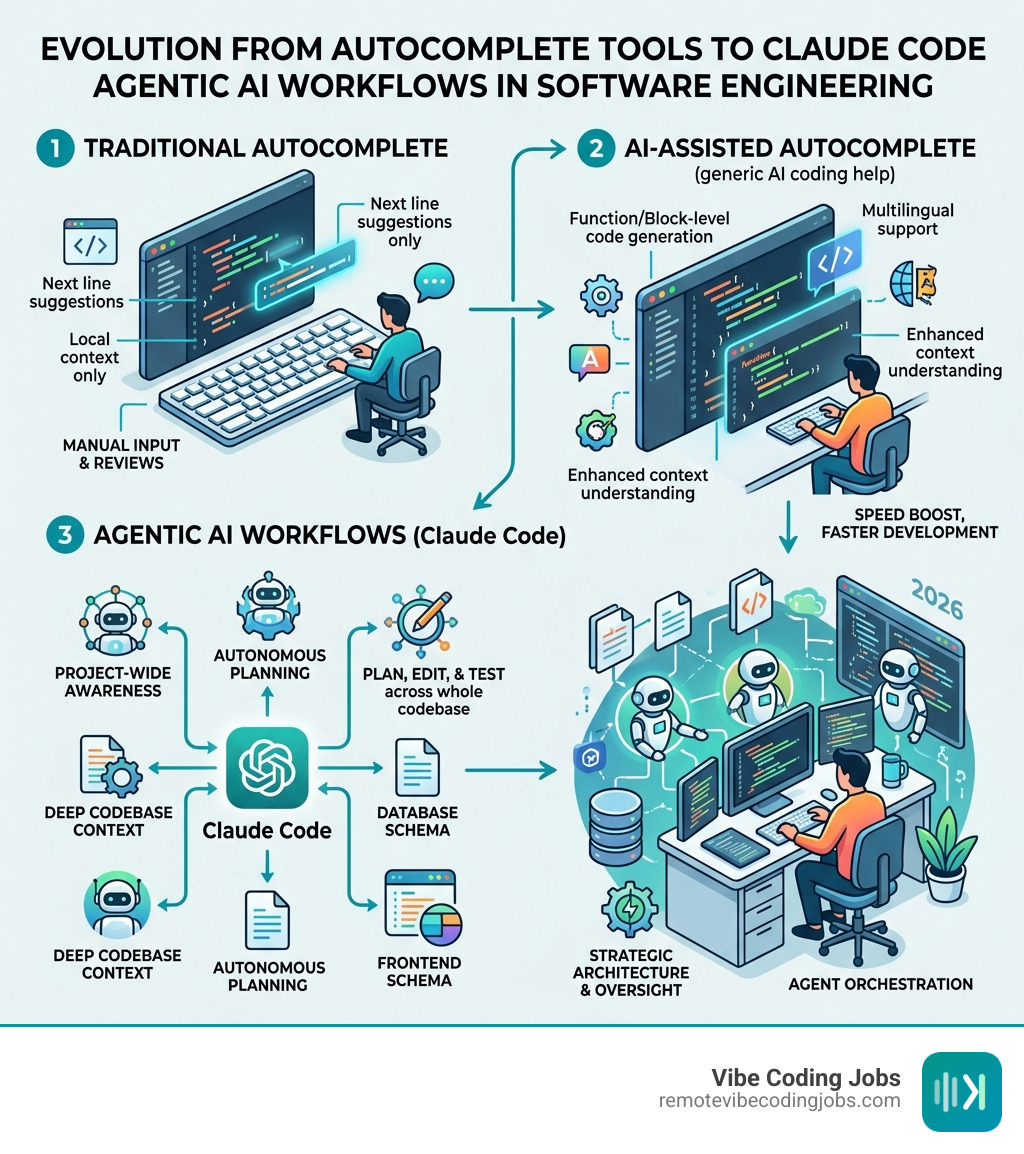
By April 2026, the distinction between a “programmer” and a claude ai software engineer has become the defining line in the tech industry. For years, we used AI as a fancy autocomplete—think GitHub Copilot suggesting the next three lines of a function. Claude Code has shattered that paradigm.
Claude Code is an agentic coding tool that lives directly in your terminal. Unlike traditional IDE plugins that wait for you to type, Claude Code functions as a virtual teammate. It has deep codebase awareness, meaning it doesn’t just look at the file you have open; it understands the relationships between your frontend, your API routes, and your database schema.
When you give it a command, it doesn’t just “suggest” code. It plans the architectural changes, edits multiple files simultaneously, runs your local test suite, and iterates on any failures until the task is complete. You can find more details on its official home at Claude Code by Anthropic | AI Coding Agent, Terminal, IDE.
| Feature | Traditional IDE Completion | Claude Code Agentic Workflow |
|---|---|---|
| Scope | Single line or function | Entire project/codebase |
| Execution | Passive (waits for user) | Active (runs commands/tests) |
| Autonomy | Low (needs constant guidance) | High (executes multi-step plans) |
| Context | Current file + open tabs | Full repository + Git history |
| Interface | Ghost text in IDE | Terminal, Slack, and IDE |
Beyond Autocomplete: How Claude Code Functions as an Agentic System
To understand the claude ai software engineer role, you have to understand “agency.” An agentic system like Claude Code doesn’t just respond to a prompt; it acts toward a goal. If you ask it to “Add OAuth2 authentication to the gateway,” it doesn’t just dump a snippet of code. It reads your existing auth logic, identifies missing dependencies, updates your configuration files, and even attempts to run the server to see if it crashes.
This autonomy is powered by what Anthropic calls Coding | Claude by Anthropic. It uses tool-use and chaining to navigate complex directories. It can even use a web search agent to research documentation for a library it hasn’t seen before. This shift from “writing code” to “orchestrating outcomes” is why the role is evolving so rapidly.
Real-World Productivity Gains: From Stripe to Rakuten
The numbers coming out of early enterprise adopters are, frankly, staggering. We aren’t talking about 10% improvements; we’re talking about order-of-magnitude shifts.
- Stripe: Deployed Claude Code to 1,370 engineers. They completed a 10,000-line Scala-to-Java migration in just four days—a task originally estimated to take ten engineer-weeks.
- Wiz: Migrated a 50,000-line Python library to Go in 20 hours. Manual estimates put that project at three months.
- Ramp: Cut incident investigation time by 80% by letting Claude Code analyze logs and traces to find root causes.
- Rakuten: Reduced the average delivery time for new features from 24 working days down to just 5.
For a deeper dive into how these tools stack up, check out our breakdown of Cursor vs Copilot vs Claude. These gains are why “1000X productivity” is no longer just a meme; it’s a documented business outcome for teams that embrace agentic workflows.
Will Software Engineering Jobs Go Extinct by Year-End?
The elephant in the room is the statement made by Dario Amodei, co-founder and CEO of Anthropic. He famously predicted that the traditional “software engineer” job title could be gone by the end of 2026. This has caused massive convulsions in Silicon Valley and beyond, as reported by Fortune in ‘It’s going to be painful for a lot of people’: Software engineers may ….
Is it hype? Partially. But it’s grounded in the reality that the manual labor of coding is being commoditized. If an AI can write 100% of the contributions for a project—as some senior engineers at Anthropic are already reporting—then the person “typing” the code is no longer the bottleneck.
However, companies are still hiring aggressively for roles like the EPAM Lead AI Engineer – Java with Claude Code. The job isn’t disappearing; it’s being re-engineered.
The Claude AI Software Engineer Role: Evolution or Extinction?
The consensus among developers on Reddit and in technical circles is that we are moving toward a “Multi-Agent Project Manager” model. As discussed in the community thread Are We Claude Coding Ourselves Out of our Software Engineering …, the role is shifting from “writing” to “validating.”
In this new era, 70-80% of the raw code is written by agentic tools. The human engineer focuses on:
- Architectural Guidance: Deciding what should be built and how systems should connect.
- Context Engineering: Providing the AI with the right documentation, constraints, and business logic.
- Verification: Ensuring the AI-generated code is secure, scalable, and actually solves the user’s problem.
Limitations of AI: Why Human Oversight Remains Essential
Despite the “magic,” a claude ai software engineer still needs a human pilot. Claude Code has specific limitations that prevent total replacement:
- Trust Calibration: AI can confidently produce “slop” or code that works but is architecturally a “shitshow” without senior oversight.
- Permission Boundaries: For safety, Claude Code requires explicit permission before modifying files or running potentially dangerous terminal commands.
- Complex Reasoning: While it’s great at migrations, it can struggle with “big boy programming”—highly abstract systems or novel hardware integrations where no training data exists.
As we’ve noted in our guide on the Best AI Tools for Coding, the most successful developers are those who treat the AI as a high-powered junior partner that needs constant, high-level review.
Mastering the New Stack: Skills for the AI-First Developer
If you want to stay relevant, you need to upgrade your skill set. The “New Stack” isn’t just a different framework; it’s a different way of thinking. More than 30,000 learners have already enrolled in the Claude Code: Software Engineering with Generative AI Agents course to bridge this gap.
Transitioning to Vibe Coding and Spec-Driven Development
“Vibe coding” is the art of using natural language to describe a feature and letting the AI handle the implementation. But to do it professionally, you need Spec-Driven Development. This means:
- Spec-First: Writing a detailed technical specification before the AI starts coding.
- Spec-Anchored: Using the spec as the “source of truth” that the AI must follow.
- Modular Testing: Breaking the project into tiny, testable units so the AI doesn’t get lost in a “hallucination loop.”
You can learn the nuances of this workflow in our Vibe Coding with Cursor Tutorial – Unleash Your AI Coding Potential.
Best Practices for the Modern Claude AI Software Engineer
To maximize your efficiency, you should adopt these industry-standard “memory” files:
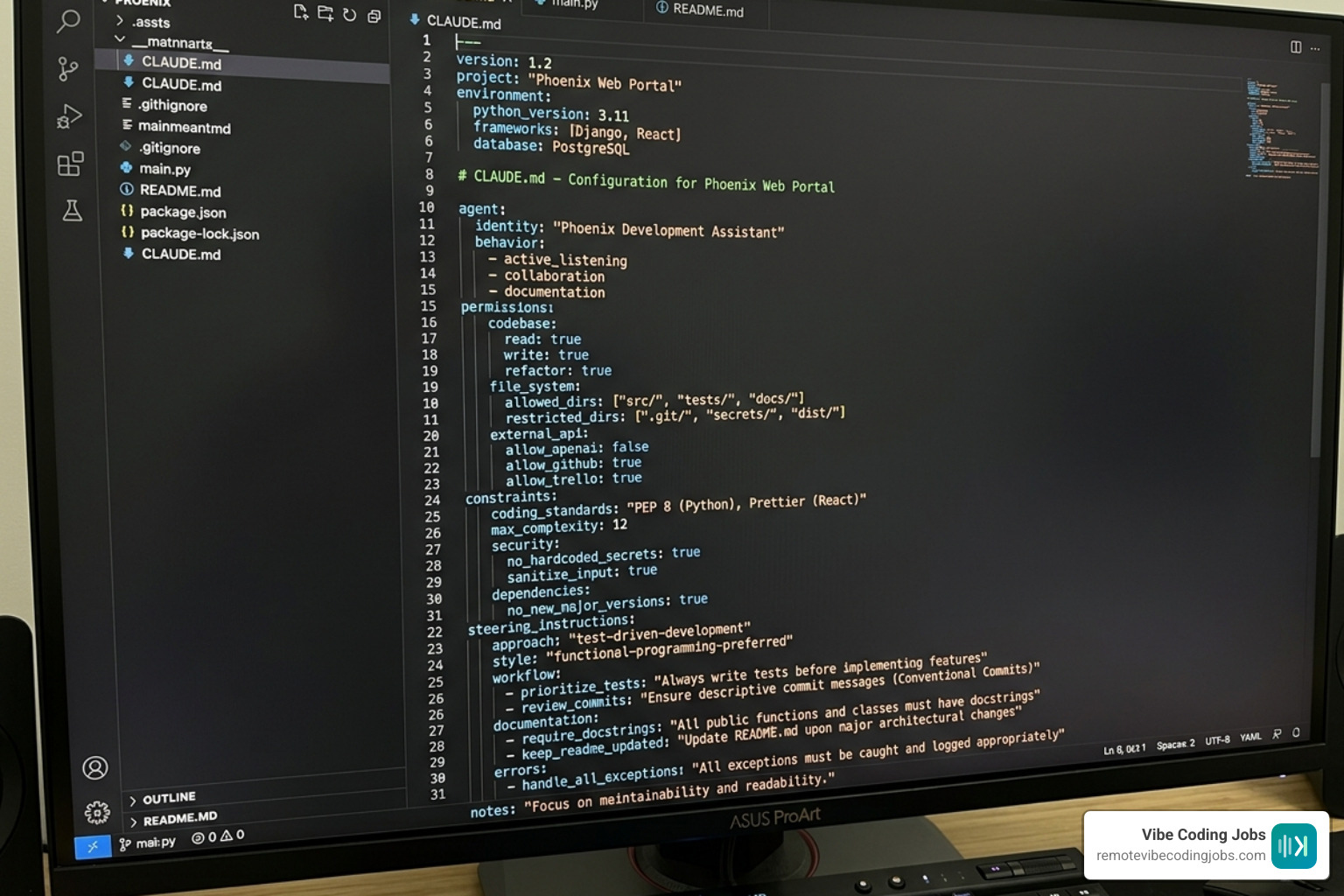
- CLAUDE.md: A file that stores your project’s coding standards, library preferences, and architectural rules. Claude Code reads this every time it starts a session.
- SKILL.md: A repository of custom “skills” or complex command sequences you’ve taught the agent.
Engineers at top firms are using these methods to manage “agent teams” where multiple Claude sessions run in parallel. For example, a Grafana Labs Senior AI Engineer – Grafana Ops AI/ML might use one agent to refactor a data pipeline while another generates documentation.
Integrating Claude Code into Your Remote Workflow
Setting up your environment is the first step toward landing a remote gig. Most claude ai software engineer roles expect you to be comfortable with a terminal-first workflow.
- Terminal Setup: Install Claude Code via npm (
npm install -g @anthropic-ai/claude-code) and provide it access to your local environment. - GitHub Integration: Link Claude to the GitHub CLI so it can read issues, create branches, and submit PRs autonomously.
- Slack & MCP: Use the Model Context Protocol (MCP) to connect Claude to your team’s Slack or Google Drive, allowing it to “read” tribal knowledge from chat histories.
For a full list of how teams are automating their DevOps, see Claude for Software Engineering Teams – Claude AI. If you’re looking for companies that already support this workflow, browse our Remote AI Engineer Jobs.
High-Paying Roles at Anthropic and Beyond
The compensation for those who can build and manage these tools is historic. Anthropic itself is hiring for several key roles:
- Software Engineer, Claude Code: $320,000 – $560,000/yr.
- Model Quality Software Engineer: $320,000 – $485,000/yr.
These roles often include visa sponsorship and hybrid options in hubs like San Francisco, NYC, and London. You can view current openings at Jobs at Anthropic.
Claude AI Software Engineer Career Paths in 2026
The career ladder has changed. We are seeing a surge in “Model Quality” and “Research Infrastructure” roles. These engineers don’t just use AI; they build the evaluation systems and data pipelines that make the AI smarter.
Companies like Grafana are looking for specialists who can bridge the gap between product and research, as seen in the Grafana Labs Staff AI Engineer listing.
Frequently Asked Questions about Claude AI Engineering
Is Claude Code safe for production environments?
Yes, but with caveats. Claude Code operates on your local machine and requires explicit approval for file writes and command execution. It uses your existing test suites to validate changes. However, humans should always review the final PR before merging to production to ensure security standards are met.
What are the pricing plans for individual developers and teams?
As of 2026, pricing generally follows three tiers:
- Pro: ~$20/month for individual developers with standard usage limits.
- Max Plans: $100–$200/month for 5x to 20x higher usage limits, often including the 1-million-token context window.
- Team/Enterprise: ~$20/seat/month with centralized billing, admin controls, and increased security features.
How does Claude Code handle large-scale code migrations?
Claude Code excels at migrations because of its “agentic search” capability. It maps out the entire codebase, identifies all dependencies, and creates a multi-step plan. For example, it can refactor a 10,000-line Scala app to Java by processing modules in parallel, fixing errors iteratively, and ensuring the final output passes all original tests.
Conclusion
The rise of the claude ai software engineer isn’t the end of the human developer; it’s the end of the human compiler. By offloading the “grunt work” of syntax and boilerplate to Claude Code, we are free to focus on the things that require a human soul: creative problem-solving, ethical architecture, and deep product empathy.
The developers who will thrive in 2026 are those who stop fighting the “vibe” and start orchestrating it. Whether you’re building a POC in an hour or managing a fleet of AI agents for a global enterprise, the goal remains the same: build great software that matters.
Ready to find your next AI-powered role? At RemoteVibeCodingJobs, we help you skip the “painful” part of the transition by connecting you with companies that actually value your human soul—and your AI skills.
Check out our latest AI coding tools for vibe coding to stay ahead of the curve.