
Will AI Assisted Coding Make You Rich or Replace You
AI Software Developer Salaries Are Surging — Here’s What You Need to Know in 2026
Understanding the AI software developer salary landscape in 2026 is essential if you’re deciding whether to specialize, negotiate, or make a career move. Here’s a quick snapshot before we dig into the details:
| Role | Median Base Pay | Median Total Comp |
|---|---|---|
| AI Software Developer | ~$149K | ~$184K |
| ML / AI Software Engineer | ~$175K | ~$243K |
| LLM Developer | ~$209K | $250K+ |
| Senior AI Engineer (SF/NY) | $180K–$280K | $350K–$400K+ |
| Staff / Principal AI Engineer | $250K–$400K+ | $350K–$600K+ |
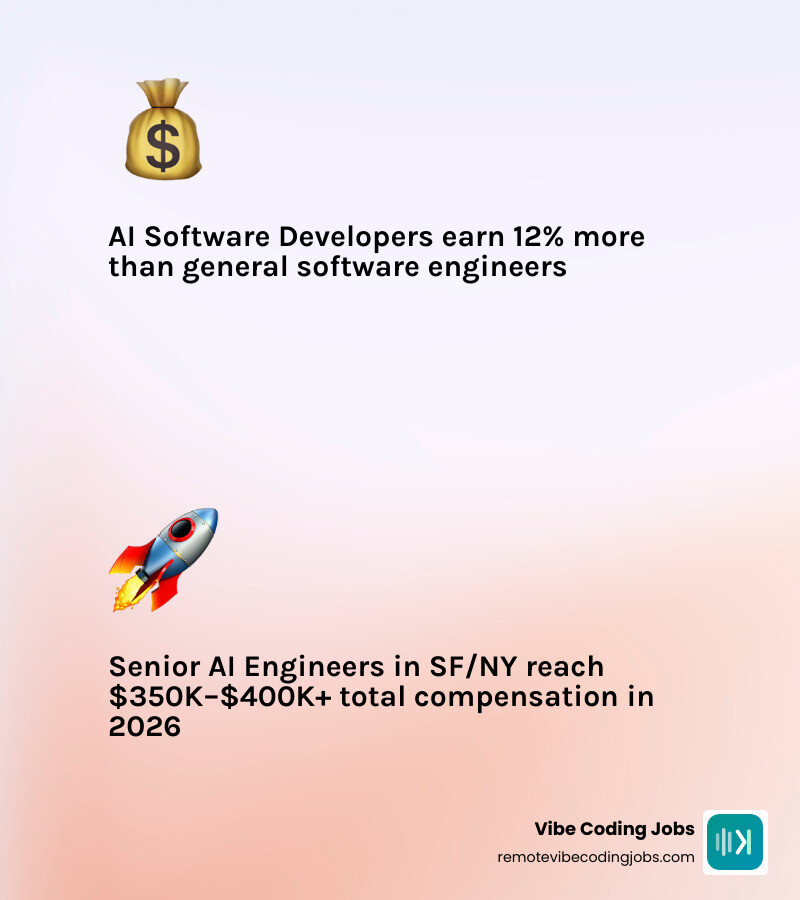
The numbers tell a clear story: AI specialization pays a real premium. AI engineers already earn roughly 12% more than general software engineers, and top-tier roles at big tech or well-funded AI startups push total compensation well past $300K — sometimes past $500K.
The gap between a mid-level AI developer and a senior one with the right skills (think LLM fine-tuning, RAG systems, or inference optimization) can be hundreds of thousands of dollars. That’s not hype — it’s where the market is right now.
I’m the RVCJ Editorial team at Remote Vibe Coding Jobs, where we track AI software developer salary trends, remote hiring patterns, and the tools shaping how developers get paid in an AI-first world. We’ve covered compensation across hundreds of remote AI roles, so we know exactly where the biggest opportunities — and the biggest misconceptions — live.
AI Software Developer Salary in 2026: The Fast Answer
If you want the quick answer, here it is: in the US, the average pay for AI-focused software roles in 2026 is clearly above standard software engineering pay, but the exact number depends on which title you mean.
Using the salary benchmarks in the research:
- AI Software Developer median total pay is about $149K, with a broader total pay range around $122K to $184K from one widely cited dataset
- AI engineer median total base pay is about $134,188
- Machine learning engineer median total base pay is about $123,117
- ML / AI Software Engineer average total compensation is about $243,333
- Full Stack AI Developer median base is about $165,000, with median total compensation around $231K
- LLM Developers average about $209,000
- Senior AI engineers in top markets can reach $350K to $400K+ total compensation
- Staff and principal AI engineers can reach $350K to $600K+ total compensation
So what should we call the “average” AI software developer salary? For a broad US guide, a realistic 2026 snapshot is:
- Base salary: roughly $145K to $175K for many established AI software roles
- Total compensation: roughly $180K to $250K for many mid-market and larger-company roles
- Premium senior roles: $300K+ total compensation
- Elite staff/principal roles: up to $500K+ total compensation in select cases

What is the average ai software developer salary in the US in 2026?
The best single-number answer depends on whether we are talking about base salary or total compensation.
For 2026 US benchmarks:
- Median AI Software Developer pay: about $149K
- Median AI engineer base pay: about $134K
- Average ML / AI Software Engineer total compensation: about $243,333
- Full Stack AI Developer median base: about $165K
Our practical takeaway: if someone asks for the average ai software developer salary in the US in 2026, we would say:
- Around $150K as a conservative median pay benchmark
- Around $180K to $240K when total compensation is included for stronger AI engineering roles
- Higher still for specialized ML, LLM, and staff-level positions
That range may sound wide, but AI titles are messy. One company’s “AI developer” is another company’s “ML engineer,” “applied AI engineer,” or “software engineer, AI platform.”
Typical ai software developer salary range: base pay, bonus, and total compensation
Here is a useful market-based framework for 2026.
| Level | Typical Base Pay | Bonus/Equity | Typical Total Comp |
|---|---|---|---|
| Entry-level AI Developer | $100K-$145K | Small bonus, limited equity | $110K-$165K |
| Mid-level AI Developer | $145K-$210K | Bonus plus meaningful equity | $170K-$260K |
| Senior AI Developer | $180K-$280K | Larger bonus/equity packages | $220K-$350K+ |
| Staff / Principal AI Engineer | $250K-$400K+ | Heavy equity/stock upside | $350K-$600K+ |
A few important notes:
- Startups may offer lower base salary but larger equity
- Public companies often have clearer bonus and stock structures
- Total compensation can swing wildly based on stock grants
- Some AI roles are still underpaid because the title says “developer” while the work is really “ML platform” or “LLM systems”
Why salary figures vary so much between datasets
This is the part that makes salary research feel like a boss fight.
The biggest reasons the numbers differ:
- Job title overlap: AI developer, AI engineer, ML engineer, LLM engineer, and software engineer with AI focus often get mixed together
- Self-reported data: salary sites rely on user submissions, so sample size and recency matter
- Equity distortion: startup stock may be worth a lot, or not much more than fancy confetti
- Company mix: enterprise SaaS, big tech, and early-stage startups all pay differently
- Skill specialization: LLM systems, agentic workflows, and inference optimization command premiums
- Seniority spread: one dataset might skew junior while another is packed with senior engineers
That is why we recommend using salary data as a range, not as a magical exact number.
How AI Software Developer Salary Changes by Experience, Skills, and Specialty
Experience still matters a lot. In fact, AI may increase the gap between levels rather than shrink it. A junior developer using AI tools can move faster. A senior developer who can architect reliable AI systems, manage model costs, and ship production workflows is much harder to replace.

Entry-level to senior: ai software developer salary by years of experience
A practical 2026 progression looks like this:
- Entry-level, 0 to 2 years: $100K to $145K base, $110K to $165K total comp
- Early mid-level, 2 to 4 years: $130K to $180K base, $150K to $220K total comp
- Mid-level, 4 to 7 years: $160K to $220K base, $190K to $280K total comp
- Senior, 7 to 10 years: $180K to $280K base, $220K to $350K+
- Staff / Principal, 10+ years: $250K to $400K+ base, $350K to $600K+ total
What changes as you move up is not just coding speed. Employers pay more for engineers who can:
- Ship AI features into production
- Improve model quality and latency
- Build evaluation pipelines
- Reduce inference costs
- Design retrieval and context systems
- Lead cross-functional AI product work
In other words, salary rises when you stop being “someone who can call an API” and become “someone who can make AI reliable, useful, and profitable.”
The highest-paying AI skills in 2026
Not all AI skills are paid equally. The biggest salary premiums in 2026 tend to go to developers who can bridge product engineering and production AI systems.
The most valuable skills include:
- LLM fine-tuning
- Retrieval-augmented generation, or RAG
- Inference optimization
- PyTorch
- MLOps and model deployment
- Agent frameworks and tool use systems
- Evaluation and benchmarking
- Data pipelines for training and inference
- Distributed systems experience
The research points especially to LLM developers averaging about $209K in 2026, which tells us the market rewards specialization around generative AI stacks.
Why these skills pay more:
- They are hard to hire for
- They directly affect product quality
- They influence cloud cost and margin
- They are close to revenue-generating features
- They require both software engineering and ML judgment
If you want to raise your market value, combining strong engineering fundamentals with LLM systems experience is one of the fastest paths.
Is $500,000 total compensation realistic?
Yes, but it is not normal, and it is not entry-level.
A $500K total comp package is realistic for:
- Staff or principal AI engineers
- Senior AI specialists at top-paying firms
- High-impact researchers who also ship production systems
- Engineers with strong LLM infrastructure or model optimization backgrounds
- Candidates in high-paying markets or with large stock grants
The research supports this. Staff and principal AI engineers can reach $350K to $600K+ total comp, while senior AI engineers in top markets can exceed $400K. Some city-specific figures also show extremely high average total compensation in premium markets.
What usually gets someone into that tier?
- 8 to 15+ years of experience
- Evidence of shipped AI products at scale
- Strong systems design and distributed systems ability
- Specialized work in LLMs, RAG, model serving, or performance optimization
- A track record of business impact
- Excellent negotiation with multiple offers in hand
So yes, $500K is achievable. No, it is not the “default AI salary” promised by random social posts between ads for keyboard wrist rests.
Where AI Software Developers Earn the Most
Location still matters in 2026, even in a remote-friendly market.
Highest-paying cities and metro areas
The top-paying US markets remain concentrated in major tech hubs. Based on the research, the strongest salary zones include:
- San Francisco
- San Jose
- New York
- Seattle
- Boston
The clearest benchmark in the research is San Francisco, where AI engineer base pay commonly lands around $210K to $250K and total comp often reaches $270K to $390K+.
San Jose is also especially strong, with one benchmark showing average total compensation for artificial intelligence developers near $495,187. That figure likely reflects a high concentration of senior, equity-heavy roles, so we should treat it as an upper-end market signal rather than a universal expectation.
A simplified comparison:
| Location Type | Typical Pay Pattern |
|---|---|
| Bay Area | Highest base and strongest stock upside |
| New York City | Very high total comp, especially in finance and enterprise AI |
| Seattle | Strong comp for platform and cloud-heavy AI roles |
| Boston | Competitive for research-driven and healthcare AI work |
| National remote roles | Wider salary bands, often lower than top hubs but still strong |
Remote vs on-site AI software developer salary
Remote work does affect compensation, but not in a simple “remote pays less” way.
Here is what we see in 2026:
- Some companies still use geo-adjusted pay bands
- Others use national pay for hard-to-fill AI roles
- Elite remote AI jobs can match on-site offers when the skill set is scarce
- Hybrid and on-site roles in top hubs still have an edge for stock-heavy packages
In practice:
- Remote entry and mid-level roles may be a bit more standardized
- Senior remote AI engineers often keep strong negotiating power
- The most specialized remote candidates can still command premium offers
For more context on this shift, see More info about x services.
If you are targeting remote roles specifically, salary depends heavily on whether the employer hires nationally, uses location-based bands, or pays one rate for top talent regardless of ZIP code.
AI Software Developer vs Software Engineer vs ML Engineer Pay
AI titles overlap, but compensation does not always line up perfectly.
How much more do AI developers make than general software engineers?
The research shows that AI engineers command about a 12% salary premium over general software engineers.
Using the benchmark average for software engineers of $148,263, that premium is meaningful. It reflects a few market truths:
- AI talent remains scarce
- AI products can drive direct revenue
- Employers are paying for both engineering and model-related capability
- Companies want people who can turn AI from demo into dependable feature
That premium can be modest at junior levels and much larger at senior levels. Once stock grants enter the picture, top AI roles can outpace standard software engineering pay by a wide margin.
AI software developer vs ML engineer vs full stack AI developer
Here is a practical breakdown.
- AI Software Developer: often product-focused, building AI features into applications
- ML Engineer: often more focused on model pipelines, training, serving, and deployment
- Full Stack AI Developer: works across frontend, backend, model integration, and user experience
- General Software Engineer: broader engineering role, may or may not touch AI systems
Based on the research:
- AI Software Developer median pay: around $149K
- Machine Learning Engineer median base: about $123,117
- ML / AI Software Engineer average total comp: about $243,333
- Full Stack AI Developer median base: about $165,000 and total comp around $231K
That tells us two things:
- Titles are inconsistent
- End-to-end AI product builders are being rewarded very well
If your work spans backend systems, prompt orchestration, retrieval, frontend UX, and deployment, you may fit the “full stack AI” market, which can pay better than narrower labels.
For adjacent role benchmarks, readers can also compare DevOps Engineer Salaries and Golang Developer Salaries.
What Actually Drives AI Compensation Higher
The biggest driver of compensation is not the label “AI.” It is the combination of scarcity, impact, and business value.
Useful market references include public compensation benchmarks for ML / AI software engineering roles and broader salary datasets for artificial intelligence developers.
Industries and companies paying the most
The highest-paying AI roles tend to cluster in:
- Big tech
- AI-native startups
- Finance
- Healthcare
- Defense
- Enterprise SaaS
Why these industries pay more:
- They have larger budgets
- AI affects revenue or cost structure directly
- The engineering challenges are harder
- Specialized compliance, reliability, and scaling expertise matters
Company size also matters, but not in a straight line.
- Large public firms often offer the highest cash-plus-stock packages
- Well-funded startups may trade lower cash for potentially valuable equity
- Mid-size firms can be competitive for senior product AI roles
- Small firms may underpay unless the role is mission-critical
How negotiation can add tens of thousands to an offer
Negotiation matters more in AI than many developers realize.
Because these roles are specialized, employers often have less confidence in “market rate” than they do for generic software roles. That uncertainty can work in your favor if you are prepared.
The biggest levers in negotiation are:
- Competing offers
- Clear evidence of specialized AI skills
- Strong portfolio or shipped AI products
- Knowing the difference between base and total comp
- Asking about refreshers, bonus targets, and equity vesting
- Timing your negotiation after the company has chosen you
A candidate who understands market benchmarks can often add substantial value to an offer package. That is especially true if the employer urgently needs experience in LLM productization, evaluation, or inference performance.
Salary trends from recent years and where pay is headed next
From 2024 to 2026, AI compensation rose quickly as generative AI moved from experimental projects into mainstream products.
The broad trend looks like this:
- 2024: hiring surge around generative AI titles
- 2025: title inflation and wider salary dispersion
- 2026: stronger separation between basic AI integration and deep production expertise
We expect the premium to continue, but not evenly. The highest growth will likely stay concentrated in people who can do more than prompt engineer a demo.
The safest projection for the next few years:
- General AI awareness becomes common
- AI feature development becomes standard software work
- Premium pay remains for advanced specialization
- Senior engineers who can ship reliable systems stay in demand
- Junior hiring may become more selective as AI raises baseline productivity expectations
For broader context, see Software developer salary trends 2026.
Frequently Asked Questions About AI Software Developer Salary
Can AI-assisted coding replace developers instead of increasing salaries?
It can reduce demand for some low-complexity work, but it is not eliminating the need for strong developers. In many teams, AI-assisted coding increases the output of good engineers instead of replacing them outright.
That creates two effects at once:
- Senior developers become more valuable because they can use AI tools effectively and safely
- Junior developers may face a tougher market because companies can do more with smaller teams
So yes, AI changes the market. But for developers who learn AI workflows, product thinking, and system reliability, it is more likely to increase leverage than erase careers.
What qualifications help you reach top-tier AI compensation?
The profiles that reach top compensation usually have a mix of:
- Strong computer science fundamentals
- Production software engineering experience
- Experience shipping AI features users actually use
- LLM stack knowledge
- PyTorch or model deployment experience
- RAG, evaluation, and inference optimization skills
- Distributed systems knowledge
- Measurable impact on revenue, latency, quality, or cost
In plain English: companies pay the most when you can connect AI work to business outcomes.
Is remote AI work still a strong path to high pay?
Yes. Remote AI work is still a strong path, especially for experienced developers. But the best-paid remote roles are selective.
High-paying remote employers usually want:
- Excellent async communication
- Proven ownership
- Strong technical depth
- The ability to ship without lots of hand-holding
- Comfort with AI tooling and modern workflows
If you want to understand senior remote expectations in more detail, read our Remote Senior Software Engineer Salary Guide 2026.
Conclusion: How to Raise Your Market Value as an AI Developer
The 2026 AI software developer salary market is strong, but the real money is not attached to the title alone. It goes to developers who combine engineering depth, AI specialization, and visible business impact.
If we had to boil it down, the biggest salary boosters are:
- Moving beyond general coding into production AI systems
- Learning high-value skills like RAG, evaluation, PyTorch, and inference optimization
- Targeting industries where AI directly affects revenue or cost
- Understanding compensation as base plus bonus plus equity
- Negotiating from solid market data, not guesswork
- Staying open to remote-first opportunities with national or premium pay bands
The core question of this article was whether AI-assisted coding will make you rich or replace you. Our answer is: it depends on whether you use AI as a shortcut or as leverage.
Developers who only use AI to write boilerplate may feel pressure. Developers who learn how to design, evaluate, ship, and improve AI systems are positioning themselves for some of the best compensation in software.
If you want to benchmark your own pay and next move, explore our Salaries hub. You may also want to compare related guides such as Vibe Coding Salary Guide (Remote), Vibe Coding Salary Guide 2026, Vibe Coding Salary – Entry, Senior (Remote USA), and Vibe Coding Salary (Remote AI Potential).
And if you are actively exploring AI-first remote roles, Remote Vibe Coding Jobs helps us find curated opportunities filtered by stack, culture, and AI tools so we can spend less time searching and more time increasing our market value.