The Real Difference Between Agentic Engineering vs Vibe Coding (And Why It Matters in 2026)
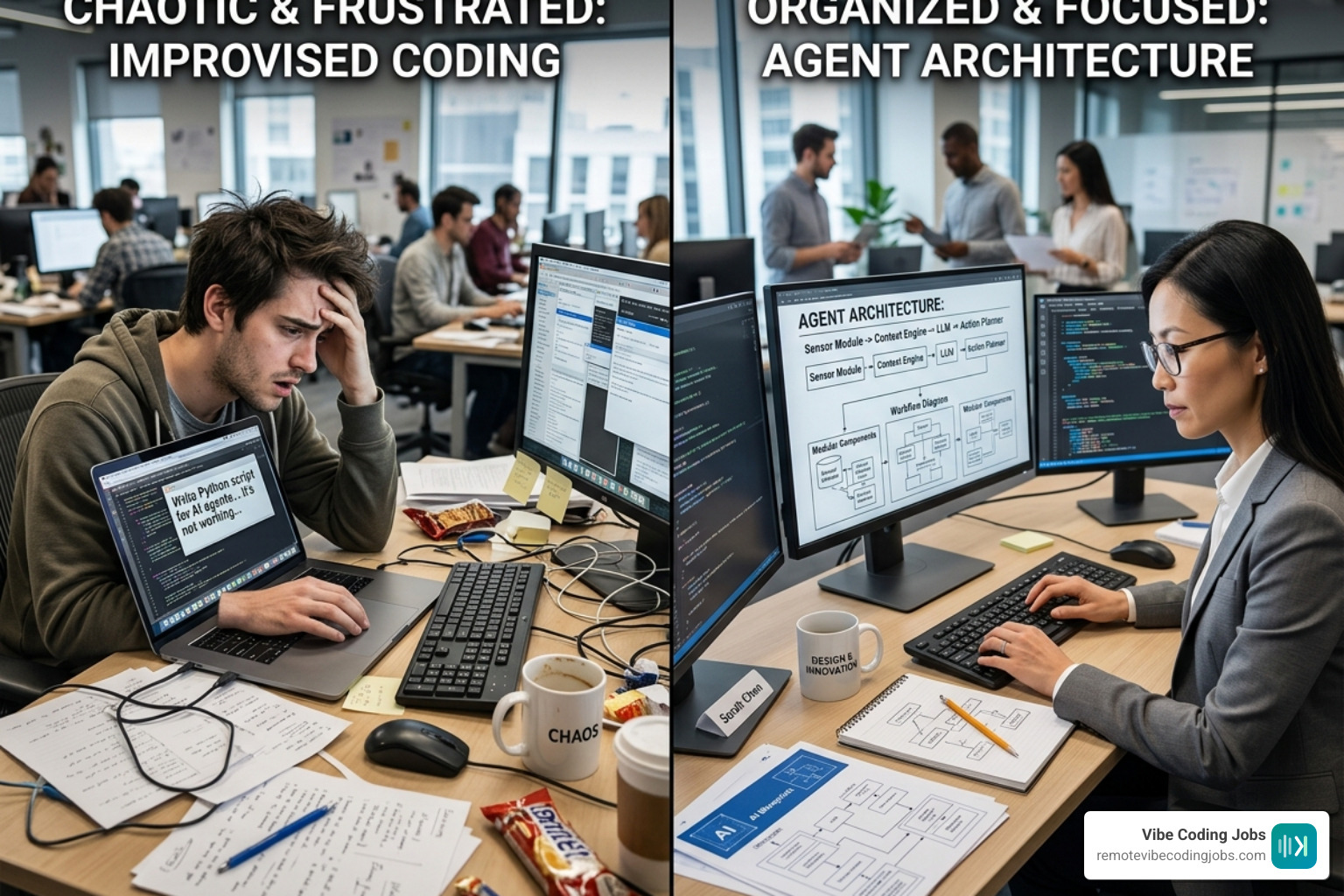
Agentic engineering vs vibe coding comes down to one thing: how much structure and intent you bring before the AI starts writing code.
Here’s the quick answer:
| Vibe Coding | Agentic Engineering | |
|---|---|---|
| Approach | Prompt AI, iterate until it works | Plan first, then direct AI execution |
| Human role | Reactor | Architect and orchestrator |
| Best for | Prototypes, demos, experiments | Production code, team projects |
| Main risk | Technical debt, fragile output | Requires upfront discipline |
| Output quality | Fast but unpredictable | Slower start, more reliable result |
The gap between these two approaches has never been more consequential. AI models can now autonomously plan, write, test, and refactor code across entire codebases. That’s a superpower — if you direct it well. Without structure, it’s just fast-moving chaos.
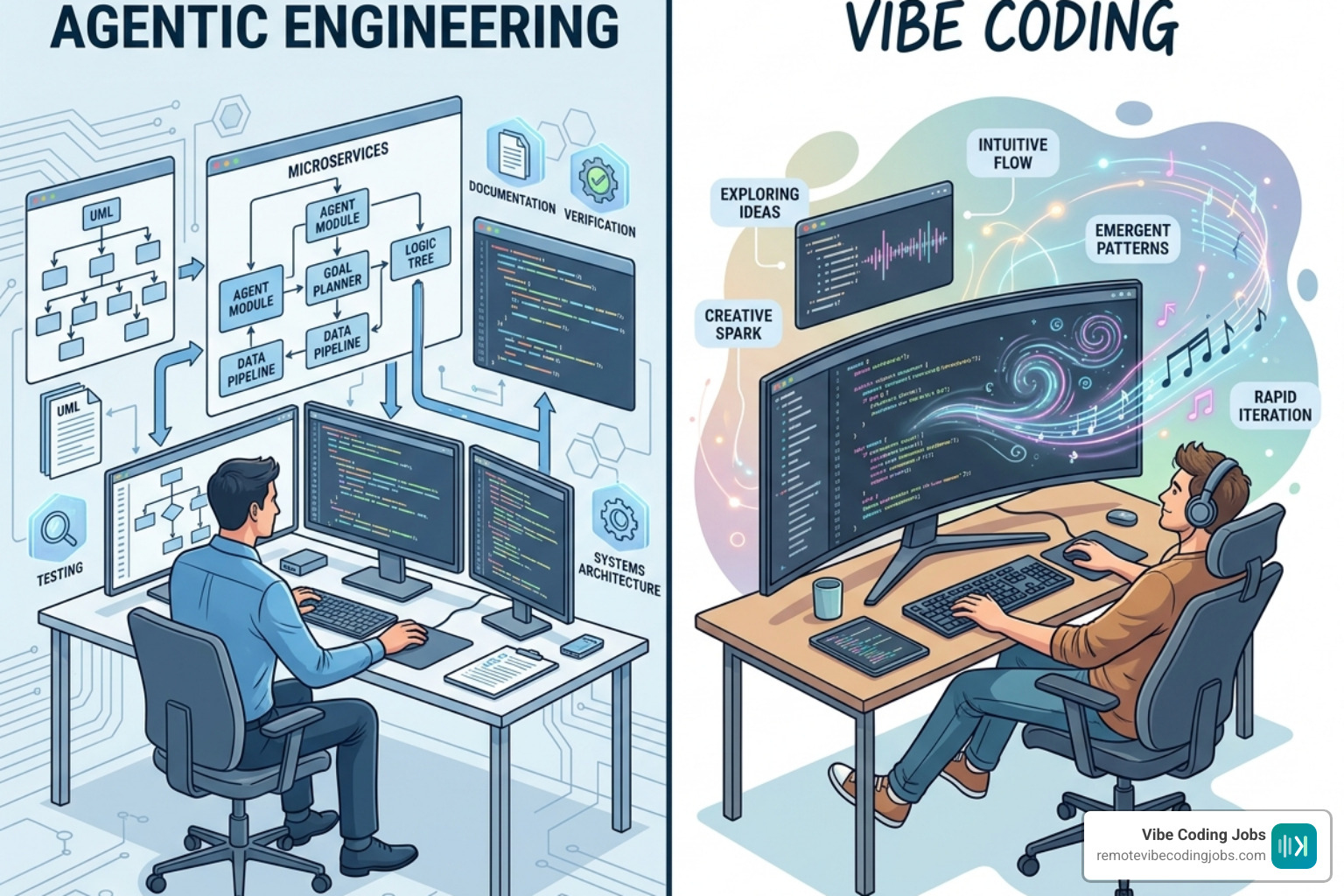
The developer community has been wrestling with this divide since Andrej Karpathy popularized the term “vibe coding” in early 2025 — describing a workflow where you describe what you want, ignore the generated code, and paste error messages back until something works. It spread fast. And so did the debt it left behind.
RVCJ Editorial covers AI-assisted development workflows, remote hiring trends, and the evolving career landscape for developers using tools like Cursor, Claude Code, and Copilot — including the shift from vibe coding to agentic engineering that’s reshaping how teams ship software. If you’re trying to stay competitive in 2026’s AI-native job market, understanding this distinction is non-negotiable.
Defining the Shift: Agentic Engineering vs Vibe Coding
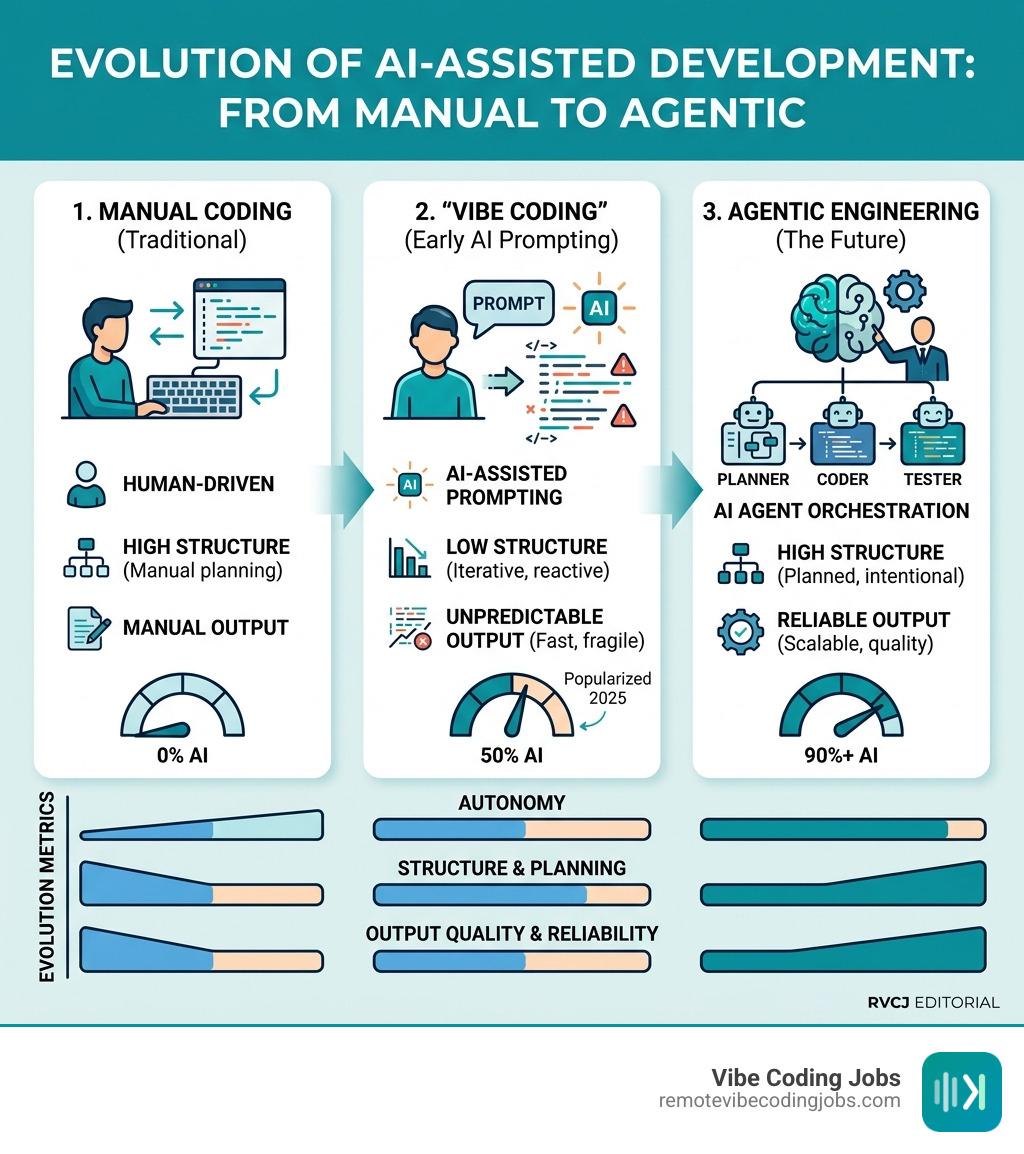
To understand where we are in April 2026, we have to look back at the “Vibe Age” of early 2025. When Andrej Karpathy first coined the term “vibe coding,” it was a celebration of accessibility. Suddenly, anyone with a natural language prompt could manifest an app. You didn’t need to know the difference between a Map and an Object; you just needed to have the right “vibe.”
However, as we’ve moved into more complex enterprise environments, the limitations of this impulsive style have become glaring. Vibe coding is essentially “word-vomit” development. You prompt a model like Claude or GPT, get a block of code, and if it doesn’t work, you just keep spamming prompts or pasting error messages until the red squiggly lines disappear.
This creates what we call “invisible debt.” Because there is no architectural oversight, the AI might suggest a solution that works on localhost but violates security protocols, ignores API rate limits, or uses unsupported DOM manipulations. It’s a “fragile black box” that collapses the moment a real user touches it.
In contrast, agentic engineering vs vibe coding represents a shift toward system thinking. In agentic engineering, the AI isn’t just a autocomplete on steroids; it’s a semi-autonomous collaborator that operates within a system you’ve designed. You aren’t just chatting with a bot; you are orchestrating a workflow that includes context, tools, validation loops, and structured repositories.
As explored in Vibe Coding vs. Agentic Coding: Fundamentals and Practical Implications of Agentic AI, the core difference lies in the locus of agency. In vibe coding, the human is an impulsive reactor. In agentic engineering, the human is a high-level supervisor who defines the mission, sets the constraints, and evaluates the outcomes.
| Feature | Vibe Coding | Agentic Engineering |
|---|---|---|
| Autonomy | Low (Human must prompt every step) | High (Agents plan and execute sub-tasks) |
| Reliability | Low (Trial and error based) | High (Validation loops and testing) |
| Maintainability | Poor (Spaghetti code and debt) | Strong (Strict conventions and docs) |
| Ideal Use Case | Weekend hackathons, learning | Enterprise SaaS, mission-critical infra |
Why Enterprises are Mandating Agentic Standards
Why has the industry pivoted so hard toward agentic standards in 2026? Because “vibes” don’t pass security audits.
Professional developers and enterprises have realized that while vibe coding is great for a demo, it’s a nightmare for production. When you tell a CTO you “vibe coded” the payment gateway, you can practically see their blood pressure rise. Production reliability requires a systematic approach to minimize critical errors.
The productivity stats coming out of early adopters are staggering. Anthropic has reported a ~200% improvement in engineer productivity since the widespread adoption of Claude Code. Even more incredible? Claude Code now accounts for 4% of all public GitHub commits, a number that doubled in just the last month.
Take the example of Boris Cherny, the Head of Claude Code. He hasn’t handwritten code since November—Claude Code authors it all. Yet, he remains one of the most productive engineers at Anthropic, shipping between 10 and 30 Pull Requests (PRs) every single day. This isn’t just about speed; it’s about the ability to maintain high quality while operating at a scale that was previously impossible.
This shift is central to the discussion in Is AI Replacing Developers? The Future of Coding in 2026. The role isn’t being replaced; it’s being elevated. The focus has moved from implementation (typing the code) to ideation, judgment, and discovery. Engineering judgment remains the “head chef” in this kitchen, while the agentic swarm acts as the “sous chefs.”
Enterprises prefer Agentic Engineering: The Future because it optimizes for correctness and maintainability rather than just immediate, flashy output. It forces a “security by design” mindset where constraints are defined before the first line of code is ever generated.
How to Build a Professional Agentic Workflow
If you want to stop being a “slop cannon” and start being an engineer, you need a structured workflow. The goal is to amplify your discipline, not replace it.
A professional agentic workflow typically follows a structured framework like SPARC (Specification, Planning, Architecture, Review, Commit). Instead of jumping straight into a chat window, you treat the AI as a tool within a deliberate engineering process.
This process is explored in detail in How Do AI Coding Agents Work? A Deep Dive for 2026, but the fundamental takeaway is that agents perform better when they have structured input and clear goals.
Step 1: Planning in Agentic Engineering vs Vibe Coding
The biggest mistake vibe coders make is starting with a prompt like “Make me a login page.” An agentic engineer starts with a REQS.md file.
This file serves as the “source of truth.” Before any code is written, you document:
- Feature Goals: Exactly what should this do?
- Architectural Constraints: Which libraries are we using? Are there specific API limits (like Microsoft Graph throttling) we need to avoid?
- Definition of Done: What tests must pass for this to be considered successful?
By taking five minutes to define the scope and boundaries, you avoid the “invisible debt” that comes from the AI guessing your intentions. As noted in The End of ‘Vibe Coding’: Why Agentic Engineering is the New Standard, the thinking happens before the first prompt, not after the tenth iteration.
Ask your agent for a detailed implementation plan based on your REQS.md. Do not let it write code yet. Refine that plan over two or three rounds of discussion. This is where you exercise your engineering judgment—identifying potential edge cases or security flaws before they are baked into the codebase.
Step 2: Execution in Agentic Engineering vs Vibe Coding
Once the plan is solid, you move to execution. This is where tools like Claude Code or Cursor’s multi-file editing capabilities shine.
In the agentic model, you might use a “clean context” agent for execution. This means starting a fresh session where the agent only has the final plan and the relevant files. This prevents “context drift,” where the AI starts hallucinating based on previous failed attempts or irrelevant chat history.
The execution phase in From Writing Code to Managing Agents: New Developer Career Path involves:
- Autonomous Execution: The agent edits multiple files, creates new components, and sets up routing.
- Validation Loops: The agent runs the test suite you defined in Step 1. If a test fails, the agent investigates the logs, fixes the code, and runs the test again—all without you needing to intervene.
- Sub-agent Swarms: For complex tasks, you might have one agent writing the backend logic while another simultaneously generates the unit tests.
This isn’t just “faster” coding; it’s a completely different way of managing the development lifecycle. You are no longer the one typing the syntax; you are the one managing the agents that are typing the syntax.
Essential Tools for the 2026 Agentic Stack
To practice agentic engineering effectively, you need tools that understand more than just the current file. You need tools that understand the entire repository.
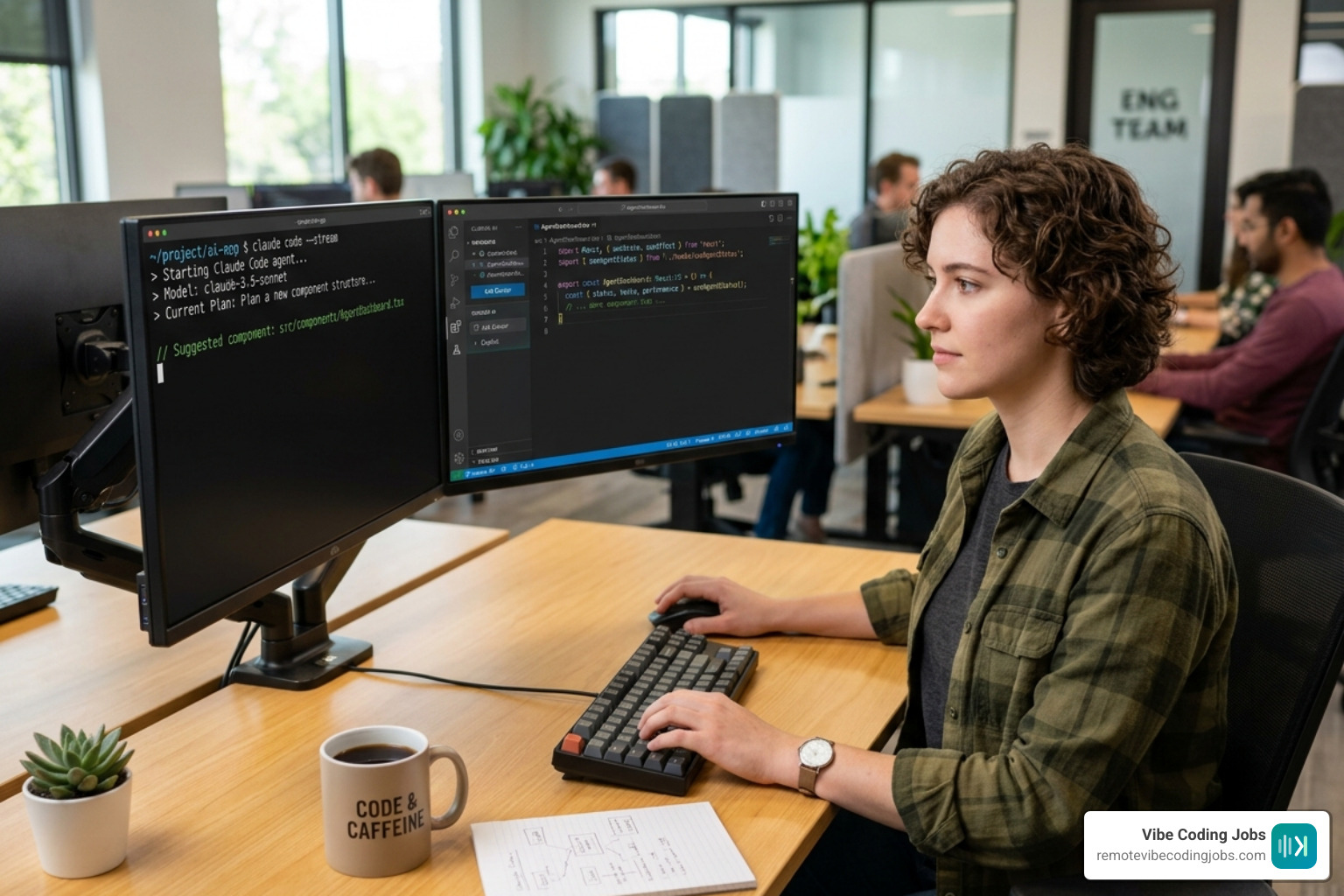
The State of Vibe Coding 2026 report highlights three primary categories of tools:
- Terminal Agents (e.g., Claude Code): These are the most powerful for agentic work. Because they live in your terminal, they can run commands, execute tests, and read files across your entire codebase. Claude Code’s “Extended Thinking” mode allows it to reason through complex migrations or refactors that span hundreds of files.
- AI-Native IDEs (e.g., Cursor, WindSurf): These provide a visual editing experience but are built from the ground up for AI. They offer features like “Composer” for multi-file edits and indexing that allows the AI to “see” your entire project.
- Orchestration Frameworks: For those building their own agentic systems, frameworks like AutoGen or LangGraph allow you to design multi-agent swarms that can handle anything from documentation to CI/CD integration.
A key feature for 2026 is MCP (Model Context Protocol) support. This allows your agents to securely connect to external tools, databases, and APIs. Instead of you having to copy-paste data, the agent can directly query your database or check your cloud logs to diagnose a bug.
Another shift is the use of Headless Mode. Many teams now run agentic tools within their CI/CD pipelines. If a build fails, an agent automatically spins up, reads the error, proposes a fix, and creates a PR for a human to review.
Frequently Asked Questions about Agentic AI
What is the main difference between vibe coding and agentic engineering?
The difference is the level of thought and structure. Vibe coding is impulsive and prompt-driven, focusing on getting something—anything—to run on the screen. Agentic engineering is deliberate and system-driven, focusing on planning, validation, and long-term maintainability. In vibe coding, the AI is a magic wand; in agentic engineering, the AI is a highly skilled but supervised employee.
Can I transition to agentic engineering without a computer science degree?
Absolutely. In fact, many “vibe coders” are finding that they are naturally suited for agentic engineering because they already have the mindset of a “builder.” However, you do need to learn software fundamentals. You don’t need to be an expert in syntax, but you must understand architecture, data structures, and security patterns. The role is shifting from “code typist” to “software architect.”
Is vibe coding still useful for rapid prototyping in 2026?
Yes! Vibe coding hasn’t disappeared; it has simply been relegated to its proper place. It is still the best way to brainstorm, learn a new framework, or build a “throwaway” prototype for a hackathon. If the code doesn’t need to live longer than 48 hours, “vibing” it out is perfectly fine. The danger only arises when you try to ship those vibes into a production environment.
Conclusion: Mastering the AI-Native Career Path
The transition from agentic engineering vs vibe coding is more than just a change in tools; it’s a fundamental mindset shift. To thrive in the 2026 job market, you must move from being someone who “chats with AI” to someone who “orchestrates AI.”
The winners in this new era are the “curious generalists”—developers who can frame broad problems, design robust systems, and use their engineering judgment to verify AI output. You should be building for the model six months from now, not just today.
At RemoteVibeCodingJobs, we see this evolution every day in our curated listings. Companies are no longer just looking for “React Developers”; they are looking for “AI-First Product Engineers” who know how to manage agentic swarms to achieve 10x productivity.
If you’re ready to advance your career, check out our Vibe Coding Career Path Remote guide and explore our daily filtered listings. Whether you’re a senior architect or a self-taught builder, understanding the Vibe Coding vs Traditional Software Engineering: Key Differences is your ticket to staying relevant.
Stop starting with implementation. Start with structure. Don’t just build fast—build responsibly. Your agents are waiting for their orders.