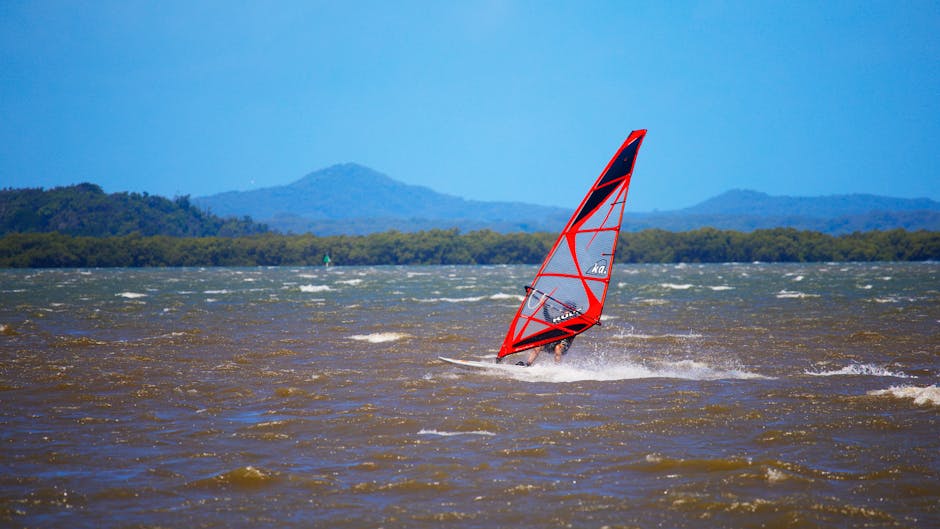
Remote Windsurf Jobs: The 2026 Guide for AI-First Developers
Remote windsurf jobs fall into two distinct categories in 2026 — and knowing the difference matters:
| Type | What It Is | Location | Salary Range |
|---|---|---|---|
| Windsurf (AI editor) roles | Remote dev jobs using Windsurf by Codeium | Fully remote | $90K–$400K+/yr |
| Windsurfing instructor roles | On-site watersports teaching positions | Beach/lake locations | ~€17–€23/hr |
Most people landing here are looking for the first type — remote developer roles at AI-first companies that use the Windsurf code editor. That’s exactly what this guide covers.
The remote tech job market has shifted fast. In 2026, AI-powered editors like Windsurf are no longer optional extras — they’re becoming the baseline expectation at async-first companies. With over 1 million users, 4,000+ enterprise customers, and a stat that turns heads — 94% of code written by AI — Windsurf has carved out a serious position in the modern dev stack.
There are currently 144 remote vibe coding positions listed across major job boards, with 6 Windsurf-specific roles live right now. Whether you’re a full-stack engineer, a product designer, or even a marketer who ships experiments with AI tools, there’s likely a role that fits.
I’m RVCJ Editorial, the team behind Remote Vibe Coding Jobs — we track AI-assisted development trends, curate verified remote windsurf jobs, and help developers navigate the fast-moving world of vibe coding careers. Read on for everything you need to find, qualify for, and land your next remote role.
What is Windsurf and Why is it Dominating Remote Work in 2026?
In the current landscape of April 2026, the Windsurf Editor has emerged as the premier AI-first coding environment. Developed by Codeium, it isn’t just another autocomplete plugin; it’s a comprehensive development platform built on a VS Code foundation that integrates AI into every layer of the coding experience.
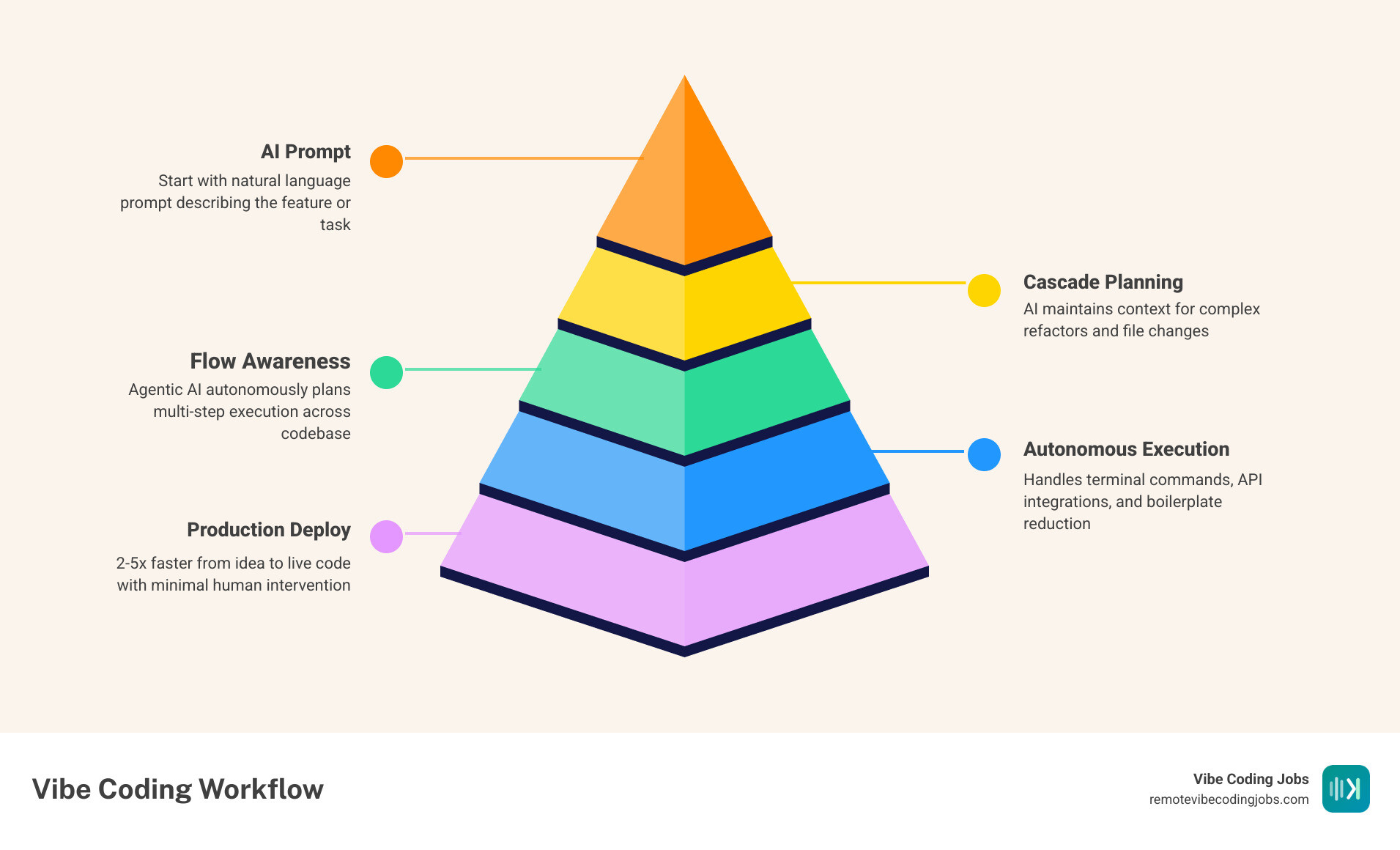
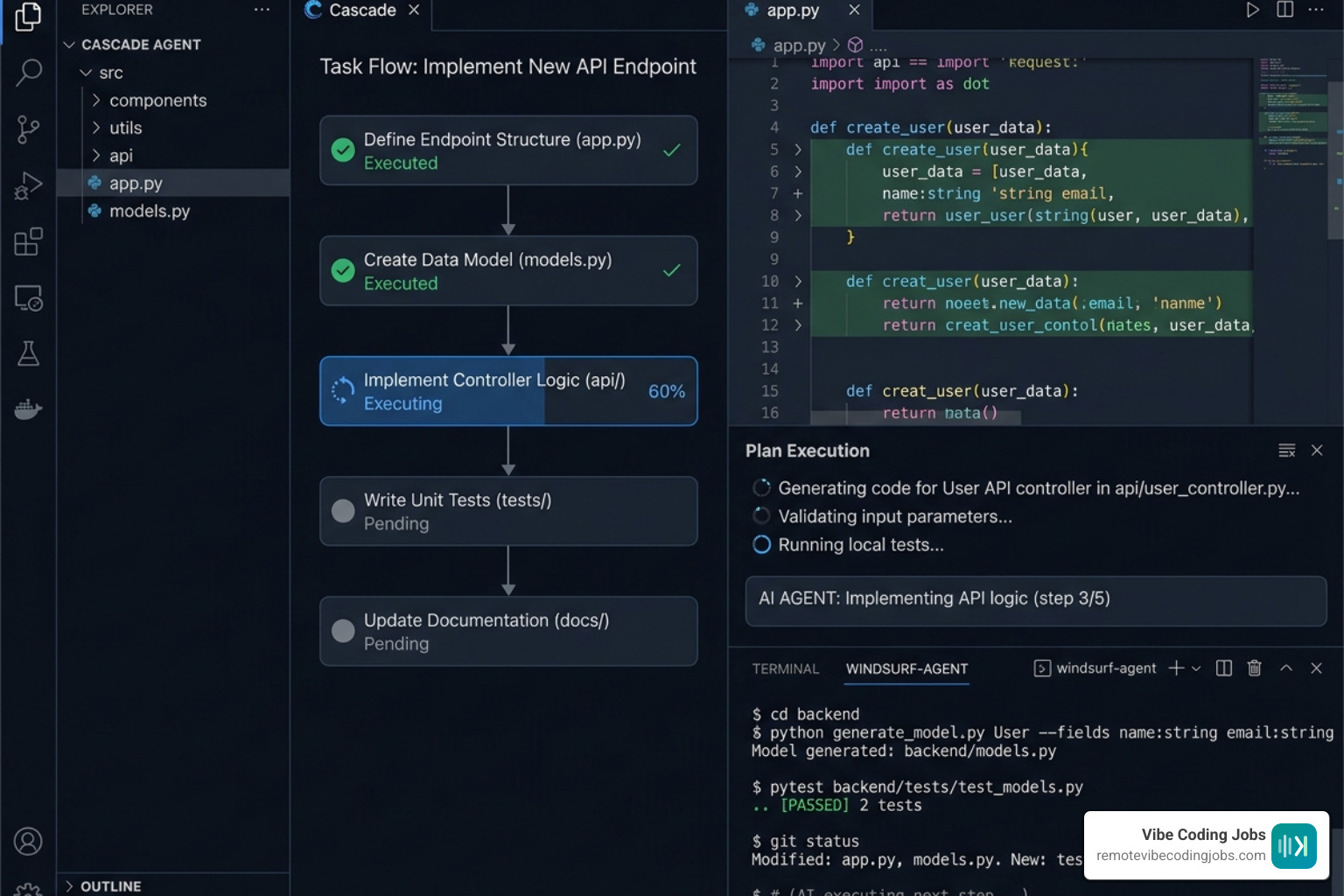
What sets it apart from traditional editors—and even early AI tools—is the Cascade feature. Cascade is an agentic AI that doesn’t just suggest lines of code; it possesses “flow awareness.” It can autonomously plan and execute multi-step tasks across your entire codebase. While other tools might help you write a function, Windsurf can refactor an entire API layer or plan a complex OAuth flow, managing the file changes and terminal commands itself.
For those of us in the remote work space, Windsurf is a game-changer. It allows us to maintain a “pure flow state” by offloading the menial, boilerplate tasks—which, according to recent data, accounts for up to 94% of code written in these environments. This efficiency is why over 1 million innovators and 4,000+ enterprise customers have made the switch.
When you Compare Cursor vs Windsurf, you see that while both are powerful, Windsurf’s strength lies in its agentic capabilities and its hybrid local-cloud agent system. It provides a unified command center where you can manage “Spaces” for specific tasks, making it the ideal tool for high-agency developers who want to spend more time on architecture and less on syntax.
Top Remote Windsurf Jobs and Career Paths
The demand for professionals who can “vibe code”—using natural language and AI orchestration to build software—is exploding. We are seeing a massive shift in how companies hire. They aren’t just looking for “Java Developers”; they are looking for “AI-First Product Engineers” who use Windsurf to ship features 5x faster than traditional methods.
Currently, there are 144 remote vibe coding jobs available globally. These roles are typically found at async-first companies that value output over hours spent at a desk. This shift has opened up a unique lifestyle: the ability to hold a high-paying tech role while living in a coastal windsurfing hub.
Career Diversity in the Windsurf Ecosystem
- Full-Stack AI Engineers: Building complex applications using Next.js, React, and Python, leveraging Cascade to handle the heavy lifting of state management and API integrations.
- AI Developer Productivity Consultants: Helping traditional enterprises transition their teams to Windsurf-based workflows.
- Growth Engineers: Shipping 10+ AI-driven experiments per month by skipping the traditional dev queue.
If you are looking to enter this market, you can find the Best remote Windsurf employees for hire in Mar 2026 | Himalayas to see the types of profiles that are currently winning these roles.
Comparing Remote Tech vs. Traditional Watersports
Many windsurfing enthusiasts wonder if they should stick to the beach or head to the cloud. Here is how the two paths stack up in 2026:
| Feature | Remote Windsurf Dev Job | Traditional Windsurf Instructor |
|---|---|---|
| Location | Anywhere with Starlink/Wi-Fi | Specific beach/lake centers |
| Pay | $90k – $400k+ annually | €17.50 – €22.50 per hour |
| Stability | Year-round, permanent | Often seasonal (March–Oct) |
| Growth | Rapid career scaling | Limited to school management |
| Daily Life | Code in the morning, sail at 4 PM | On the water all day teaching |

Can non-coders apply for remote windsurf jobs?
Absolutely. One of the most exciting trends of 2026 is the democratization of software creation. We see many Job offer – Platform Manager Kitesurfing (remote possible) | bstoked listings and similar roles that require “vibe coding fluency” rather than a Computer Science degree.
- Product Managers: Now use Windsurf to build functional MVPs and high-fidelity prototypes to test ideas before handing them to a core engineering team.
- UX Designers: Use tools like v0 and Windsurf to bridge the gap between Figma designs and production-ready React components.
- Marketing Strategists: Build their own internal tools, scrapers, and automation loops using Claude and Windsurf without waiting for a developer’s help.
The key skill here isn’t memorizing syntax; it’s prompt engineering and having a “product mindset.” If you can describe the logic and the “vibe” of what you want, the AI handles the implementation.
Where are the best platforms to find remote windsurf jobs?
Finding these roles requires looking beyond the generic job boards. You need platforms that understand the “vibe coding” movement.
- RemoteVibeCodingJobs: Our platform specializes in curating roles specifically for those using tools like Windsurf and Cursor.
- Niche Watersports Boards: For those looking for the “Platform Manager” or “School Manager” side of things, the Windsurf Instructor Jobs Category – Surf Jobs is a great place to start, though these are more likely to be on-site.
- Talent Marketplaces: Sites like Himalayas and specialized AI communities are seeing a surge in “AI-Native” job filters.
Essential Skills for Landing Windsurf Developer Roles
While the AI writes the code, the human provides the direction. To land high-paying remote windsurf jobs, you need a specific tech stack and a new set of “soft technical” skills.
The 2026 Tech Stack
- Languages: TypeScript, JavaScript, and Python remain the “Big Three” for AI-assisted development.
- Frameworks: React, Next.js, and Node.js are the standard for rapid prototyping.
- AI Orchestration: Understanding how to use MCP (Model Context Protocol) servers to connect Windsurf to external tools like Slack, Figma, and Stripe.
The “Vibe Coding” Skillset
- Agentic Workflow Management: Knowing how to delegate tasks to Cascade or Devin (the cloud agent) and managing the “Agent Command Center.”
- System Design Thinking: Because the AI can build a feature in seconds, your value shifts to ensuring that feature fits into a scalable, secure architecture.
- Debugging AI-Generated Code: You must be able to read code and spot logic errors, even if you didn’t type every character. This is why understanding Cursor vs Windsurf for Developers in 2026: Which is Best? is crucial—you need to know which tool is best for the specific debugging task at hand.
Salary Expectations and Market Outlook for 2026
The financial outlook for remote windsurf jobs in the tech sector is incredibly strong. Because AI-fluent developers are 2x to 5x more productive, companies are willing to pay a premium.
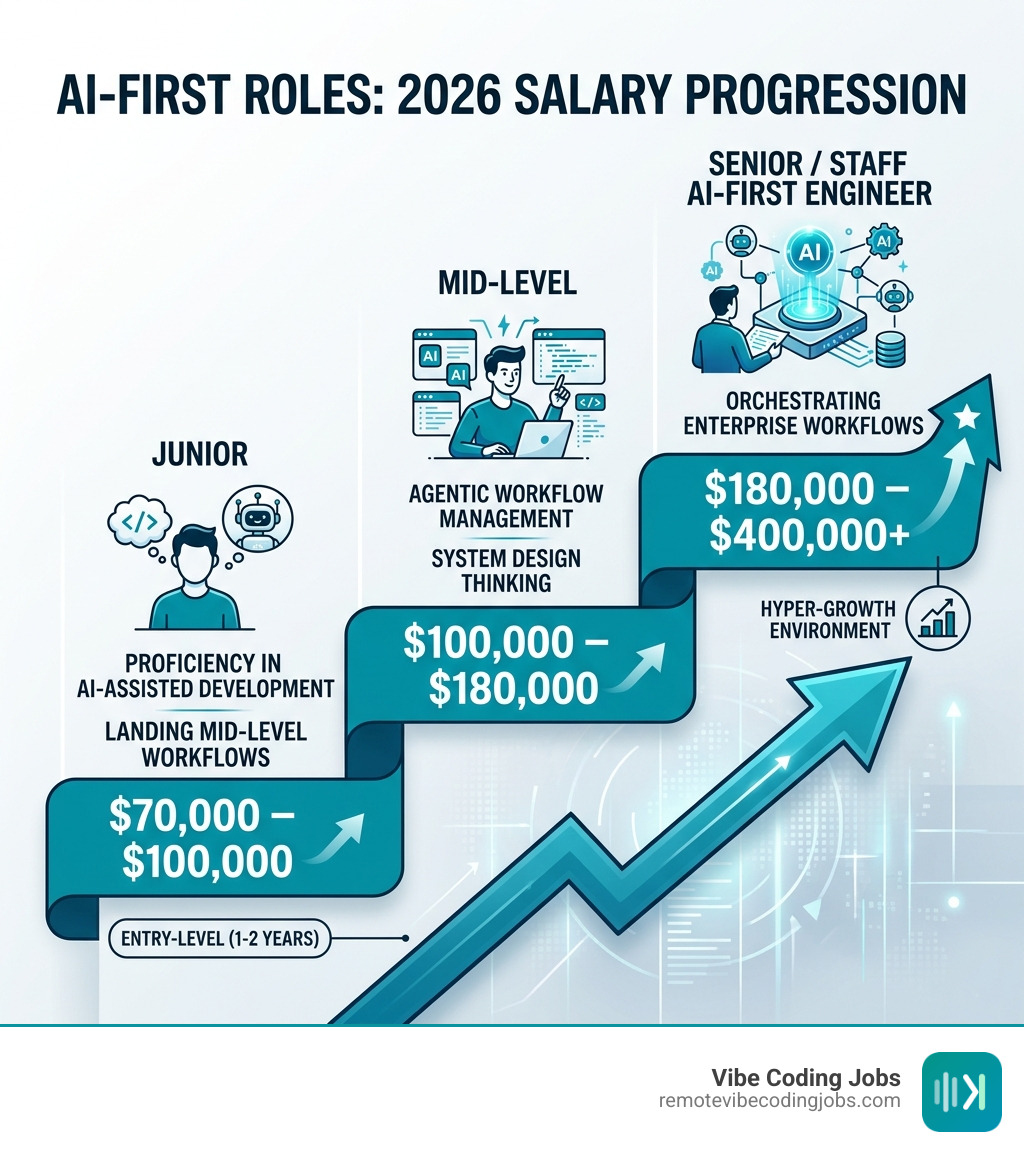
- Entry-Level (1-2 years): $70,000 – $100,000. Even with less experience, proficiency in Windsurf can land you a mid-level salary because you can produce at a mid-level pace.
- Mid-Level: $100,000 – $180,000.
- Senior/Staff AI-First Engineers: $180,000 – $400,000+. Major tech companies and hyper-growth startups are currently in a “vibe coding” arms race.
- Freelance Vibe Coders: Rates typically range from $75 to $150 per hour, with top-tier specialists charging up to $300/hr for rapid MVP builds.
The market outlook for the rest of 2026 and into 2027 is bullish. As more of the 4,000+ enterprise customers currently using Windsurf move their entire workflows to AI-native models, the demand for developers who can orchestrate these agents will only grow.
Frequently Asked Questions about Windsurf Careers
How does the Cascade feature improve efficiency in remote windsurf jobs?
Cascade acts as a local agent that understands your entire project context. Unlike a simple chat window, it can create folders, run terminal commands, and perform codebase-wide refactors. This means a remote developer can handle complex tasks that used to require a whole team. For example, you can tell Cascade to “Add a new billing tier to the entire app,” and it will modify the frontend, the backend API, and the database schema autonomously.
What are the top locations for remote windsurf jobs?
The beauty of a remote role is the ability to live in high-wind destinations. Many Windsurf developers are currently based in:
- Fuerteventura, Canary Islands: Known for year-round wind and a growing digital nomad community. You might even find a JOB OFFER : Kite, Surf & Wingfoil Instructor – Fuerteventura if you want to teach on the side.
- Lake Garda, Italy: Perfect for those who prefer freshwater and mountain views with consistent morning and afternoon winds.
- Jericoacoara, Brazil: A top-tier destination for serious windsurfers with a laid-back lifestyle that suits the “async-first” work model.
Is Windsurf better than other AI code editors for remote teams?
While it often comes down to personal preference, Windsurf is widely praised for its UX and its “Agentic Command Center.” It offers a hybrid approach where local agents (Cascade) and cloud agents (Devin) work together. This is particularly useful for remote teams where a developer might want to delegate a long-running task to a cloud agent while they continue working on the frontend locally. Additionally, the ability to obtain an IKO license or similar certifications in the watersports world is a parallel to how developers are now seeking “AI-First Certifications” to prove their efficiency with Windsurf.
Conclusion
The era of “pure” manual coding is fading, replaced by a more creative, strategic, and efficient era of vibe coding. Whether you are looking for remote windsurf jobs to fund your life on the beach or you want to be at the forefront of the AI revolution, mastering the Windsurf editor is your fastest path to success.
The role of the developer is evolving from a “code typist” to a “software architect.” By leveraging agentic tools, you can future-proof your career and gain the location freedom you’ve always wanted.
Ready to make the move? Find the latest remote Windsurf roles on our curated job board and start your journey toward a high-impact, AI-powered career that lets you catch the wind whenever it blows.