
Your First Python Internships Remote is Closer Than You Think
The Real State of Python Internships Remote in 2026
Python internships remote are genuinely within reach right now — even though they make up a small slice of the total market.
Here’s a quick snapshot to answer your most pressing questions:
| Question | Answer |
|---|---|
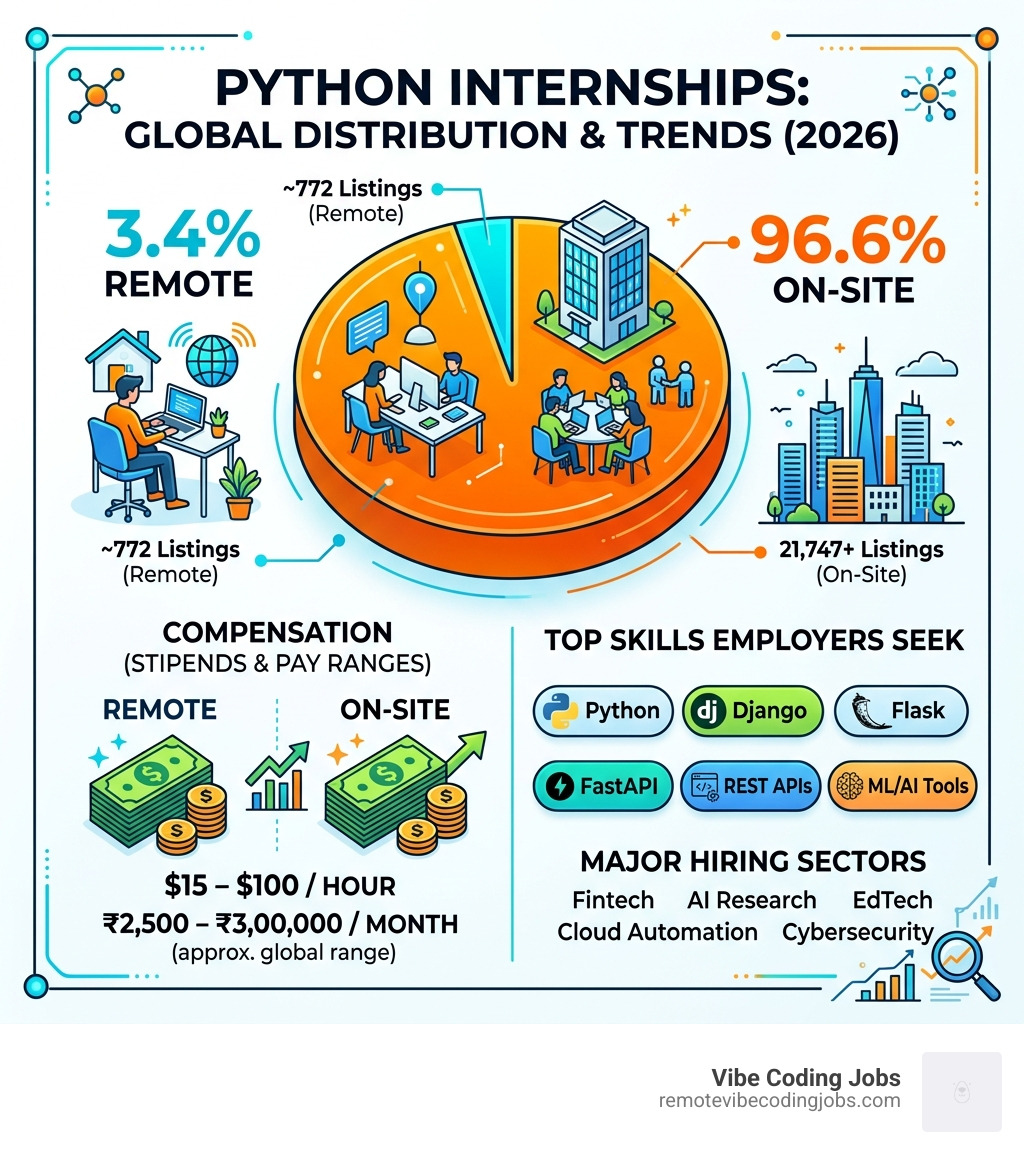
| How many remote Python internships exist in the US? | ~772 out of 22,519 total listings (3.4%) |
| What do they pay? | $15–$100/hour or ₹2,500–₹3,00,000/month (stipends) |
| What skills do employers want most? | Python, Django, Flask, FastAPI, REST APIs, ML/AI tools |
| Who is hiring? | Fintech, AI Research, EdTech, Cloud Automation, Cybersecurity |
| Do you need a CS degree? | Often preferred, but not always required |
The competition is real. Over 1,480 new Python internship listings appear every 24 hours. But only about 1 in 30 of those is fully remote.
That ratio sounds discouraging. It isn’t. It just means you need to know exactly where to look and how to stand out — which is exactly what this guide covers.
I’m RVCJ Editorial, the team behind Remote Vibe Coding Jobs, where we track remote developer hiring trends and AI-assisted development workflows to help engineers land roles that match their stack and work style. We’ve curated and analyzed hundreds of python internships remote to understand what separates applicants who get offers from those who don’t.
The 2026 Landscape for Python Internships Remote
As we move through May 2026, the job market for Python developers is more dynamic than ever. While the total number of Python internship listings in the United States has soared to over 22,500, the “remote” slice of the pie remains exclusive. Our research shows that approximately 772 of these are classified as remote, representing about 3.4% of the total market.

This scarcity doesn’t mean the opportunities aren’t there; it means they are highly concentrated in forward-thinking companies that prioritize async-first communication. Most of these roles are full-time, though we are seeing a rise in part-time “vibe coding” roles where interns contribute to specific AI-driven modules.
To help you understand the financial side, check out Python Engineer Salaries to see how entry-level pay scales as you gain experience. Generally, compensation for a python internships remote varies significantly based on the company’s funding and the technical depth required.
Hourly Rates vs. Monthly Stipends: A 2026 Comparison
| Compensation Type | Typical Range (USD) | Common Industry |
|---|---|---|
| Hourly Rate | $15 – $45 / hour | Standard Software Dev / Web Apps |
| High-End Hourly | $50 – $100 / hour | Specialized AI / ML / Quant Research |
| Monthly Stipend | $500 – $2,500 / month | Startups / International Roles |
| Performance Stipend | $3,000+ / month | Fintech / High-Growth AI |
Top Industries Hiring for Python Internships Remote
Where should you focus your search? In 2026, several industries are leading the charge for remote-friendly Python talent:
- Fintech: High-frequency trading firms and blockchain startups need Python for backtesting and automation.
- AI Research: This is the hottest sector. Companies are looking for interns to help with data pipelines and fine-tuning models.
- Cloud Automation: Organizations like CloudLinux hiring for Python Developer Intern (worldwide remote, work anywhere)) are perfect examples of businesses that allow you to work from literally anywhere while building enterprise-grade infrastructure.
- EdTech: With the rise of personalized AI tutors, EdTech firms are hiring Python interns to build recommendation engines.
- Cybersecurity: Python is the go-to for scripting security audits and automating SIEM platforms.
High-Paying Python Internships Remote in AI and Fintech
If you are looking for the top tier of compensation, AI-specialized roles are where you’ll find rates reaching $50 to $100 per hour. These roles often require more than just basic syntax; they demand an understanding of “Agentic Engineering”—building systems that can think and act autonomously.
We frequently see listings like this Python Engineer Remote role, which looks for interns and juniors capable of working with Large Language Models (LLMs). Many of these high-paying positions also offer “job guarantees” or post-internship offers with annual salaries reaching well into the six figures.
Essential Tech Stacks: Beyond Core Python
Knowing Python 3.12 is the baseline, but the “remote” market in 2026 demands a specific stack. Employers aren’t just looking for someone who can write a script; they want someone who can build a service.
- Frameworks: Django remains the king for enterprise web apps, but FastAPI has become the standard for high-performance AI APIs. Flask is still widely used for lightweight microservices.
- Databases: You should be comfortable with both PostgreSQL (relational) and MongoDB or Pinecone (vector databases for AI).
- Frontend Integration: Most remote Python roles are “backend-heavy full-stack.” Being able to connect your Python logic to a React or Next.js frontend is a massive advantage.
- The Backend Focus: Roles like this Python Backend Engineer Remote highlight the importance of understanding RESTful APIs and cloud deployment.
Mastering AI-Assisted Development for Remote Roles
In 2026, the term “Vibe Coding” has moved from a meme to a legitimate job requirement. At Remote Vibe Coding Jobs, we define this as AI-assisted development where the engineer orchestrates tools like Cursor and Claude to ship code at 10x the traditional speed.

For a python internships remote, mastering these tools is no longer “cheating”—it’s a core competency. Employers now look for:
- Cursor & Claude Mastery: Can you use AI to refactor a legacy Django app in minutes?
- Prompt Engineering: Can you write precise prompts to generate complex data processing pipelines?
- Hugging Face & Transformers: Do you know how to pull a model from Hugging Face and deploy it via a FastAPI endpoint?
- Agentic Workflows: Can you build a Python script that uses an LLM to browse the web, extract data, and save it to a database?
If you want to see what these AI-native roles look like, browse our curated Remote Python Developer Jobs to see how companies are integrating AI tools into their daily tech stacks.
How to Secure Your Remote Python Internship
Landing a python internships remote requires a different strategy than an on-site role. Since you won’t be in the office, your digital footprint is your only resume.
1. Build a “Vibe Coding” Portfolio
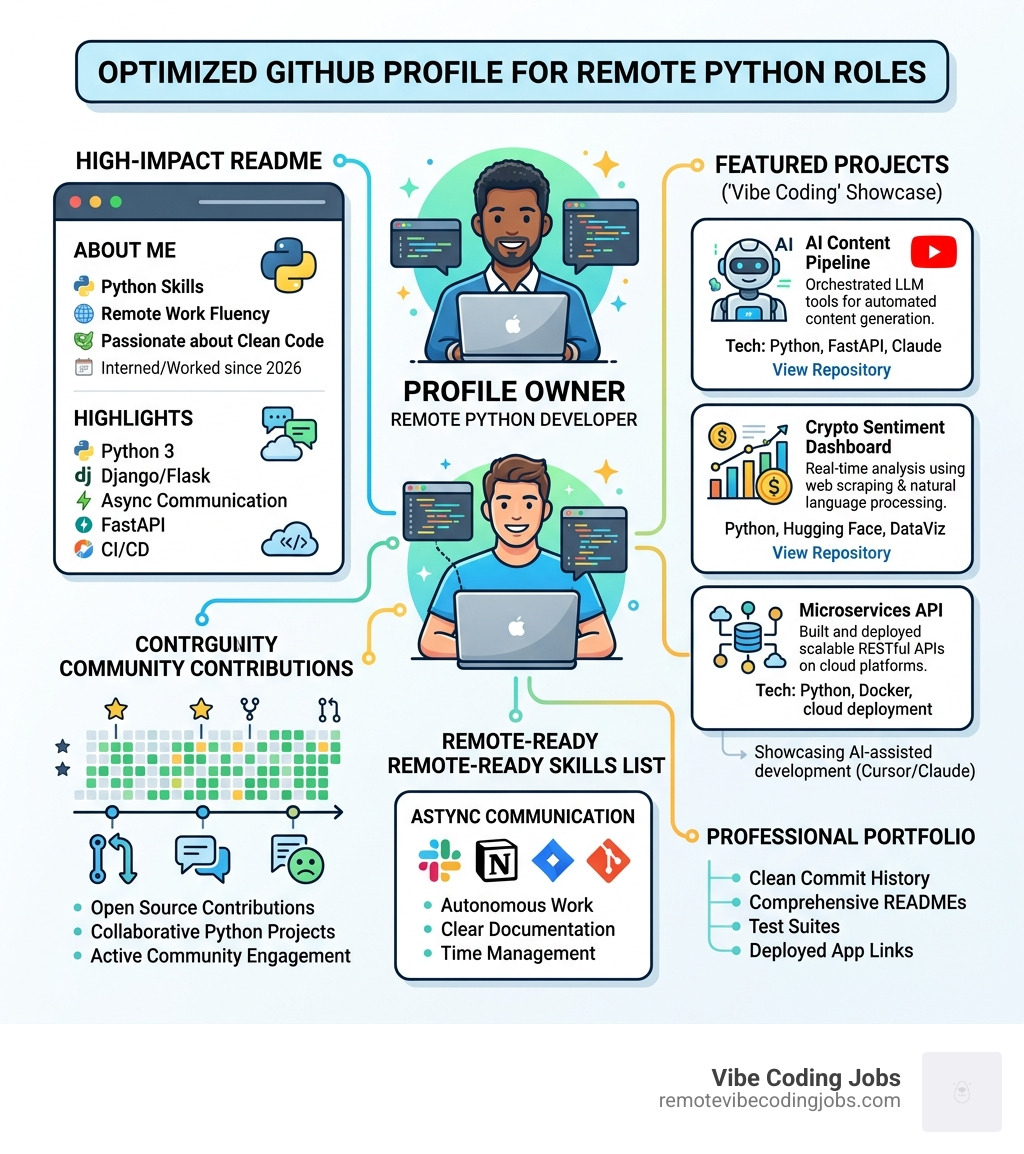
Don’t just show code; show products. Use AI tools to build and deploy 3-5 working applications. A great project would be an “AI-powered YouTube Content Pipeline” or a “Real-time Crypto Sentiment Dashboard.” Host these on GitHub and ensure your READMEs are impeccable.
2. Master Async Communication
Remote teams live and die by documentation. In your interviews, emphasize your ability to work autonomously. Mention your experience with tools like Slack, Notion, and Jira. For those still in school, looking for something like the Summer 2026 CS Internship can provide the structured environment needed to learn these professional habits.
3. Prepare for Technical “Vibe” Interviews
Expect live coding sessions where you might be asked to use an AI assistant. The interviewer isn’t just checking if the code works; they are watching your “vibe”—how you debug AI-generated code, how you verify its security, and how you maintain code quality.
Frequently Asked Questions about Python Internships
What is the typical compensation for remote Python interns in 2026?
In the US market, hourly rates typically fall between $20 and $45 for general roles. However, specialized AI or Fintech internships can pay up to $100/hour. Internationally, monthly stipends range from $500 to $3,000 depending on the company’s location and the intern’s experience level.
Do I need a Computer Science degree to qualify for remote roles?
While many large firms still list a CS degree as a requirement, 2026 has seen a shift. Startups and AI-native companies often prioritize a strong portfolio and “vibe coding” proficiency over a formal degree. If you can prove you can ship production-ready code, you have a fighting chance.
What are the primary responsibilities of a remote Python developer intern?
Your day-to-day will likely include:
- Developing and maintaining RESTful APIs using FastAPI or Django.
- Writing automation scripts for data scraping or cloud infrastructure.
- Participating in async code reviews via GitHub or GitLab.
- Integrating AI models (LLMs) into existing applications.
- Debugging and optimizing database queries.
Conclusion
The path to your first python internships remote is paved with AI tools and async communication skills. While the remote market is competitive, the demand for “AI-native” developers who can leverage Python to build the future is at an all-time high.
At Remote Vibe Coding Jobs, we believe that the traditional way of coding is evolving. By embracing “vibe coding” and focusing on high-growth industries like AI Research and Fintech, you aren’t just looking for a job—you’re starting a career that is future-proof.
Ready to start your search? Check out More info about remote python developer jobs and join the community of developers who are shipping faster and smarter. Your remote office is waiting.