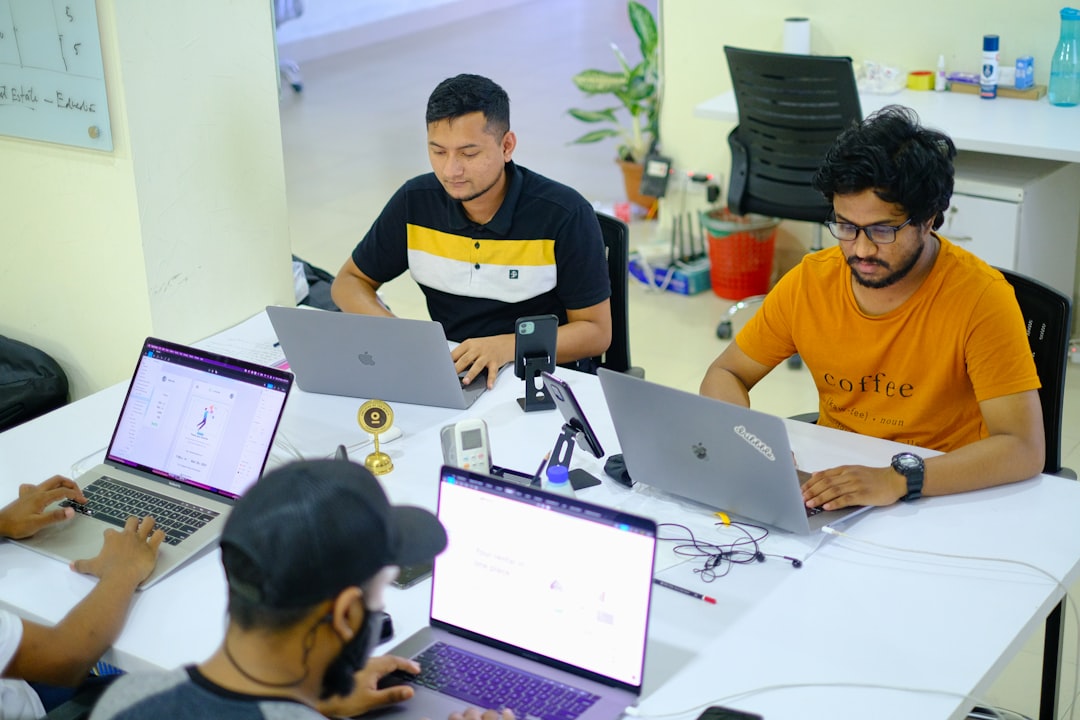
The Lazy Engineer’s Guide to Async AI Development Jobs
What Are Async AI Development Jobs (and Why They’re Booming in 2026)?
Async ai development jobs are remote engineering roles where you work on your own schedule, communicate through written updates instead of constant meetings, and ship AI-powered software without being chained to a 9-to-5 calendar.
Here’s a quick snapshot of what defines these roles in 2026:
| Feature | What It Means for You |
|---|---|
| Async-first culture | 4-5 meetings per week on average, not 4-5 per day |
| AI-native workflows | Daily use of tools like Cursor, Claude Code, and GitHub Copilot |
| Remote by default | ~45.5% of async roles are fully remote, worldwide |
| Strong documentation | Written context replaces real-time verbal handoffs |
| High autonomy | You own your work from design to deployment |
The market is real and growing fast. As of early 2026, there are over 3,620 async-related job listings worldwide, with more than 1,300 posted in a single week. The majority — around 93% — are full-time roles, and salaries range from competitive to exceptional depending on the stack and seniority level.
The appeal is simple: deep focus over constant interruption. One developer on Reddit summed it up well — they’d been at “remote-first” companies that still filled their calendar with unnecessary Zoom calls. Async done right looks very different from that.
But async AI roles aren’t for everyone. They reward developers who write clearly, manage their own time, and know how to use AI tools to move fast without breaking things.
I’m part of the RVCJ Editorial team at Remote Vibe Coding Jobs — we cover AI-assisted development, remote hiring trends, and practical career guidance for engineers navigating async AI development jobs. In the sections below, we’ll break down exactly what it takes to land and thrive in these roles.
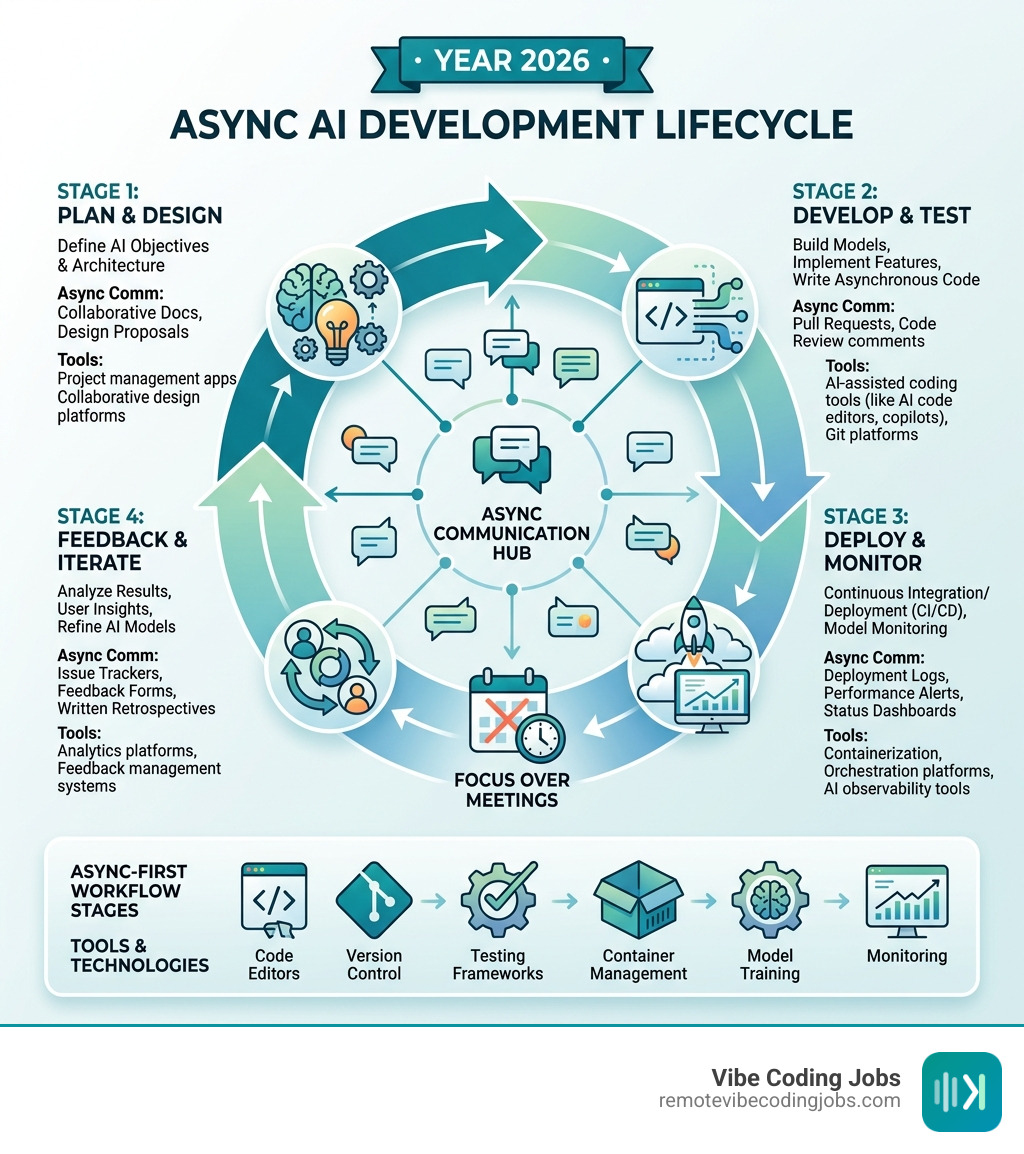
The Tech Stack of High-Velocity Async AI Development Jobs
To thrive in async ai development jobs, you need more than just a passing familiarity with Python. The “lazy” engineer—the one who avoids unnecessary effort by building robust, automated systems—is the one who wins here. In 2026, the tech stack for these roles has evolved to prioritize speed, safety, and seamless AI integration.
Python 3.12+ remains the undisputed king, particularly when paired with Asyncio. Because async teams often build real-time AI features like streaming TTS or voice cloning, mastering asynchronous programming in Python is no longer optional; it is a core requirement. We see a massive surge in roles requiring Pydantic AI for data validation and Model Context Protocol (MCP) to help LLMs interact more effectively with local tools and data sources.
For those looking to push the boundaries of performance, Rust is increasingly appearing in job descriptions for AI infrastructure. Whether you are building high-speed data pipelines or optimizing inference engines, Rust provides the memory safety and concurrency needed for globally distributed systems.
Beyond the languages, you must be comfortable with the “glue” that holds async systems together. This includes:
- FastAPI/Flask: For creating the microservices that serve your models.
- Docker & Kubernetes: Essential for ensuring your code runs the same way in production as it does on your local machine. More info about Docker in async roles.
- Cloud Platforms (GCP/AWS): Most async AI startups live in the cloud, utilizing services like AWS ECS or Google Kubernetes Engine.
- Vector Databases & ClickHouse: For handling the massive amounts of data required for RAG (Retrieval-Augmented Generation) and real-time analytics.

If you’re ready to see who is hiring for these specific stacks, you can Browse Async AI Development Jobs (May 2026) to find your next match.
Mastering AI-Assisted Engineering Tools
In 2026, we don’t just “write” code; we “vibe” with it. Top-tier async ai development jobs now explicitly list AI-assisted tools as a mandatory part of the daily workflow. Tools like Cursor, Claude Code, and GitHub Copilot are the primary pair programmers for the modern engineer.
These tools allow for “agentic workflows,” where you describe a feature or a bug, and the AI handles the boilerplate, the unit tests, and the initial refactoring. This is how small, distributed teams maintain a velocity that rivals much larger, traditional companies.
However, being “efficiently lazy” doesn’t mean being careless. The best developers use these tools to accelerate prototyping but spend their saved time on high-level system design and rigorous code review. You are the architect; the AI is the tireless builder. For a deeper look at how this impacts your day-to-day, check out More info about async workflow and productivity.
Why Web3 and Blockchain Fuel Async AI Development Jobs
There is a significant overlap between the Web3 world and the async AI world. Many decentralized companies were “born async” and have spent years perfecting the art of global collaboration. Companies like Consensys have paved the way, offering Senior Software Engineers salaries ranging from $104,000 to $156,000.
In the Web3 sector, Solidity and Rust are common, but the real synergy lies in “Decentralized AI.” These projects often use blockchain for salary transparency, equity distribution, and securing the data used to train models. If you are a DevOps engineer in this space, you can expect ranges between $73,000 and $110,000, with a heavy focus on AWS and infrastructure as code. For those working with high-performance data layers, More info about Redis in async stacks is a great resource to understand how these technologies scale.
Navigating the Workflow: Documentation-First and Deep Focus
The secret sauce of successful async ai development jobs isn’t a tool—it’s a culture. When you can’t tap a colleague on the shoulder, documentation becomes your lifeline. A “documentation-first” culture means that every decision, every architectural change, and every sprint goal is written down in a way that is clear and searchable.
We use tools like Linear for task tracking and Slack (often with async standup integrations) to keep the pulse of the team without demanding an immediate response. This environment creates “Deep Focus” blocks—uninterrupted hours where you can actually solve hard AI problems instead of bouncing between “quick syncs.”
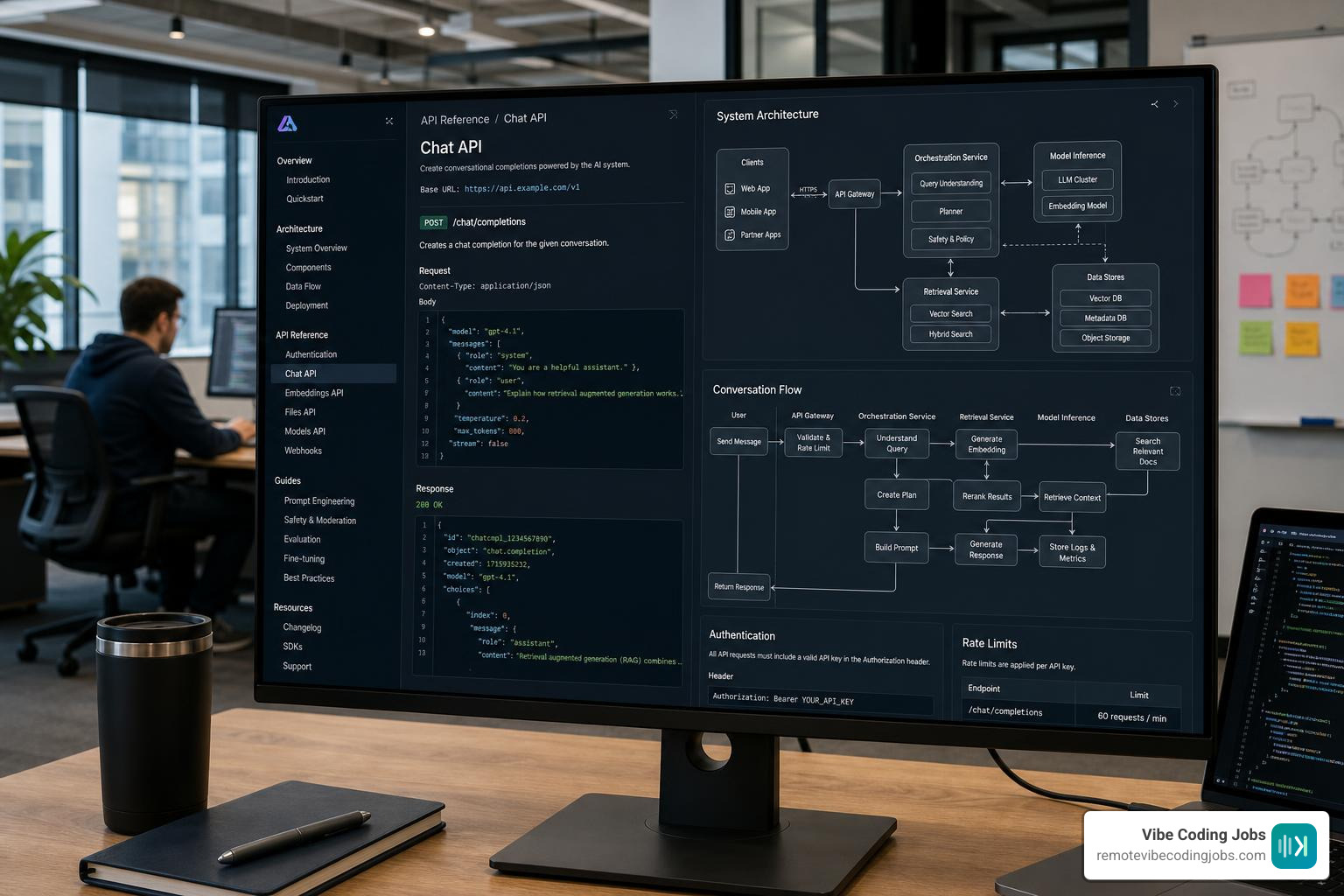
The transition from synchronous to asynchronous can be jarring. To help visualize the difference, we’ve put together this comparison:
| Feature | Synchronous AI Workflow | Asynchronous AI Workflow |
|---|---|---|
| Communication | Instant pings, Zoom calls | Detailed PRs, Loom videos, Slack threads |
| Knowledge | Tribal, lives in people’s heads | Documented in Notion, GitHub, or Wiki |
| Problem Solving | “Let’s hop on a call” | “Here is a write-up of the issue” |
| Productivity | Fragmented by interruptions | Long stretches of deep work |
| Accountability | Attendance-based | Result-based |
To master this, you need to be a strong writer. As we often say, More info about async communication is the foundation of any remote career.
Balancing Focus with Periodic Sync Touchpoints
“Asynchronous” does not mean “never talking.” Even the most decentralized AI teams need a heartbeat. We typically see a balance where teams have 4 to 5 meetings per week, totaling about 5.5 hours of video time.
These touchpoints are usually reserved for:
- Sprint Planning: Aligning on the “what” and “why” for the next two weeks.
- 1:1s: Focusing on personal growth and unblocking long-term hurdles.
- Postmortems: Discussing what went wrong when a production system failed.
Many companies implement “Meeting-Free Wednesdays” or “Focus Fridays” to protect developer time. Others use video updates (like Loom) for mid-sprint reviews, allowing teammates to watch and comment whenever it fits their timezone. This flexibility is a hallmark of the flexible hours culture that makes these jobs so desirable.
Overcoming Challenges in Distributed AI Systems
Building real-time AI is hard. Building it with a team spread across 12 timezones is even harder. When working on low-latency systems like voice cloning or real-time transcription, the technical challenges are compounded by the async model.
How do you handle a production outage at 3 AM in London when the lead engineer is in San Francisco? The answer lies in on-call rotations and a “follow-the-sun” support model. Async AI companies invest heavily in automated monitoring (Datadog, Prometheus) and clear SLIs/SLOs to ensure the system heals itself when possible.
For a Senior Machine Learning Engineer, the job isn’t just about the model—it’s about the reliability of the endpoint. You’ll likely be working with Kubernetes in production to manage scaling and ensure that your AI services stay up regardless of where the traffic is coming from. If you’re looking for these high-stakes roles, check out the Latest Async AI Engineer Roles.
Autonomy and the Pitfalls of Micromanagement in Async AI Development Jobs
The biggest killer of async culture is “message-based micromanagement.” This happens when a manager replaces a 30-minute meeting with 300 Slack messages, demanding instant replies.
In a true async environment, trust is the default. You are hired as an Individual Contributor (IC) with the expectation that you can manage your own queue. This requires a high level of seniority—not necessarily in years of experience, but in “self-management” skills. You need to be able to make decisions without waiting for a “thumbs up” from a boss who is currently asleep.
However, this doesn’t mean juniors are left in the dark. Successful teams provide mentorship through detailed code reviews and “pair programming” sessions that are scheduled intentionally, rather than as a reaction to a crisis. For more on how to spot a healthy team, read More info about async culture.
Frequently Asked Questions about Async AI Careers
Is the async model viable for junior AI engineers?
It can be, but it’s a steep learning curve. Most async ai development jobs (about 93% of senior roles) require at least 3+ years of experience in ML or backend-ML hybrid roles. For a junior, the lack of real-time “over the shoulder” guidance can be isolating. However, if a company has a stellar documentation culture and a dedicated mentorship program, a self-motivated junior can thrive by consuming the existing knowledge base and contributing to well-defined tasks.
What are the standard non-technical benefits for AI startups?
Top-tier async AI startups offer more than just a paycheck. Standard benefits in 2026 include:
- Professional Development Budgets: Often $2,000+ per year for courses, books, or conferences.
- Flexible Scheduling: Work when you are most productive, whether that’s 5 AM or 11 PM.
- Generous Leave: Policies often include up to 40 paid days off per year or “unlimited” sick leave.
- Home Office Stipends: To ensure your “tropical location” or home office has the best gear. You can find more details on these perks at More info about async benefits.
How do async teams handle critical production incidents?
They use a “Follow-the-Sun” model. By hiring engineers across various timezones, there is almost always someone “online” during their normal working hours to handle an incident. Teams use automated alerting systems that page the person currently on shift. Once the fire is out, the responder writes a detailed postmortem so the rest of the team can learn from the event asynchronously.
Conclusion
The era of the “Lazy Engineer”—the one who uses AI to automate the boring stuff and async workflows to protect their time—is officially here. Async ai development jobs offer a level of freedom and focus that was unimaginable a decade ago.
By mastering the right tech stack (Python, Asyncio, Rust), embracing AI-assisted tools like Cursor, and leaning into a documentation-first mindset, you can build a career that fits your life, not the other way around. Whether you are interested in Web3, real-time voice tech, or agentic workflows, the opportunities are vast and growing.
Ready to skip the LeetCode grind and start shipping? Join the community of AI-powered developers and Find your next AI Engineer role today.