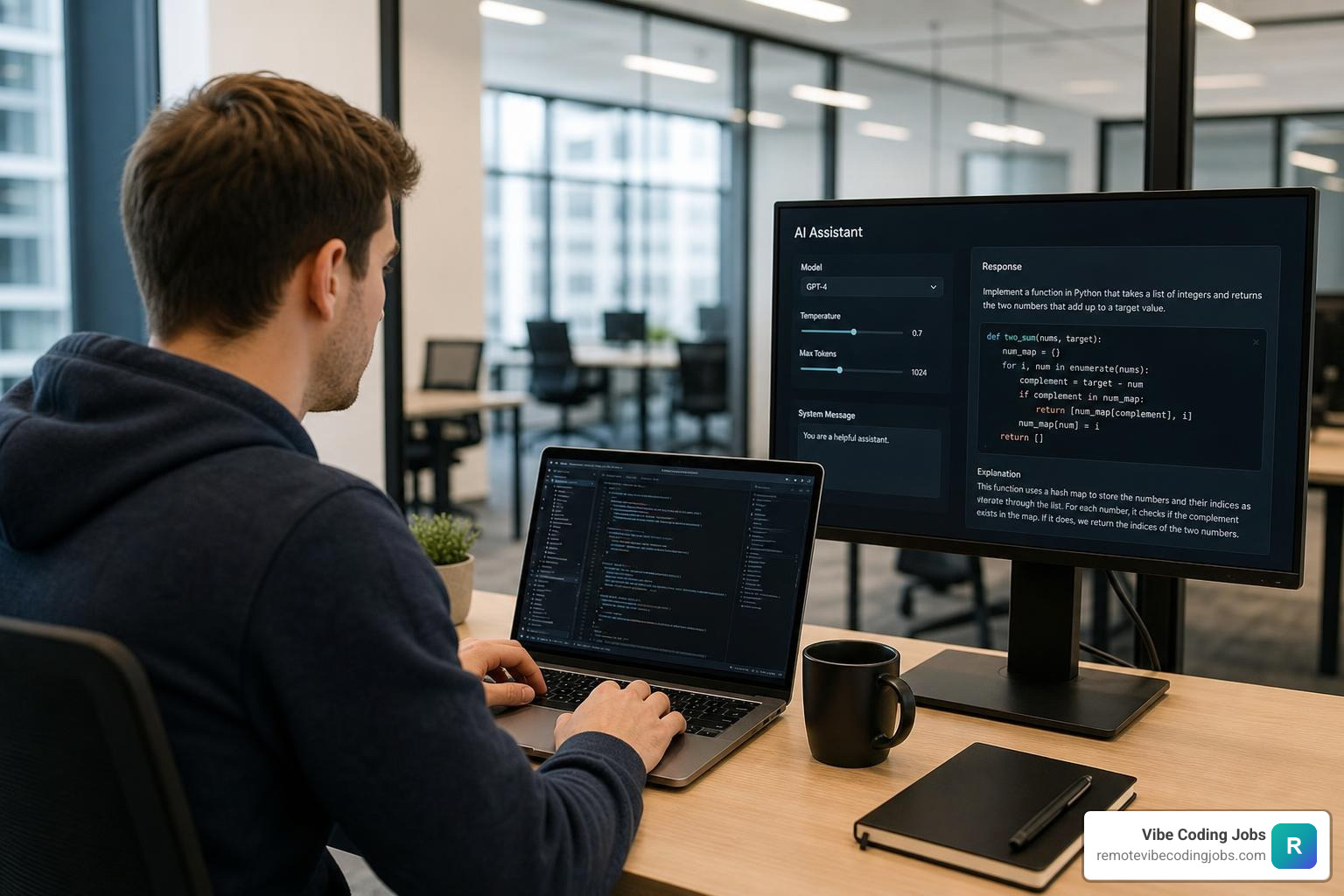
Your Roadmap to Landing Claude AI Developer Positions in 2026
Claude AI Developer Positions Are One of 2026’s Fastest-Growing Career Paths
Claude AI developer positions are multiplying fast — and the salary upside is real.
Here’s a quick snapshot of what you need to know:
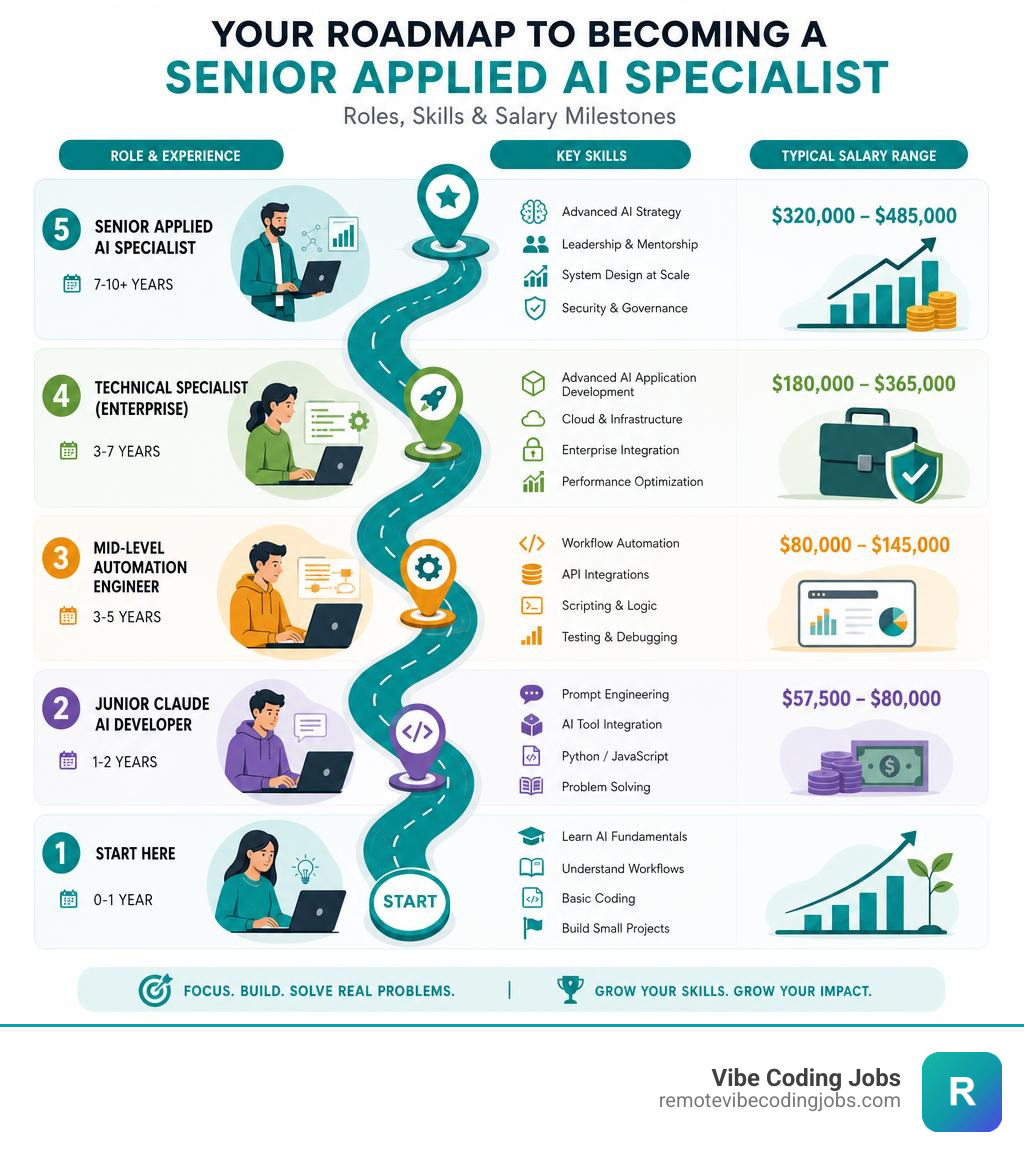
| Role Type | Experience | Typical Salary Range |
|---|---|---|
| Junior Claude AI Developer | 1-2 years | $57,500 – $80,000 |
| Mid-Level Automation Engineer | 3-5 years | $80,000 – $145,000 |
| Technical Specialist (Enterprise) | 3-7 years | $180,000 – $365,000 |
| Staff / Senior Platform Engineer | 7-10+ years | $320,000 – $485,000 |
| Freelance / Contract (global) | Varies | $30 – $300/hour |
The average Claude AI developer salary sits around $88,968 per year, but roles at Anthropic itself — like Staff Software Engineer on the Claude Developer Platform — can pay up to $405,000.
This isn’t just a few niche postings. Anthropic currently has 67 open AI Research & Engineering roles and 31 Applied AI roles. Beyond Anthropic, companies across industries are hiring developers to build Claude-powered agents, automate workflows, and drive enterprise adoption of AI tools. Freelance platforms like Upwork list over 1,200 active AI jobs with Claude skills explicitly valued.
The demand is broad. The roles range from junior agent builders to enterprise technical specialists who run live-coded demos for engineering organizations. The common thread? Hands-on experience building real things with Claude.
We are RVCJ Editorial, the team behind Remote Vibe Coding Jobs — we cover AI-assisted development careers, remote hiring trends, and practical job-search guidance for developers working with tools like Claude, Cursor, and Copilot, including curating and analyzing claude ai developer positions across global markets. In this roadmap, we’ll walk you through every layer of this career path — from the skills you need to the roles that pay the most.
Learn more about claude ai developer positions:
What Claude AI Developer Positions Actually Involve in 2026
To land one of these coveted claude ai developer positions, you first need to understand what the day-to-day work looks like. Companies aren’t just looking for people who can write clever prompts in a chat window. They want specialists who can build robust, production-grade systems powered by the Anthropic API.
Core Responsibilities in Claude AI Developer Positions
As a developer specializing in Claude, your primary mandate is to turn raw LLM capabilities into reliable business software. This involves:
- API Integration: Writing clean backend code (typically Python or Node.js) that manages the full lifecycle of Anthropic API requests, handles rate limits, and parses JSON outputs.
- Agentic Workflows: Constructing multi-step autonomous workflows where Claude uses tool calling (function calling) to interact with external databases, CRMs, and third-party APIs.
- RAG Systems: Designing Retrieval-Augmented Generation architectures to supply Claude with relevant contextual documents, minimizing context window bloat and keeping costs manageable.
- Production QA and Monitoring: Implementing strict validation layers, error handling, and logging to catch hallucinations, format breaks, or API downtime before they reach users.
Day-to-Day Tasks: From Prompt Experiments to Production Agents
If you step into one of these roles, your typical day might look like this:
- Iterating on Prompts: Testing system prompts, context constraints, and temperature settings to optimize Claude’s response formats.
- Workflow Mapping: Translating a manual business process (like onboarding a new customer or analyzing a legal contract) into a structured sequence of agentic steps.
- Writing Glue Code: Connecting the Anthropic API to your database or web applications.
- Benchmarking Model Tiers: Deciding whether a task requires the deep reasoning of Claude Opus, the balanced performance of Claude Sonnet, or the rapid, cost-effective execution of Claude Haiku.
- Collaborating on Demos: Building rapid prototypes to show internal teams or enterprise clients how Claude can solve their specific operational bottlenecks.

How Claude Roles Differ From General AI, ML, and Chatbot Jobs
It is easy to confuse Claude AI developer roles with adjacent tech positions, but the differences are distinct:
| Feature | Claude AI Developer | General AI / ML Engineer | Traditional Chatbot Developer |
|---|---|---|---|
| Primary Focus | Applied orchestration, API integration, and agentic workflows using Claude models. | Training, fine-tuning, and deploying custom machine learning models. | Building rigid, rule-based decision trees and simple intent-matching flows. |
| Required Math | Basic logic, token economics, and semantic vector mathematics. | Heavy linear algebra, calculus, and statistical modeling. | None. Mostly conditional logic and basic string matching. |
| Core Tools | Anthropic API, LangChain, LlamaIndex, Cursor, Claude Code. | PyTorch, TensorFlow, AWS SageMaker, CUDA, Pandas. | Dialogflow, ManyChat, basic regex, visual flow builders. |
| Speed to Market | Days to weeks (rapid prototyping and prompt-driven MVPs). | Months to years (long training runs and data collection phases). | Days (simple conversational scripts). |
Skills, Tools, and Experience Needed for Claude AI Developer Positions
To clear the hiring bar for claude ai developer positions, you need a balanced blend of traditional software engineering and modern AI engineering. Let’s break down the exact stack employers are looking for, which we also detail in our guide on Remote AI Developer Jobs Requirements.
Technical Skills Employers Expect in Claude AI Developer Positions
You do not need a PhD in Machine Learning, but you must be a highly competent software engineer. The baseline technical stack includes:
- Programming Languages: Deep proficiency in Python or TypeScript/JavaScript.
- Web Development Frameworks: Experience with FastAPI, Django, Express, or Next.js to build the applications wrapping your AI features.
- Database Management: Comfort with SQL (PostgreSQL, MySQL) and NoSQL databases, alongside vector databases (Pinecone, Weaviate, pgvector) for managing embeddings.
- DevOps & Version Control: Git workflows, CI/CD pipelines, and basic cloud infrastructure (AWS, GCP, or Vercel) to deploy your agents securely.
LLM-Specific Skills That Make Candidates Stand Out
To move beyond junior-level considerations, you should master the following LLM-specific concepts:
- Advanced Prompting: Mastery of system prompts, XML tagging (which Claude is uniquely optimized to parse), few-shot examples, and chain-of-thought prompting.
- Model Context Protocol (MCP): Understanding how to build and connect MCP servers to allow Claude to read databases, run local terminal commands, and navigate file systems.
- State Management & Memory: Building mechanisms that allow long-running agents to remember past interactions and maintain state across multi-turn conversations.
- Evaluation Frameworks: Using tools to quantitatively measure prompt changes and agent accuracy against fixed evaluation datasets, rather than relying on manual “vibe checks.”
Portfolio Projects That Prove You Can Do the Work
Nothing proves your capabilities faster than a public GitHub repository containing a live, working demo. When building your portfolio, focus on projects that solve real business problems:
- Autonomous Department Agent: Build a system of coordinated agents that replicates a department function (e.g., a marketing assistant that pulls CRM data, drafts content, and sends email reports).
- Interactive Document Assistant: Build a RAG-powered application that lets users upload complex PDFs and query them using Claude, utilizing structured output to generate clean summaries.
- Developer CLI Tool: Build a terminal application using Claude Code or the Anthropic API to automate routine coding tasks like generating unit tests or scanning for security vulnerabilities.
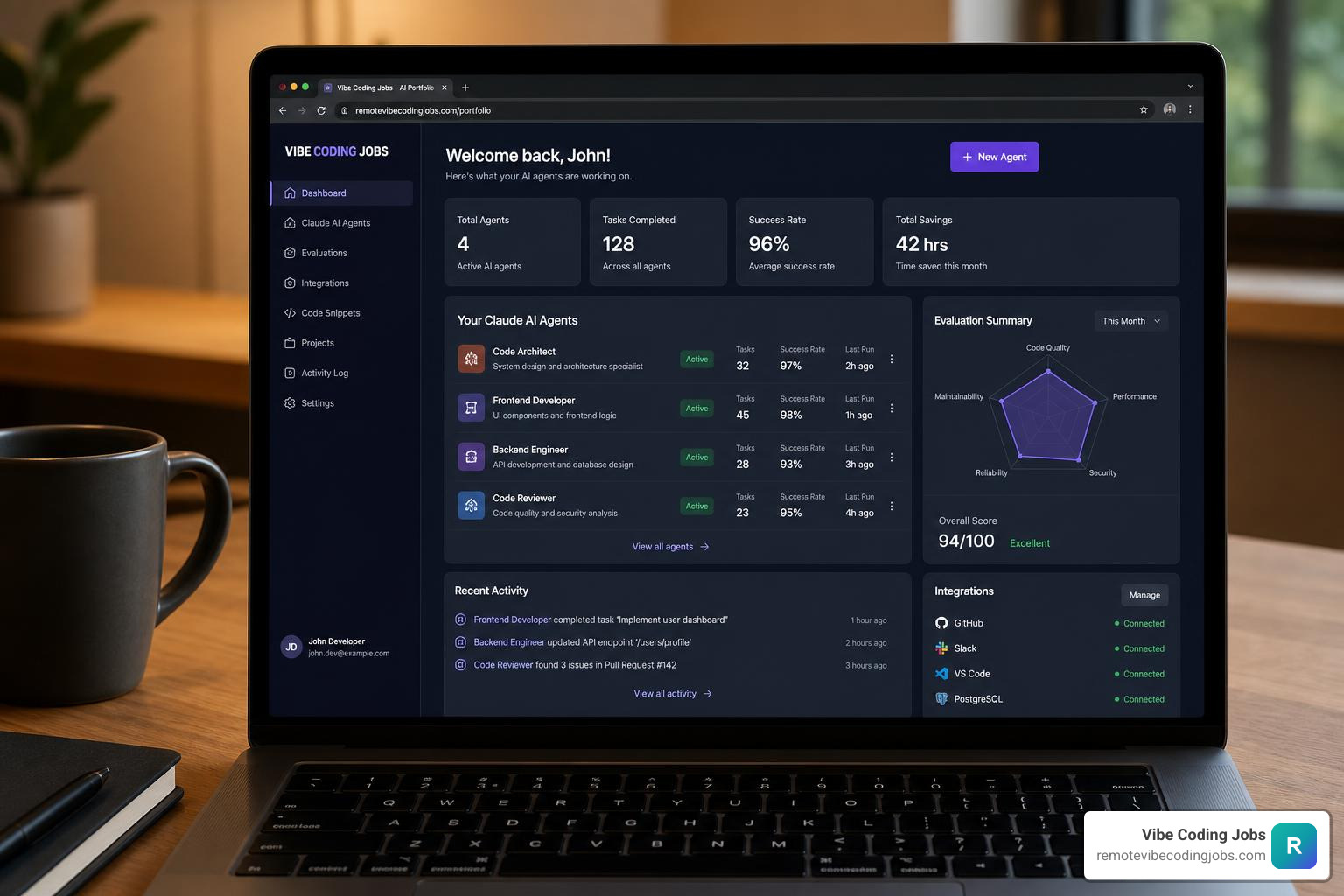
These projects showcase your ability to combine the Essential AI Tools for Vibe Coding into cohesive, production-ready systems.
The Most In-Demand Claude AI Developer Role Types
As the market matures, claude ai developer positions are branching into distinct specializations. Depending on your background and interests, you can target several different career paths.
Technical Specialist and Enterprise Enablement Roles
This role is the bridge between product capabilities and developer adoption. For example, Anthropic regularly hires for roles like the Job Application for Technical Specialist, Claude Code at Anthropic.
In this position, you are not just writing code in isolation; you are driving deep adoption of tools like Claude Code inside major enterprise accounts. This involves delivering live-coded demos, running architectural workshops, and building reference implementations tailored to client codebases. It requires high technical credibility, strong customer empathy, and the ability to explain complex agentic patterns to engineering leaders.
Claude Agent Developer and AI Automation Roles
These positions focus on building the “connective tissue” of modern businesses. An excellent example of this is the Claude AI Agent Developer – Berry Virtual role, where developers are tasked with designing and deploying suites of autonomous agents to replicate standard operating procedures (SOPs).
Your work here involves building tool integrations, managing agent memories, conducting prompt audits, and tracking adoption metrics to ensure the AI agents are actually saving human staff time.
Claude Code, Developer Platform, and Full-Stack Product Roles
If you prefer building developer tools rather than end-user applications, platform roles are your best bet. Anthropic’s own team hires engineers to build the infrastructure that other developers rely on, such as the Staff Software Engineer, Claude Developer Platform (Full Stack) job in San Francisco, CA, United States at Anthropic or roles focused on CLI tools like Software Engineer — Claude Code at Anthropic · $200k–$350k — AI Dev Jobs .
These positions require deep expertise in React, Next.js, and TypeScript to build intuitive developer consoles, manage API latency, and construct the SDKs and IDE extensions that power modern “vibe coding” workflows. To understand how these tools fit into the modern developer’s toolkit, check out our deep dive on Claude Code vs Copilot for Developers in 2026: A Deep Dive.
Salary, Compensation, and Remote Work Outlook
The financial rewards for specializing in Claude development are substantial, reflecting the high demand and scarcity of practical AI engineering talent. For a broader analysis of the market, read our guide on Remote AI Developer Jobs Tools Salary.
Typical Salary Ranges by Experience Level
Salary bands for claude ai developer positions scale rapidly based on your experience and the complexity of the systems you build:
- Entry-Level / Junior AI Developer: Typically ranges from $57,500 to $122,000 annually, with a national average of $88,968. These roles focus on basic prompt design, API calls, and simple workflow automation.
- Mid-Level AI & Automation Engineer: Ranges from $120,000 to $200,000. These developers own full integrations, build complex RAG pipelines, and manage agent databases.
- Enterprise Technical Specialist: Ranges from $180,000 to $365,000. These roles demand excellent communication skills alongside deep technical capability.
- Senior / Staff Software Engineer (Platform): Ranges from $320,000 to $485,000 (often accompanied by generous equity grants and benefits packages). These engineers build the core platform features and developer tools.
Freelance, Contract, and Global Claude AI Opportunities
If you prefer the flexibility of contracting, the freelance market for Claude development is thriving. Platforms like Upwork and Toptal are packed with active contracts:
- Entry-Level Tasks: Setting up basic Claude integrations or writing simple Google Workspace automations starts at $15 to $20 per hour.
- Elite Freelancing: Senior engineers on premium networks command rates between $150 and $300 per hour to architect custom enterprise agents.
- Global Remote Arbitrage: Developers in regions like South Africa can leverage favorable exchange rates to earn premium USD rates remotely, making a highly lucrative living by working with international clients. You can browse active listings in our curated Remote AI Automation Jobs Directory – Claude and read about market expansion in our analysis of AI Coding Jobs Remote Options Growth.
Location, Hybrid, and Remote Work Expectations
While many startups and freelance clients offer 100% remote contracts, premier AI labs like Anthropic often balance remote flexibility with in-person collaboration.
According to the Careers – Anthropic page, most of their core staff are based in the Bay Area, operating under a hybrid model that requires a minimum of 25% office presence (or visiting the office for one full week per month for those living further away). However, they do offer robust visa sponsorship and relocation support for exceptional candidates.
Hiring Process, Interviews, and How to Stand Out
Landing claude ai developer positions requires navigating a highly competitive interview process. Because these roles are relatively new, companies are looking for specific signals of practical competence.
What the Interview Process Usually Tests
A typical interview process for a Claude-focused developer role involves:
- Portfolio Screening: Reviewing your public GitHub repositories, technical blog posts, or live demo videos to verify “proof of work.”
- Live Coding Assessment: Testing your comfort with basic syntax, standard libraries, and API handling. You are often encouraged to use AI tools like Claude or Cursor during the test to see how effectively you navigate and debug code.
- System Design Interview: Designing a multi-agent system or RAG pipeline on a whiteboard, explaining how you would handle rate limits, context window management, and fallback mechanisms.
- Behavioral & Safety Review: Assessing your alignment with safety-first principles, user empathy, and your ability to collaborate with cross-functional teams.
How to Prepare for Claude AI Developer Positions
To give yourself the best chance of success, follow this preparation checklist:
- Build Publicly: Publish your prompt libraries, agent architectures, and custom integrations to GitHub.
- Write Technical Content: Share walkthroughs of how you solved specific API limitations or optimized tool-calling latency on platforms like Medium or LinkedIn.
- Master the CLI: Get comfortable using terminal-based development tools like Claude Code and Cursor to build apps rapidly in live settings.
- Study Safety Guidelines: Familiarize yourself with Anthropic’s commitment to building helpful, honest, and harmless AI systems.
Collaboration With Sales, Applied AI, Product, and Customer Success
In applied AI roles, you will rarely write code in a vacuum. You will work closely with other departments:
- Sales & Solutions Architects: Helping scope pre-sale pilots and proving to prospective clients that Claude can handle their data securely.
- Applied AI & Research: Converting the latest research breakthroughs into intuitive user interfaces and developer APIs.
- Customer Success: Running post-sale enablement workshops to ensure client developers are utilizing Claude’s advanced capabilities (like MCP servers and subagents) effectively.
Career Growth and Future Outlook for Claude AI Developers
The long-term outlook for developers specializing in the Anthropic ecosystem is incredibly bright. As businesses move from simple chatbot implementations to complex agentic operations, your skills will only grow in value.
Advancement Paths Inside Companies
Starting as a junior developer opens up several internal promotion paths:
- The Technical Track: Junior AI Developer $\rightarrow$ Applied AI Engineer $\rightarrow$ Senior/Staff Platform Engineer $\rightarrow$ Solutions Architect.
- The Leadership Track: AI Automation Lead $\rightarrow$ Engineering Manager $\rightarrow$ Director of AI Strategy.
- The Product Track: AI Product Manager $\rightarrow$ Technical Founder.
You can learn more about starting this journey in our guide to Entry Level AI Coding Jobs.
Company Roles vs Freelance Claude AI Work
Both paths offer unique advantages depending on your career goals:
- In-House Roles (e.g., Anthropic): Provide massive product ownership, access to cutting-edge research before it goes public, top-tier compensation bands, and a mission-driven safety culture.
- Freelance & Consulting: Offers complete location independence, control over your schedule, exposure to a wide variety of industries, and the ability to set your own premium rates.
Trends Shaping Claude AI Developer Hiring Through 2026
As we navigate 2026, several major trends are shifting the hiring landscape:
- The Rise of “Vibe Coding”: Natural-language-driven development is shortening the gap between product strategy and live software, making rapid prototyping a core developer skill.
- Multi-Agent Orchestration: Companies are moving away from single-prompt chatbots and toward networks of dozens of coordinated agents running on local and cloud servers.
- Standardized Model Evaluation: Organizations are demanding rigorous, quantitative testing of prompt updates to ensure safety and prevent regression in production environments.
To stay ahead of these trends, keep an eye on our curated list of the Best AI Coding Tools 2026.
Frequently Asked Questions About Claude AI Developer Positions
What experience do you need for Claude AI developer positions?
For junior roles, 1–2 years of general programming experience (ideally Python or JavaScript) along with a portfolio of self-built LLM projects is sufficient. Senior platform and enterprise specialist roles typically require 3–7+ years of customer-facing technical experience or full-stack software development.
Do Claude AI developer positions require a machine learning degree?
No. While research roles at Anthropic often require advanced degrees, the vast majority of applied AI, automation, and developer platform roles prioritize practical software engineering, API design, and system architecture over formal ML credentials.
Are Claude AI developer positions remote in 2026?
Yes, a massive portion of the market is remote. While premier research labs like Anthropic favor hybrid setups in San Francisco, thousands of startups, enterprise partners, and freelance clients offer 100% remote contracts to developers globally.
Conclusion
The market for claude ai developer positions in 2026 is rich with opportunity, offering high salaries, flexible remote options, and the chance to work at the absolute forefront of technology. By stacking your technical skills, building a robust public portfolio, and mastering agentic workflows, you can position yourself as a premium candidate in this fast-growing field.
If you are ready to find your next remote role, let us help. At RemoteVibeCodingJobs, we aggregate daily curated listings filtered by team culture, tech stack, and modern AI tools like Cursor and Claude. Grab our free playbook, browse our active jobs, and fast-track your applications today.
Explore more career resources: