
The Quest for Remote Game Development Jobs
Remote Game Development Jobs Are Booming — Here’s What You Need to Know
Remote game development jobs are more accessible than ever in 2026, with hundreds of openings across every experience level, engine, and role type.
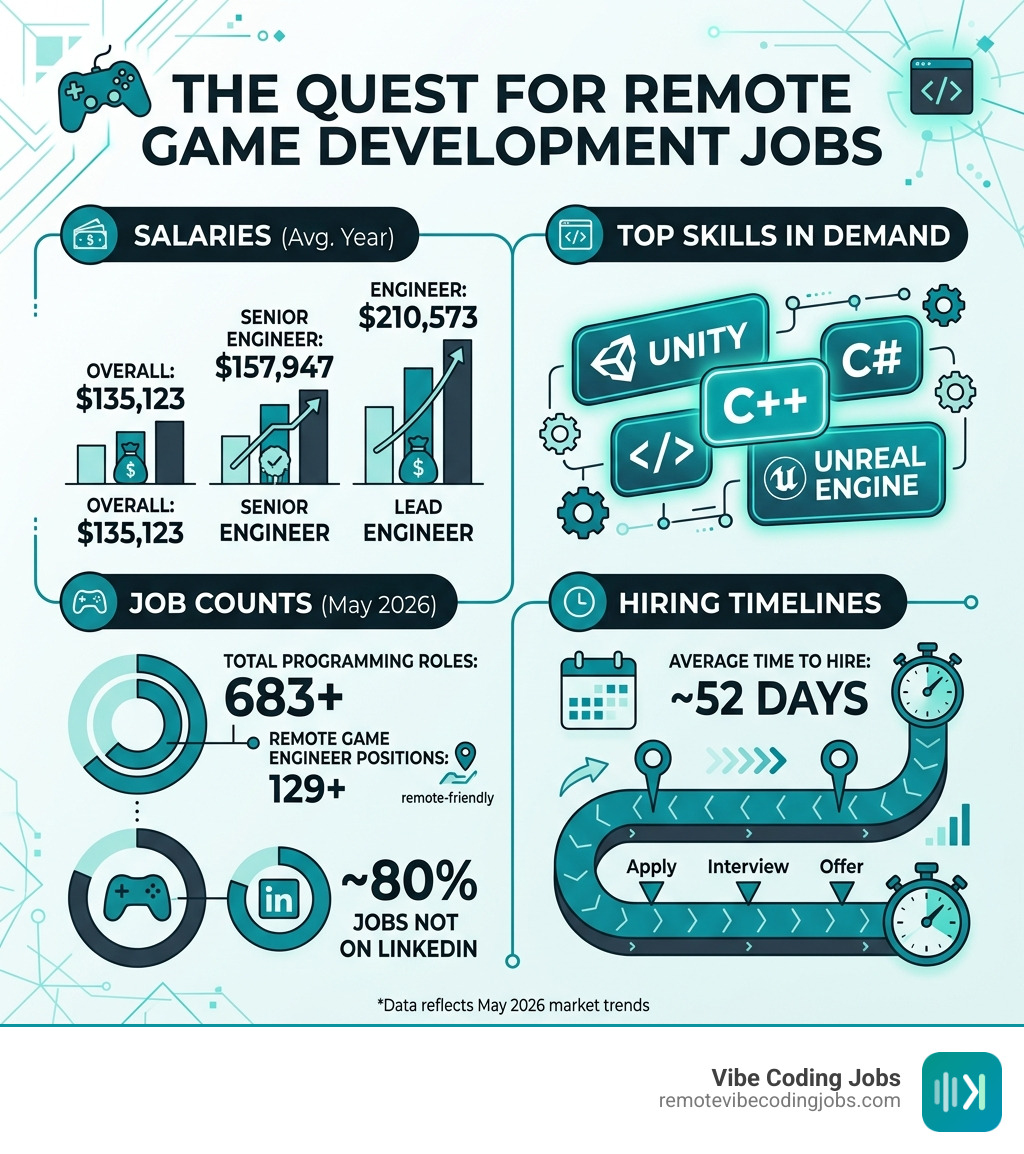
Here’s a quick snapshot of what’s available right now:
| Category | Data |
|---|---|
| Remote game engineer positions | 129+ active listings |
| Average salary | $135,123/year |
| Senior engineer average | $157,947/year |
| Lead engineer average | $210,573/year |
| Top skills in demand | Unity, C++, C#, Unreal Engine |
| Jobs NOT on LinkedIn | ~80% |
| Average time to hire | ~52 days |
The gaming industry has quietly become one of the most remote-friendly sectors in tech. Major AAA studios, scrappy indie teams, and mobile-first startups are all hiring developers who can ship great work from anywhere.
But the market is fragmented. Most listings never show up on the big job boards. Roles fill fast. And the skill bar — especially for senior positions — is high.
That’s exactly why navigating this space requires a smart, targeted approach.
I’m part of the RVCJ Editorial team at Vibe Coding Jobs, where we track hiring trends, AI-assisted workflows, and async-first companies actively filling remote game development jobs right now. We’ll break down everything you need to find, evaluate, and land the right role.
The State of Remote Game Development Jobs in 2026
The landscape for remote game development jobs has undergone a massive transformation. As of May 2026, the demand for specialized talent is at an all-time high. Currently, there are over 683 active listings within the programming and development sector of the games industry. Specifically, we are seeing a surge in “work from home” game engineer positions, with at least 129 specialized roles currently open for immediate hire.
However, the hiring process in gaming is a marathon, not a sprint. On average, it takes companies about 52 days to close a remote game engineer opening. This reflects the high technical bar and the thoroughness of “culture fit” interviews in async-first environments.
One of the most surprising insights we’ve uncovered is the “hidden market.” Our research indicates that a staggering 80% of remote game engineer jobs are NOT listed on LinkedIn. Instead, studios are turning to niche communities and specialized platforms to find candidates who already understand the “vibe” of modern development.
Strategies for Finding Remote Game Development Jobs
If you are only refreshing your LinkedIn feed, you are missing out on the majority of the market. To land the best remote game development jobs, you need to go where the developers hang out.
- Specialized Job Boards: Platforms like Remote Game Jobs and GameJobs.co are essential. They aggregate roles specifically for the industry, often featuring listings you won’t find anywhere else.
- Networking in Discords: Many indie studios and even AAA teams have community Discords where they drop “we’re hiring” announcements before they hit the public boards.
- Direct Applications: Studios like Gunfire Games and Romero Games often maintain their own career portals.
- AI-Forward Platforms: At Vibe Coding Jobs, we specialize in connecting AI-fluent developers with companies that embrace modern tools like Cursor and Claude to accelerate production.
Finding Entry-Level Remote Game Development Jobs
While senior roles are plentiful, breaking into the industry remotely as a junior requires a different playbook. Entry-level remote game development jobs do exist—about 12% of current listings target those starting their careers—but competition is fierce.
Focus on building a portfolio that shows you can ship. Indie studios are often more willing to take a chance on a junior developer who has a strong presence on GitHub or has contributed to open-source game engines. Mentorship is also key; look for “remote-first” studios that explicitly mention mentorship programs in their job descriptions to ensure you aren’t left on an island.
Essential Tech Stacks and Skills for Remote Success
To succeed in remote game development jobs, your technical foundation must be rock-solid. You aren’t just writing code; you are collaborating across time zones on complex, performance-critical systems.
- Engines: Unity remains the leader in terms of sheer volume, appearing in 41.9% of job postings. Unreal Engine 5 is close behind at 29.8%, particularly for high-fidelity AAA projects.
- Core Skills: You need a deep understanding of 3D math and linear algebra. Whether you are implementing character controllers or optimizing shaders, the math is unavoidable.
- Systems: Knowledge of the Gameplay Ability System (GAS) in Unreal or advanced C# scripting in Unity is often a prerequisite for mid-to-senior roles.
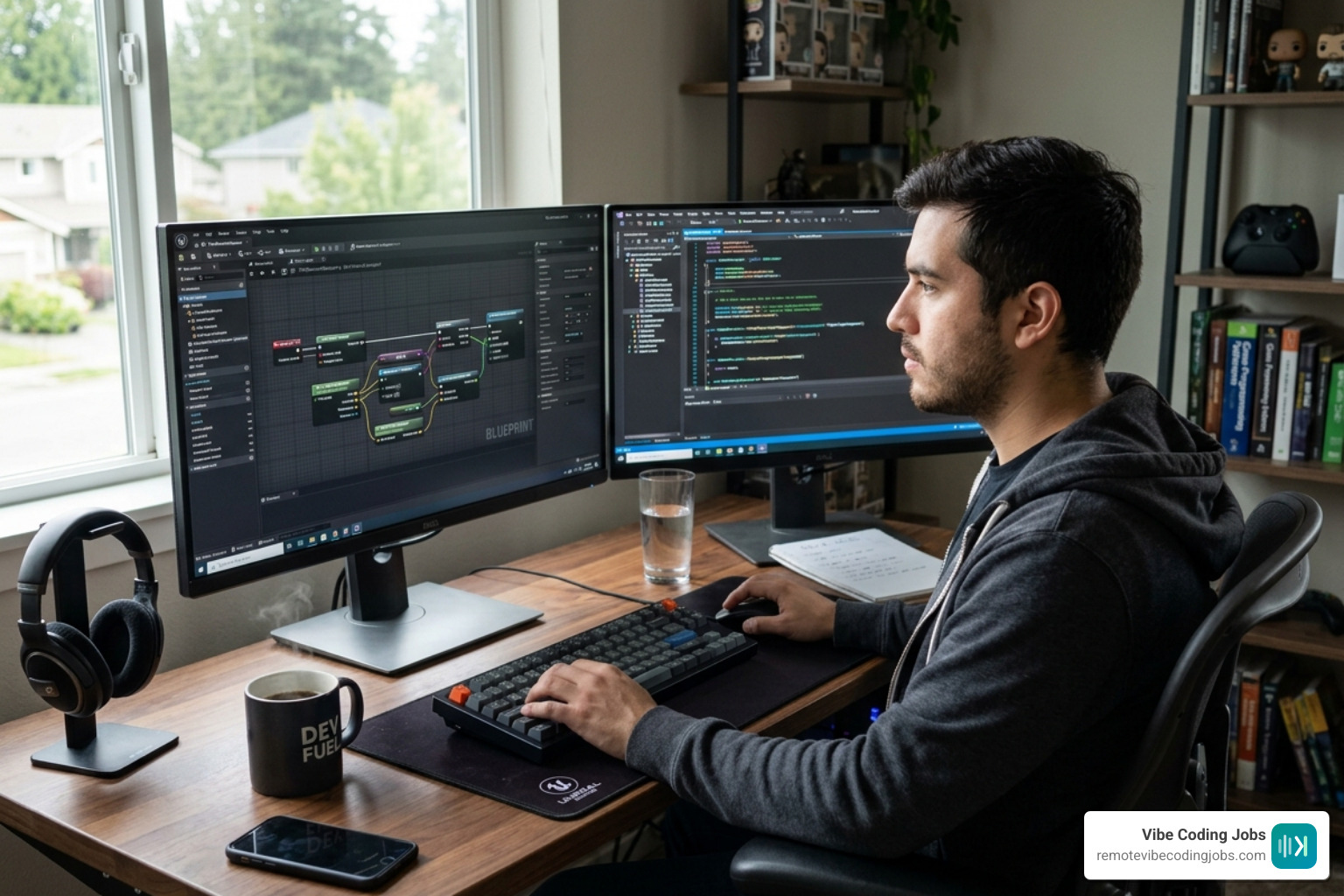
Most In-Demand Programming Languages
The language you choose often dictates the type of studio you’ll work for.
- C++: The gold standard for AAA and engine-level work (found in 36.8% of jobs).
- C#: The primary language for Unity and many indie projects (found in 34.9% of jobs).
- Python: Increasingly used for building backend tools and automation pipelines.
- Rust: Gaining traction in high-performance engine components.
- Swift/Kotlin: Essential for studios focused on mobile optimization.
Specialized Roles in Remote Game Development
The “Game Developer” title is broad, but the market is looking for specialists:
- Gameplay Programmer: Focusing on how the game feels—mechanics, physics, and input.
- Tools Engineer: Building the software that artists and designers use to create the world.
- Backend Developer: Managing the servers, player data, and multiplayer matchmaking.
- AI Designer: Creating complex behaviors for NPCs and enemies.
- Technical Artist: The bridge between art and code, ensuring assets look great and run efficiently.
Salary Benchmarks for Remote Game Development Jobs
Money matters, and in the remote world, your location shouldn’t limit your earning potential. The average salary for remote game engineers currently sits at $135,123 per year.
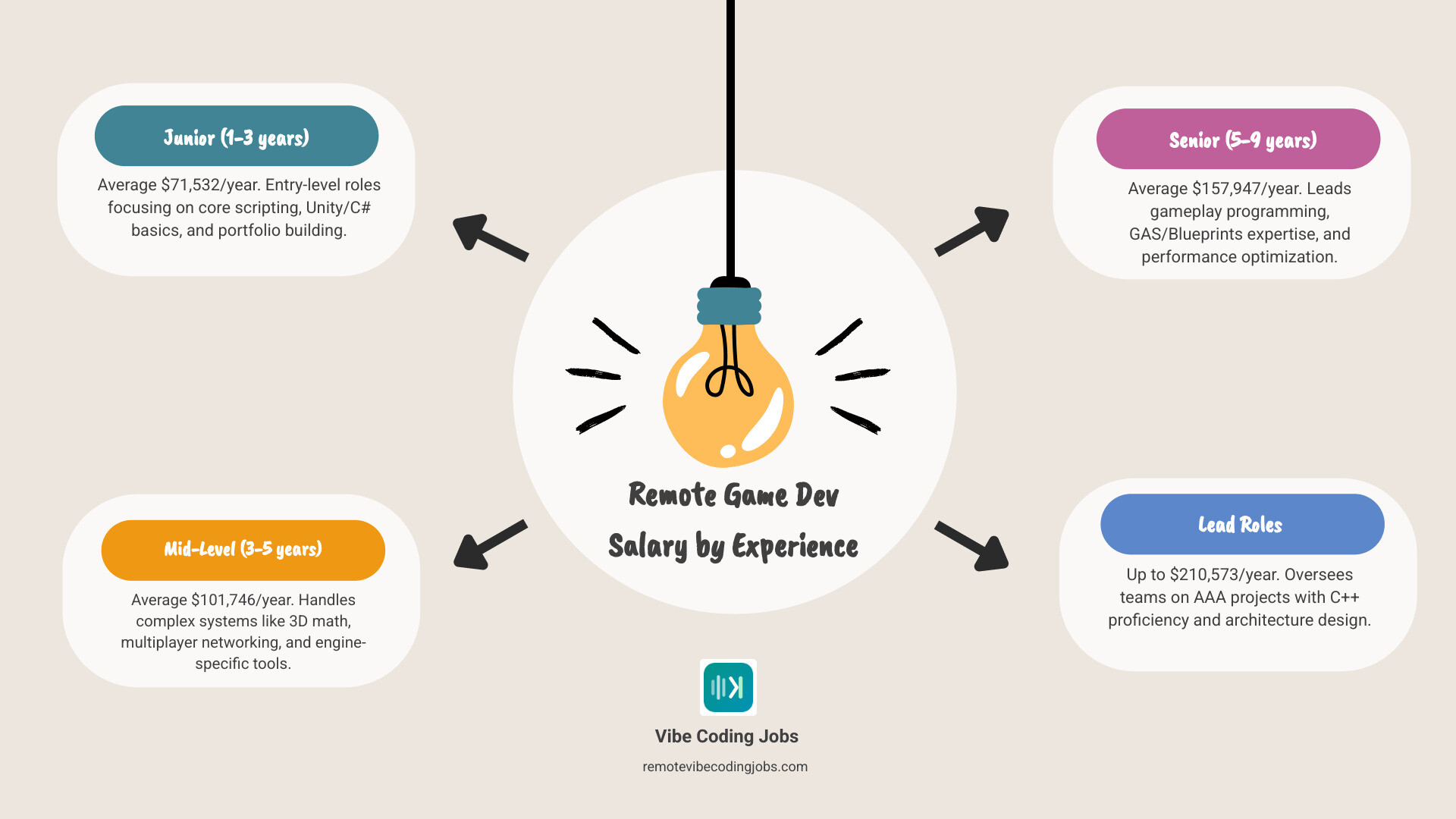
| Experience Level | Average Annual Salary |
|---|---|
| Junior (1-3 years) | $71,532 |
| Mid-Level (3-5 years) | $101,746 |
| Senior (5-9 years) | $157,947 |
| Lead (10+ years) | $210,573 |
For those who prefer the flexibility of contracting, hourly rates for senior gameplay programmers often range between $82.74 and $100 per hour.
Benefits and Perks in Remote-First Studios
Remote studios are competing for the same elite talent as Big Tech, so the perks are becoming legendary. Beyond the standard health coverage (which many studios like Eleventh Hour Games pay 90% of), we are seeing:
- Unlimited PTO: A trust-based culture where you take time when you need it.
- Equity & Ownership: Every employee getting a stake in the game’s success.
- Sabbaticals: Some studios offer paid time off (up to 20% pay) after 5 years to work on personal projects.
- Unique Leave: Compassionate leave that includes fertility treatments or loss of pregnancy.
- Async Culture: No more 9-to-5; work when you are most productive.
The Rise of Vibe Coding and AI in Game Development
The biggest shift we’ve seen in 2026 is the integration of AI. “Vibe coding”—the practice of using natural language and AI tools like Cursor, Claude, and WindSurf to handle the heavy lifting of syntax—is becoming a standard requirement.
AI isn’t replacing developers; it’s acting as a force multiplier. Developers who are “AI-fluent” can ship features 2-5x faster than those using traditional methods. In game dev, this means using GenAI to boilerplate ECS systems, debug complex physics interactions, or even generate placeholder assets on the fly.
Emerging Trends: VR, AR, and Web3
While traditional PC and console gaming remain the core of the market, emerging tech is creating new niches for remote game development jobs.
- Immersive Tech: VR and AR roles are expanding as hardware becomes more mainstream.
- Web3 & Blockchain: While controversial to some, studios like Gameplay Galaxy are hiring for remote mobile/Web3 hybrid roles.
- Cross-Platform Play: The demand for engineers who can sync state across PC, Console, and Mobile is skyrocketing.
Frequently Asked Questions about Remote Game Dev
What qualifications do I need for a remote game development job?
While a Computer Science degree is common, the industry is increasingly “skills-first.” To land a senior role, you typically need 5+ years of experience and at least two shipped titles. A portfolio that includes a playable demo or a deep dive into a specific technical challenge (like a custom networking solution) is often more valuable than a diploma.
How do I stand out in the remote game dev market?
Be a “Product Engineer,” not just a “Code Typist.” Show that you understand the “vibe” of the game you are building. Contributing to open-source projects or winning game jams shows initiative. More importantly, demonstrate that you are comfortable with async communication—clean, well-documented code is your best resume.
Are remote game development jobs available at AAA studios?
Absolutely. The old myth that AAA games can only be made in a physical office is dead. Major players like Sony PlayStation and Mob Entertainment are actively hiring for fully remote positions. Even legendary figures like John Romero are building their next big titles with fully remote teams.
Conclusion
The quest for remote game development jobs is no longer a niche pursuit—it is the future of the industry. By 2026, the barrier between “working in games” and “working from home” has effectively vanished for those with the right skills and the right tools.
Whether you are a seasoned C++ veteran or an AI-fluent “vibe coder” looking to ship your first indie hit, the opportunities are there if you know where to look. The industry is moving toward an async-first, AI-augmented workflow that rewards creativity and strategic thinking over manual syntax entry.
Ready to take the next step in your career? More info about remote AI engineering roles can help you master the tools that the world’s most innovative game studios are using right now. Your next great adventure is just a remote application away.