
How to Land Async Remote Engineer Jobs Without Losing Your Mind
Async Software Engineering Jobs Are Booming — Here’s What You Need to Know
Async software engineering jobs are remote roles where you work on your own schedule, without real-time meetings or overlapping hours with teammates.
Here’s a quick breakdown of what they look like in practice:
| Feature | What It Means for You |
|---|---|
| Schedule | Work when you’re most productive, not 9–5 |
| Communication | Slack threads, Loom videos, docs — not standups |
| Location | Fully remote, often global |
| Hiring focus | Output and autonomy over face time |
| Salary range | $73k up to $260k depending on seniority |
Right now, there are 3,000+ async jobs listed on LinkedIn worldwide, with over 1,600 of those fully remote. Companies like Gusto and Klaviyo are actively hiring engineers with async infrastructure skills, offering salaries between $160k and $222k. Smaller startups and AI-first companies are also building async-first teams, often with four-day workweeks and flexible PTO.
The demand is real. The roles are varied. And the competition is tough if you don’t know where to look or what to highlight.
This guide cuts through the noise. It covers the tools employers want, where to find verified listings, what pay to expect, and how to position yourself — whether you’re switching from a traditional role or leveling up into senior async engineering territory.
At Vibe Coding Jobs, we’re the RVCJ Editorial team — we cover AI-assisted development, remote hiring trends, and practical career guidance for engineers navigating async software engineering jobs and beyond. We’ve tracked hundreds of async-first job listings and the companies building remote-native engineering cultures, so the insights here come from real market data.
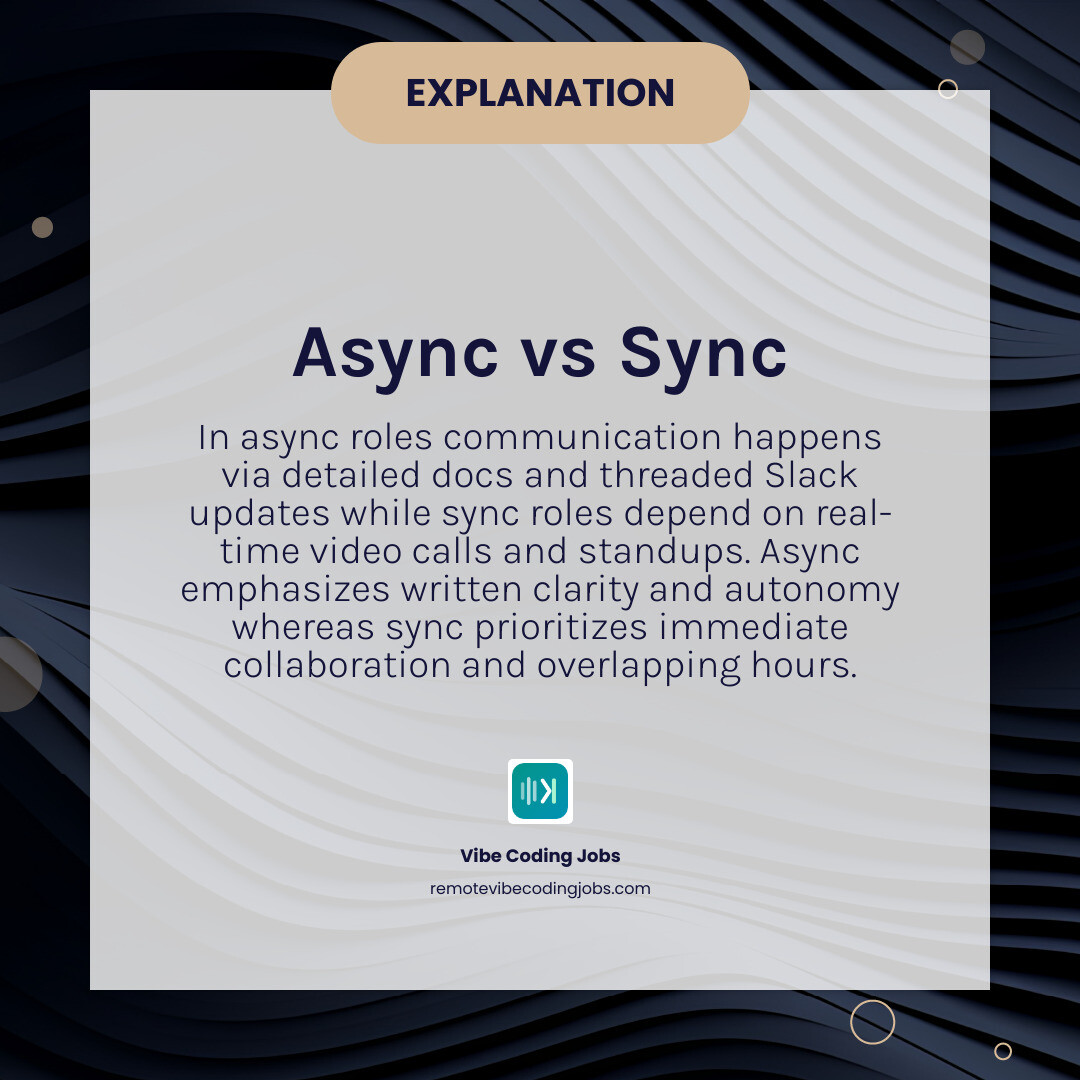
Defining Async Software Engineering Jobs in 2026
In May 2026, the traditional 9-to-5 is increasingly seen as a relic of the past. For us in the tech world, the rise of Async software engineering jobs has redefined what “going to work” actually means. At its core, asynchronous work is about decoupling work from time. It means that while we are all working toward the same goal, we aren’t necessarily doing it at the same time.
This shift creates a non-linear schedule. You might prefer to write code at 2:00 AM when the house is quiet, while your teammate in a different time zone is just finishing their morning coffee. In an async-first culture, this isn’t just “allowed”—it’s the standard. We focus on a results-oriented culture where the quality of your PRs and the stability of your deployments matter infinitely more than how many hours your Slack status was set to “Active.”
To make this work, these companies adopt a documentation-first mentality. Since you can’t just tap someone on the shoulder to ask how an API works, every decision, architectural shift, and bug fix must be documented. This creates a flexible culture that rewards clear thinkers and strong writers.
Synchronous vs. Asynchronous: The Great Divide
| Feature | Synchronous (Traditional) | Asynchronous (Modern) |
|---|---|---|
| Primary Comm Tool | Zoom, Google Meet, Huddles | Notion, GitHub, Loom, Slack |
| Meeting Frequency | High (Daily Standups, Syncs) | Low (Weekly or Monthly Syncs) |
| Response Expectation | Immediate (minutes) | Delayed (hours/next day) |
| Knowledge Base | “Tribal knowledge” in heads | Searchable, written documentation |
| Developer State | Constant interruptions | Deep work and “flow” states |
The Essential Tech Stack for Asynchronous Development
Working in Async software engineering jobs requires more than just knowing how to code; it requires expertise in technologies that handle time-shifted data. When a system is asynchronous, the software itself often mirrors the team’s workflow.
We see a heavy emphasis on distributed systems and background processing. Tools like Sidekiq (for Ruby on Rails environments) and Kafka or Apache Pulsar (for massive event-streaming) are the bread and butter of these roles. Companies like Klaviyo and Gusto specifically look for engineers who can “harden” this infrastructure to be resilient under heavy loads.
Common technologies mentioned in 2026 job listings include:
- Languages: Golang, Python, Ruby on Rails, and TypeScript.
- Infrastructure: AWS (SQS, Lambda), Kubernetes, and Terraform.
- Data Movement: Kafka, Sidekiq, Karafka, and Redis.
Mastering this tech stack and tools is vital. Employers want to see that you understand failure isolation and observability. In an async environment, if a background job fails at 3:00 AM, the system should be self-healing or provide enough culture, tools, and salary data for you to diagnose it when you wake up.
Mastering AI Tools for Async Software Engineering Jobs
The biggest game-changer in 2026 is the integration of AI into the developer workflow. We call this “Vibe Coding.” It’s the practice of using AI tools like Cursor, Claude, and GitHub Copilot to handle the manual syntax while the engineer focuses on architecture and intent.

In Async software engineering jobs, velocity is king. Companies like Tradeify and Activus Capital Partners are now explicitly hiring “Vibe Coders” who can use AI to move from a natural language idea to a production-ready solution in hours rather than weeks. This workflow and productivity shift means you aren’t grinding through boilerplate. Instead, you are orchestrating agents and LLMs to build functional prototypes at lightning speed.
Top Companies and Compensation for Async Roles
The market for async talent is robust. While many companies talk about flexibility, a few industry leaders have made it their core identity.
- Gusto: Often hiring for their “Async Team,” Gusto focuses on developer productivity and hardening background job infrastructure using Sidekiq and Kafka.
- Klaviyo: Their Asynchronous Processing team manages event-driven systems that handle millions of messages per second using Golang and Python.
- Tradeify: A fintech leader that embraces “Vibe Coding,” looking for developers who can own projects end-to-end using AI-powered tools.
- 4dayweek.io: This platform highlights companies that combine async work with a 4-day work week, prioritizing extreme work-life balance.
Finding top companies that actually walk the walk is easier when you look for those listing specific “Async” or “Infrastructure” roles.
Salary Ranges for Async Software Engineering Jobs
Compensation for these roles is highly competitive, often rivaling or exceeding traditional on-site positions in tech hubs.
Based on current 2026 data:
- Senior Software Engineer (Async/Infrastructure): $160,000 – $222,000 per year.
- Senior Staff/Principal Roles: $195,000 – $260,000 per year.
- AI Trainers/Specialists (DataAnnotation): $50 – $150 per hour on a contract basis.
Many of these companies offer location-agnostic pay or broad “zones.” For instance, Gusto targets $160k-$180k for most remote locations, while bumping that to $220k for high-cost-of-living areas like NYC or San Francisco. Beyond the base, expect salary and compensation guides to include equity packages and generous PTO.
How to Transition into an Async-First Career
If you’re coming from a high-meeting, synchronous environment, the transition requires a mindset shift. You need to prove you can work autonomously.
- Start with AI Training: Platforms like DataAnnotation allow over 100,000 professionals to contribute to AI development. It’s a great way to get used to setting your own hours and working on diverse coding problems.
- Build a “Vibe Coding” Portfolio: Don’t just show code; show launched products. Use Cursor and Claude to ship MVPs quickly. This demonstrates you can handle the full lifecycle of a project independently.
- Refine Your Documentation Skills: Since roles and teams in async companies rely on written word, start a technical blog or contribute to open-source docs.
- Follow a Roadmap: Transitioning isn’t an overnight process. Use a career roadmap to identify gaps in your distributed systems knowledge.

Frequently Asked Questions about Async Engineering
How does async work impact work-life balance?
The impact is generally profound and positive. By removing the “9-to-5” constraint, you gain flexible hours that allow you to plan work around your life, not the other way around. This significantly reduces burnout. Many Async software engineering jobs are found at companies offering flexible hours and even 4-day work weeks, giving you more time for deep work and personal interests.
What are the main challenges of working in async software engineering roles?
It’s not all sunshine and rainbows. The most common challenges include:
- Isolation: You might miss the social energy of an office.
- Documentation Burden: You have to write everything down, which can feel tedious.
- Timezone Management: While you don’t need to be online at the same time, you still need to coordinate handoffs across the globe.
Success requires a strong culture and workflow where these challenges are acknowledged and managed through regular (but infrequent) social syncs and excellent tooling.
Which skills are most valued by employers seeking async software engineers?
Beyond the code, employers look for:
- Systems Thinking: Understanding how your change impacts the whole distributed system.
- Written Communication: The ability to explain complex technical trade-offs in a Slack thread or Notion doc.
- Self-Management: Being your own project manager and staying productive without someone checking in on you every four hours.
This flexible communication style is often the deciding factor in whether an engineer thrives or struggles in an async role.
Conclusion
The landscape of Async software engineering jobs is evolving rapidly. Whether you are a seasoned distributed systems expert or a “Vibe Coder” leveraging the latest AI tools, the opportunity to work with total location freedom and schedule autonomy has never been greater.
At RemoteVibeCodingJobs, we are dedicated to helping you find these high-impact, high-freedom roles. The future of work isn’t just remote; it’s asynchronous, AI-assisted, and results-driven. If you’re ready to stop “grinding” and start “vibing,” it’s time to update your stack and look for companies that value your output over your hours.
For more insights on the tools shaping this new era, check out our guide on cursor-copilot-developer-jobs.