
The Ultimate Guide to Remote AI Coding Positions in 2026
Remote AI Coding Positions Are Reshaping How Developers Work in 2026
Remote AI coding positions are a fast-growing category of tech roles where developers write code, evaluate AI-generated output, train language models, or build AI-native tools — all from anywhere in the world.
Here’s a quick snapshot of what’s available right now:
| Role Type | Typical Pay | Hours/Week | Experience Needed |
|---|---|---|---|
| AI Code Trainer / Evaluator | $20–$100/hr | 10–30 hrs | 2–5+ years |
| Senior AI Code Ranker (RLHF) | ~$100.50/hr | 10–40 hrs | 5+ years |
| Machine Learning Engineer | $150–$250/hr | 15–30 hrs | Senior level |
| Vibe Coder / AI-Native Developer | $70K–$250K+/yr | Full-time | All levels |
| AI Tool Builder (LLM integrations) | $100K–$210K/yr | Full-time | 3–5+ years |
The market has shifted dramatically. It’s no longer just about writing code line by line. Companies are now hiring developers to teach AI how to code, rank AI-generated solutions, and build with AI tools like Cursor, Claude Code, and Windsurf at speeds that weren’t possible two years ago.
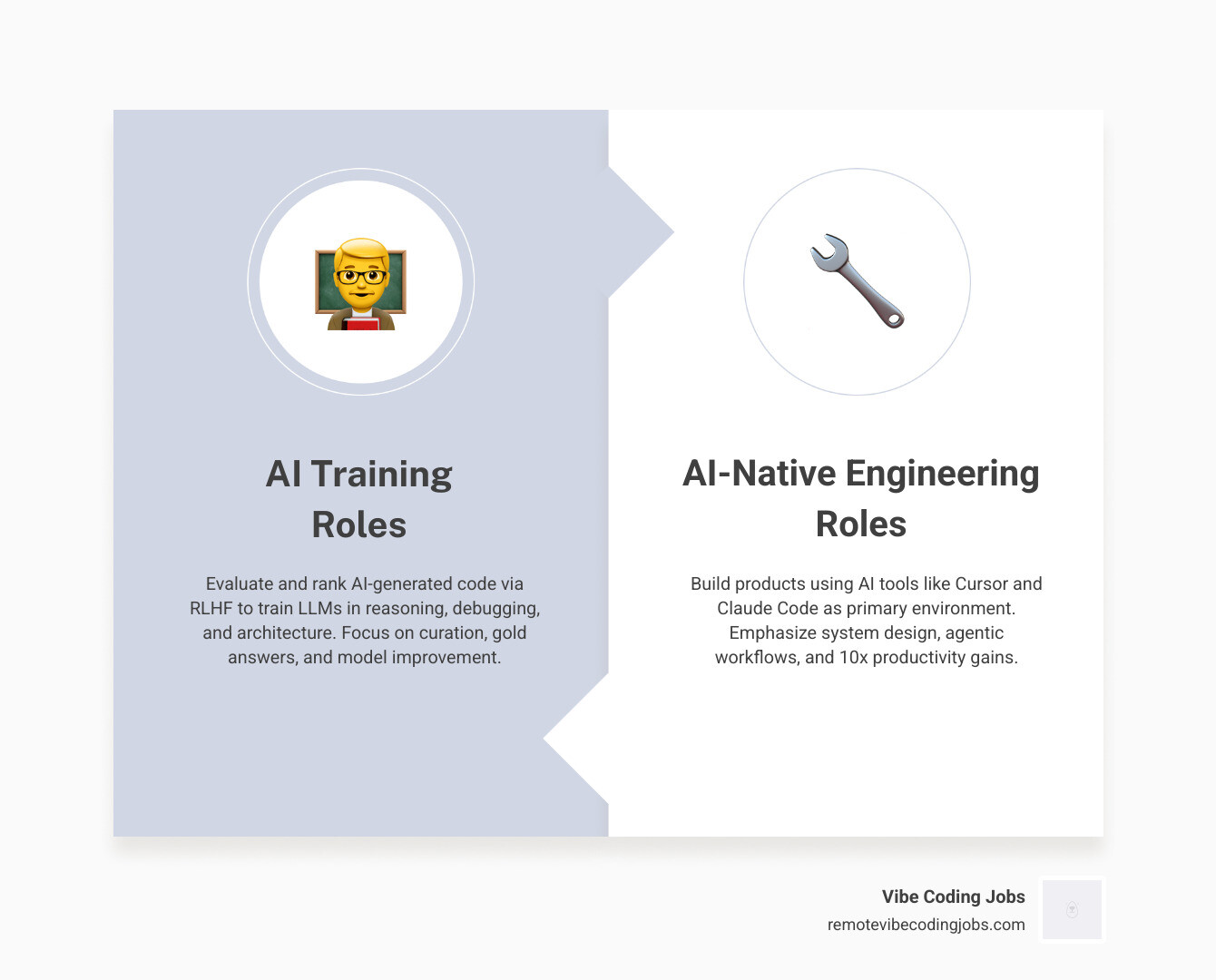
There are two broad paths:
- AI training roles — evaluating, ranking, and curating code to improve large language models (LLMs)
- AI-native engineering roles — building products and systems using AI tools as your primary development environment
Both pay well. Both are remote. And both are hiring right now in 2026.
The shift is real. A forum discussion from the r/ClaudeCode community put it plainly: managers who stepped away from coding are now returning as individual contributors — outpacing entire engineering teams in feature output by leaning fully into AI tooling.
I’m RVCJ Editorial, the team behind Remote Vibe Coding Jobs, where we cover AI-assisted development, remote hiring trends, and practical career guidance for developers navigating the rise of remote AI coding positions. We’ve tracked hundreds of job listings, platform changes, and salary benchmarks across this space so you don’t have to.
Defining Remote AI Coding Positions: Training vs. Engineering
When we talk about remote AI coding positions, we aren’t just talking about one type of job. In 2026, the market has split into two distinct but overlapping disciplines. Understanding the difference is the first step to landing a high-paying role that fits your lifestyle.
On one side, we have AI Training. This is the process of helping frontier models (like the successors to GPT-4 and Claude 3.5) learn how to reason, debug, and architect software. It involves Reinforcement Learning from Human Feedback (RLHF), where you act as the “teacher.” You might be presented with two different code snippets generated by an AI and asked to rank which one is more efficient, secure, and idiomatic.
On the other side, we have AI-Native Engineering. These are roles where you are building production software, but your primary “teammate” is an AI agent. You aren’t typing out every bracket; you are directing agents to handle the manual implementation while you focus on the high-level architecture.
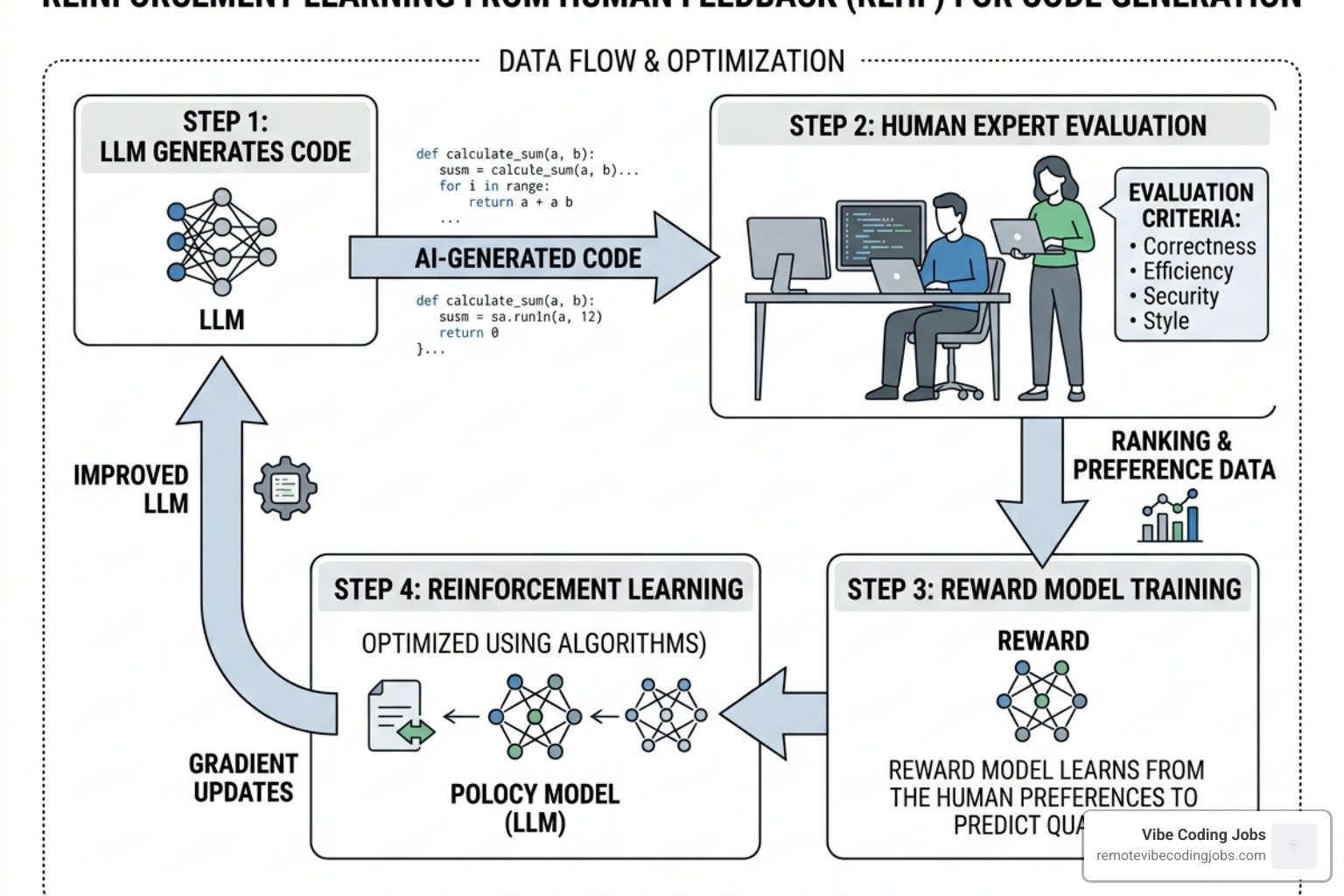
If you are looking for high-compensation contract work, roles like Senior Software Engineer — AI Code Ranking | High-Comp Remote Contract Roles are currently paying upwards of $100.50 per hour. These positions require you to create “gold answers”—perfectly documented, bug-free solutions that serve as the ground truth for training the next generation of AI.
Alternatively, for those who want to build the future of apps, you can Browse AI Developer jobs in Remote Locations to find full-time roles focused on model deployment and MLOps.
Types of Remote AI Coding Positions Available Now
The variety of titles in 2026 can be a bit overwhelming, but most fall into these categories:
- Vibe Coding: A term popularized for AI-assisted development where the developer focuses on the “vibe” or high-level logic and intent, while tools like Cursor or Claude Code handle the syntax.
- Agentic Engineering: Designing and managing “agents” that can autonomously perform tasks like refactoring an entire codebase or generating end-to-end test suites.
- AI Data Assembly: Specialized roles (often paying $117k–$153k GBP/year in the UK) focused on gathering and structuring the massive datasets needed for model fine-tuning.
- AI Pilot: A hybrid role emerging in many startups where you orchestrate multiple AI models to handle everything from data scraping to automated product launches.
- Prompt Engineering & RAG Pipelines: Building “Retrieval-Augmented Generation” systems that allow an AI to access a company’s private documentation to provide better code suggestions.
There are currently 1,000+ AI Programmer opportunities for remote experts across these niches, ranging from part-time gigs to executive-level engineering roles.
The Difference Between AI Training and Traditional Software Engineering
Traditional software engineering is about implementation. You get a ticket, you write the code, you pass the tests. Remote AI coding positions in the training sector are about verification and evaluation.
In an AI training role, your day looks different. Instead of building a feature, you might review 34 different model-generated responses for a single complex logic puzzle. You have to identify subtle edge cases that the AI missed—like a race condition in a Go routine or a memory leak in a C++ script. You aren’t just a coder; you’re a critic and a strategist.
This work is “cognitive deep work.” It often takes 45 to 60 minutes just to complete one task because the quality standards are so high. If you prefer the creative side of building products, you might find more satisfaction in Remote Artificial Intelligence Jobs – Work From Home & Flexible options that focus on product development.
The Rise of Vibe Coding and AI-Native Development
We are currently seeing what experts call the “Barbell Pattern” of AI adoption. The most experienced developers and the most curious juniors are seeing massive productivity gains, while the “middle” often struggles to unlearn old habits.
“Vibe coding” is the heart of this movement. By using tools like Cursor, Claude Code, and Windsurf, developers are reporting 2x to 5x productivity increases within their first month. Some even claim 10x leverage, allowing a single engineer to do the work of a small team.
This isn’t just “cheating” at coding; it’s a new way of working. It requires maintaining specific context files like SKILL.md (which tells the AI how you want things built) and ARCHITECTURE.md (which gives the AI a map of the system). This shift toward an async-first culture means you can ship a production-ready app in days rather than weeks.
Essential Skills for Remote AI Coding Positions
To thrive in these roles in 2026, the “old” skills still matter, but the “new” skills are what get you hired.
- Core Languages: Python remains king for AI/ML, but JavaScript/TypeScript, Go, and Rust are essential for building the high-performance agents and backends that power AI tools.
- LLM API Proficiency: You need to know how to work with OpenAI, Anthropic, and open-source models via APIs, including managing prompt chains and context windows.
- Technical Communication: Because you are “teaching” the AI, you must be able to articulate complex concepts clearly. If you can’t explain why a piece of code is bad, you can’t rank it effectively.
- Debugging AI Output: AI is great at writing code, but it’s also great at hallucinating. You must be an expert at “red-teaming” AI code—intentionally looking for the security flaws and logical gaps it might leave behind.
Why Senior Engineers and Juniors Benefit Most from AI Tools
The “Barbell Effect” is a fascinating trend we’ve observed.
Senior Engineers (5-10+ years) benefit because they already know the high-level architecture. They don’t need to spend time looking up syntax for a specific library; they just “vibe” the requirements to the AI and spend their time reviewing the logic. They are moving from “code typists” to “software architects.”
Juniors benefit because AI acts as a 24/7 senior mentor. It can explain every line of code it writes, helping them learn faster. We’ve seen junior-to-senior career acceleration happen in 3–6 months rather than 3–5 years.
The people in the middle—those who are comfortable with their existing manual workflows and resistant to “unlearning”—are the ones most at risk in the 2026 job market.
Compensation, Salaries, and Workload Expectations
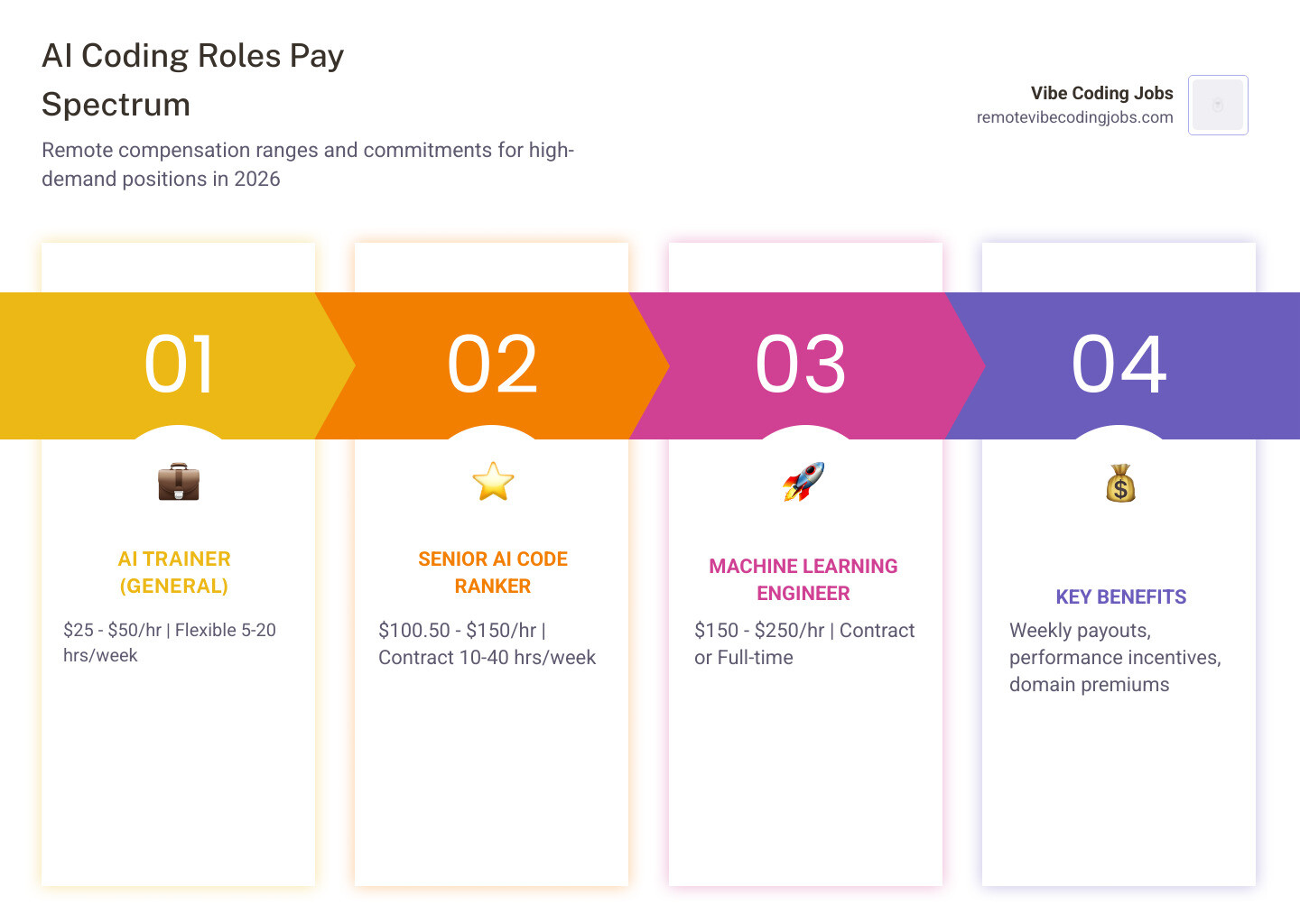
The pay for remote AI coding positions is currently some of the highest in the tech industry, reflecting the specialized expertise required to train and deploy these models.
| Position | Compensation Range | Commitment |
|---|---|---|
| AI Trainer (General) | $25 – $50/hr | Flexible (5-20 hrs/week) |
| Senior AI Code Ranker | $100.50 – $150/hr | Contract (10-40 hrs/week) |
| Machine Learning Engineer | $150 – $250/hr | Contract or Full-time |
| Vibe Coder (Mid-level) | $100k – $150k/year | Full-time Remote |
| Staff AI Engineer | $200k – $250k+/year | Full-time Remote |
Many of these roles offer weekly payouts and performance-based cash incentives. For example, some platforms offer “Elite Coder” status for those who commit to 30 hours a week, with pay reaching $100/hour for consistent, high-quality work.
Entry-Level vs. Senior AI Coding Opportunities
While there are entry-level “Vibe Coding” roles starting at $70k–$100k, many of the highest-paying training positions have a high barrier to entry.
- Senior Roles: Often require 5+ years of experience at a leading tech company. Some specialized roles (like training AI for structural engineering, medicine, or RF engineering) pay $125/hour but require a Masters or PhD. In fact, 70% of AI trainers on top platforms currently hold advanced degrees.
- Entry-Level Roles: These focus more on “AI-first” development. Companies are looking for people who have built solo projects using AI tools. A “clickable” portfolio of live products is often more valuable than a traditional resume in this space.
How to Land a Remote AI Coding Job in 2026
Getting hired for remote AI coding positions is different from a traditional tech interview. You likely won’t be doing a standard LeetCode challenge on a whiteboard.
Instead, expect the following:
- Timed Technical Assessments: Platforms like Alignerr use strict TestGorilla tests. These are often “one-shot”—if you fail, you may be permanently locked out from applying again. They test your ability to debug and rank code in a blank environment without the help of your own AI tools.
- Portfolio of Live Products: Since AI makes building fast, employers want to see that you’ve actually shipped things. Show them a live URL, not just a GitHub repo.
- GitHub PR Conversion: Some AI training roles will ask you to take a real-world GitHub Pull Request and convert it into a training task with a “verifier” to check the AI’s work.
- Resume Optimization: Use tools to ensure your resume highlights “AI fluency” and specific experience with LLM APIs and agentic workflows.
Top Platforms and Companies Hiring for AI Roles
While major job boards like LinkedIn and Indeed have thousands of listings, the most successful candidates are looking at specialized platforms.
- Mindrift & Toloka: Focus on domain experts and AI trainers, paying up to $90/hour for Data Science and Python experts.
- Remotasks & Alignerr: Known for high-stakes, high-pay code ranking tasks ($100+/hr).
- Stellar AI: A great entry point for those with university degrees looking for flexible, task-based work starting at $25/hour.
- Turing: Connects senior engineers with major AI companies for evaluation and dataset curation.
Of course, if you want a curated list of companies that actually “get” the AI-native workflow, you can Find your next role at RemoteVibeCodingJobs.com. We filter for async-first companies that provide AI tool budgets (like paying for your Cursor subscription) and value location freedom.
Frequently Asked Questions about AI Coding
Do I need to be an expert in Machine Learning to apply?
No! For many remote AI coding positions, specifically in training and vibe coding, you don’t need to know how to build a neural network from scratch. You just need to be an expert in software engineering. The AI companies need people who know how good code looks and functions so they can teach the model those patterns.
What are the most common challenges in remote AI training roles?
The biggest challenge is the “Strict Assessment” phase. Many platforms have a “one strike and you’re out” policy for their initial tests. Additionally, the workload can be variable; you might have 40 hours of work one week and zero the next. Finally, the work is mentally taxing—you are essentially doing high-level code review for hours on end.
Can vibe coding replace traditional software development jobs?
It’s not about replacement; it’s about evolution. A “vibe coder” who uses AI can often outperform a traditional developer who refuses to use it. As the saying goes: “AI won’t replace you, but a human using AI will.” In 2026, the demand for “AI-fluent” professionals is exploding while traditional “manual” roles are becoming harder to find.
Conclusion
The landscape of remote AI coding positions is the new frontier of the gig economy and full-time tech employment. Whether you want to earn $150/hour as a specialized ML trainer or land a $200k/year role as an Agentic Engineer, the opportunities in May 2026 have never been more lucrative.
The key to staying relevant is to lean into the tools. Master Cursor, understand prompt chaining, and build a portfolio that proves you can ship at 10x speed. Career stability in the age of AI belongs to those who can effectively “vibe” with the machines to create something great.
Ready to start your journey? Check out the latest curated listings at RemoteVibeCodingJobs and Find your next role at RemoteVibeCodingJobs.com today. The future of coding is remote, AI-powered, and waiting for you.