
The Ultimate Guide to Remote Backend and Junior Dev Roles
The 2026 Landscape for a Backend Developer Remote
As we navigate through May 2026, the market for a Backend developer remote has reached a level of maturity that was only a dream a few years ago. The data is staggering: there are currently over 3,000 remote backend developer jobs listed in the United States alone. Even more impressive is the velocity of the market, with 3,810 new remote backend positions posted within the last 24 hours.
If you are looking for true location independence, you are in luck. Out of the current active listings, 2,839 are classified as fully remote, meaning you can ditch the “hybrid” commute for good. While the demand spans all levels, the “sweet spot” for recruiters right now is the mid-senior tier, which accounts for 1,843 available positions.
Salary benchmarks have also shifted upward. According to our Remote Developer Salary Guide 2026, the floor for high-quality remote roles is rising. In fact, nearly 200 currently listed roles offer a base salary of $100,000+ USD, with specialized roles in Web3 or high-throughput infrastructure reaching as high as $215,000.
| Experience Level | Typical Salary Range (Remote) | Key Focus Areas |
|---|---|---|
| Junior | $65,000 – $95,000 | API consumption, bug fixes, unit testing |
| Mid-Level | $95,000 – $145,000 | Feature ownership, database schema design |
| Senior | $145,000 – $190,000+ | System architecture, mentoring, SLOs |
| Staff/Principal | $190,000 – $250,000+ | Cross-team strategy, high-scale infra |
Mastering AI Tools for Backend Developer Remote Roles
The biggest shift we’ve seen in 2026 isn’t just where we work, but how we work. We are firmly in the era of “vibe coding”—a term for AI-assisted development where the engineer acts more like an architect and reviewer than a manual syntax writer.
Companies are no longer just “okay” with AI; they are demanding it. Some forward-thinking firms now explicitly state a goal to quintuple developer output by integrating tools like Cursor and Claude into the daily workflow. This isn’t about replacing developers; it’s about a 500% productivity boost. By leveraging Remote Developer Jobs with AI Tools, you can focus on agentic workflows—proposing and operationalizing end-to-end plans where AI agents handle the boilerplate while you verify the security and scalability.
Finding Junior and Senior Backend Developer Remote Opportunities
While the mid-senior level is the most populated, the path for both juniors and seniors is distinct in 2026.
For Juniors: The entry-level hurdle remains real, but the “vibe coding” revolution has actually opened doors. Juniors who can demonstrate proficiency in AI-assisted debugging and rapid prototyping are finding roles faster than those sticking to traditional methods. Look for companies that offer “learning budgets” and mentorship programs to bridge the gap.
For Seniors: If you are a veteran, the market is your oyster. You are expected to lead architectural decisions and mentor global talent pools. You can Browse Senior Backend Developer Roles to find positions that prioritize high-level system design over “grinding” tickets. At this level, your ability to manage “tail reliability” and p99 latency in distributed systems is what commands those $200k+ salaries.
Essential Tech Stacks and the Rise of Vibe Coding
What languages should you have in your arsenal for a Backend developer remote role today? The 2026 stack is a mix of reliable workhorses and high-performance newcomers.
- Elixir & Phoenix: This has become a darling of the remote-first world, especially for companies like Remote.com and Supabase. Its ability to handle massive concurrency makes it perfect for global HR platforms and real-time tools.
- TypeScript & Node.js: Still the king of versatility. It’s frequently used for Management APIs and building the “vibe coding” platforms themselves.
- Java & Spring Boot: The backbone of fintech. If you want to work on international money movement or core banking systems, this is your stack.
- Python & Go: Essential for data-intensive platforms and high-performance microservices.
- Rust: Increasingly mentioned in job postings for Web3 infrastructure and performance-critical gateway layers.
For a deeper dive into how these stacks translate to your paycheck, check out our Backend Developer Salary Guide. Beyond the language, you need to understand event-driven architecture. Knowledge of RabbitMQ for messaging and Kubernetes for orchestration is no longer “optional”—it’s expected for any system running at scale.
Key Requirements for a Backend Developer Remote
The technical bar for remote roles is often higher because you must be self-sufficient. Key requirements we see across the board include:
- Robust API Design: Deep knowledge of REST, GraphQL, and increasingly, JSON-RPC. You need to understand versioning, pagination, and error mapping.
- Advanced Security: Proficiency in OAuth and JWT is standard. You’ll also need to handle rate limiting and CORS to protect public-facing interfaces.
- DevOps Integration: You aren’t just writing code; you’re shipping it. This means mastering CI/CD pipelines (GitLab CI/CD is a favorite), Docker, and AWS.
- Observability: In a remote environment, you own your production operations. You must be able to build dashboards, set SLOs (Service Level Objectives), and respond to incidents using tools like Prometheus or Datadog.
If you specialize in these areas, you should look into Backend API Developer Roles which specifically value these “plumbing” skills.
Navigating the Async-First Hiring Process

One of the best perks of a Backend developer remote role in 2026 is the shift toward Async First Remote Developer Jobs. What does “async-first” actually mean for you?
- No Daily Standups: Forget the 9 AM Zoom call. Communication happens via Slack, GitLab, or Loom on your own schedule.
- Flexible Hours: Work when you are most productive, whether that’s 5 AM or midnight.
- The “Bar Raiser” Interview: Hiring processes often involve a “bar raiser”—an interview with someone outside your immediate team to ensure you fit the high-autonomy culture.
- Global Compliance: Modern remote-first companies use sophisticated HR platforms to ensure you get 16 weeks of paid parental leave and local tax compliance, regardless of where you live.
- Home Office Budgets: It’s common to receive a $1,000+ stipend to set up your workspace, plus a company-provided laptop.
The application process itself is becoming more automated. You’ll often start by submitting a PDF CV, followed by an asynchronous code exercise. This allows you to prove your skills without the pressure of a “live coding” whiteboard session.
Key Challenges and Benefits of Remote Backend Work
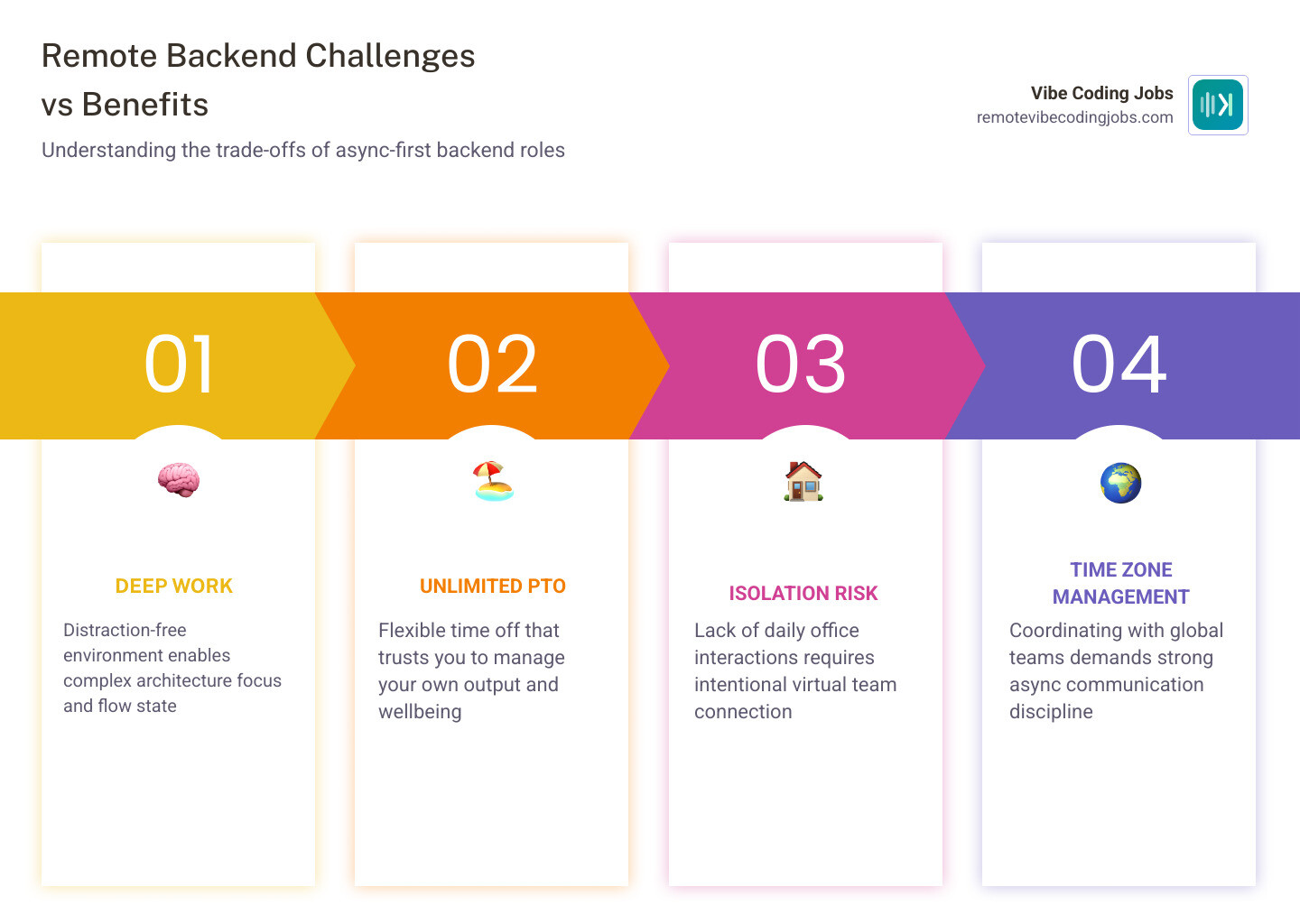
Working as a Backend developer remote isn’t all sunshine and pajamas. It requires a specific temperament to succeed.
The Benefits:
- Deep Work: Without office distractions, you can achieve the “flow state” required for complex backend architecture.
- Unlimited PTO: Many remote-first companies offer flexible time off, trusting you to manage your output.
- Wealth Building: With stock options and high salaries, many developers are achieving financial independence earlier.
- Holistic Support: It’s now standard to see benefits like virtual fitness, telemedicine, and even psychological support apps included in the package.
The Challenges:
- Isolation: You have to be intentional about social interaction to avoid the “lonely coder” syndrome.
- Time Zone Management: Even in async cultures, you might occasionally need to overlap with a teammate in a different hemisphere.
- High Autonomy: There is no one looking over your shoulder. If you struggle with self-discipline, remote work will be difficult.
Frequently Asked Questions about Remote Backend Roles
What are the most in-demand backend skills in 2026?
The most in-demand skills are a combination of “vibe coding” (AI tool proficiency), Elixir/Phoenix for scalability, and a deep understanding of cloud-native infrastructure (AWS/Kubernetes). Being “backend-leaning” but able to touch the frontend (React/Next.js) is also a major plus.
How do I transition from on-site to a fully remote backend role?
Start by adopting remote-friendly habits in your current job: document everything, communicate asynchronously, and master your CI/CD tools. When applying, highlight your experience with distributed systems and your ability to work without direct supervision.
What is the average salary for a remote backend developer?
For a mid-level role, expect between $95,000 and $145,000. Senior roles frequently climb above $150,000, and specialized roles in high-demand sectors like Web3 or AI-infrastructure can exceed $200,000.
Conclusion
The era of the Backend developer remote is here to stay, and it’s more sophisticated than ever. By embracing AI-assisted development and seeking out async-first cultures, you can build a career that offers both high compensation and incredible freedom.
At RemoteVibeCodingJobs, we specialize in connecting talented engineers with companies that actually “get” remote work. We filter for the best tech stacks, the most innovative AI tools, and the healthiest company cultures so you don’t have to. Ready to change how you work? Find your next role at Jellyvision or browse our daily curated listings today.