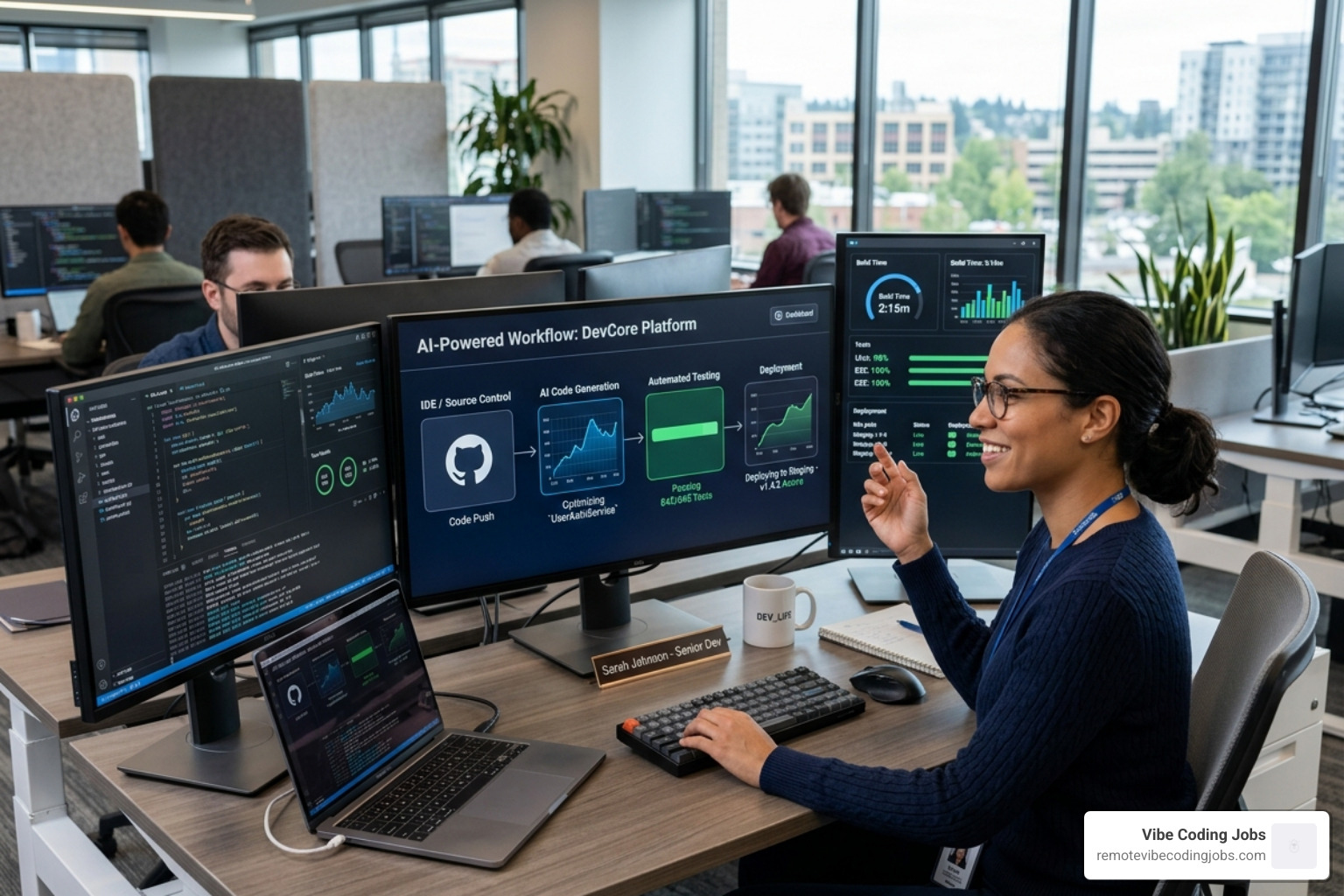
The Lazy Engineer Guide to AI Assisted Development
Why AI Powered Development Is Changing How Software Gets Built
AI powered development is the practice of using artificial intelligence — especially large language models (LLMs) — to automate, accelerate, and augment the software development process, from writing code to testing, deployment, and documentation.
Here’s a quick snapshot of what it means in practice:
- What it is: Using AI tools like GitHub Copilot, Cursor, or Claude to generate, review, and debug code through natural language prompts
- Who it’s for: Professional developers, junior engineers, and even non-technical builders using no-code/low-code platforms
- Key benefit: Developers complete tasks up to 26% faster overall — with junior developers seeing gains of 21–40%
- How it works: AI interprets your intent, generates code suggestions, catches bugs, and can run autonomously as an “agent” across your entire codebase
- Where it fits: Every stage of the software development lifecycle (SDLC) — planning, coding, testing, deployment, and maintenance
Think about this: a fully functional Wikipedia-scrolling app, built in 90 minutes using AI tools. That’s not a concept — it actually happened, and it’s the kind of moment that signals a genuine shift in how software gets made.
Software development has always evolved. The 1990s brought fourth-generation languages (4GLs) that many feared would replace programmers. They didn’t — they just changed the job. AI is doing the same thing, only faster and at a much larger scale.
The developers who thrive aren’t the ones who resist this shift. They’re the ones who learn to direct it.
Written by RVCJ Editorial, the team behind Remote Vibe Coding Jobs — we cover AI-powered development workflows, remote hiring trends, and career guidance for engineers building with tools like Cursor, Claude, and Copilot. We’ve tracked the rise of AI-centric development firsthand, from early copilots to fully agentic coding environments, so you get practical, no-fluff insight into where this space is actually heading.
The Rise of AI Powered Development
We are currently witnessing the most significant shift in software engineering history. Gone are the days of “artisanal hand-crafted commits” being the only way to build a product. Today, AI powered development has moved from a niche experiment to the industry standard. This shift is driven by the realization that we can achieve an order of magnitude increase in productivity by moving from manual coding to AI-driven orchestration.
In the past, the software development lifecycle (SDLC) was a linear, human-heavy process. We spent weeks in planning, weeks in execution, and weeks in testing. Now, with AI-assisted software development, the barriers between an idea and a working prototype have virtually vanished. By leveraging Natural Language Processing (NLP) and Large Language Models (LLMs), we can now “talk” our software into existence.
This isn’t just about autocomplete anymore. We are moving toward AI coding agents that don’t just suggest the next line of code but actually understand the context of our entire repository, manage dependencies, and even execute terminal commands to fix errors in real-time.
Core Components of AI Powered Development
To understand how we got here, we need to look at the “engine” under the hood. Modern AI powered development relies on several key technologies:
- Generative AI: The ability for models to create new content (code, docs, tests) rather than just retrieving existing information.
- Context Windows: Tools like Gemini Code Assist now offer 1M token context windows, allowing the AI to “read” your entire codebase, documentation, and history all at once.
- Natural Language Prompts: The ability to describe a feature in plain English and have the AI translate that into a functional React component or a Python backend.
- Agentic Workflows: Systems like Codex or Codex Agent that can plan, execute, and verify tasks across multiple files autonomously.
For those just entering the field, the AI Coding Jobs Entry Level Market is rapidly expanding, looking for “AI-native” developers who know how to wield these components effectively.
Why AI Powered Development is the New Standard in 2026
By May 2026, the data is undeniable. Research shows that AI coding assistants boost developer productivity by an average of 26% in completed tasks. But the real story is in the democratization of skill. Junior-level developers are seeing massive productivity boosts of 21% to 40%, effectively closing the gap between entry-level talent and senior engineers.
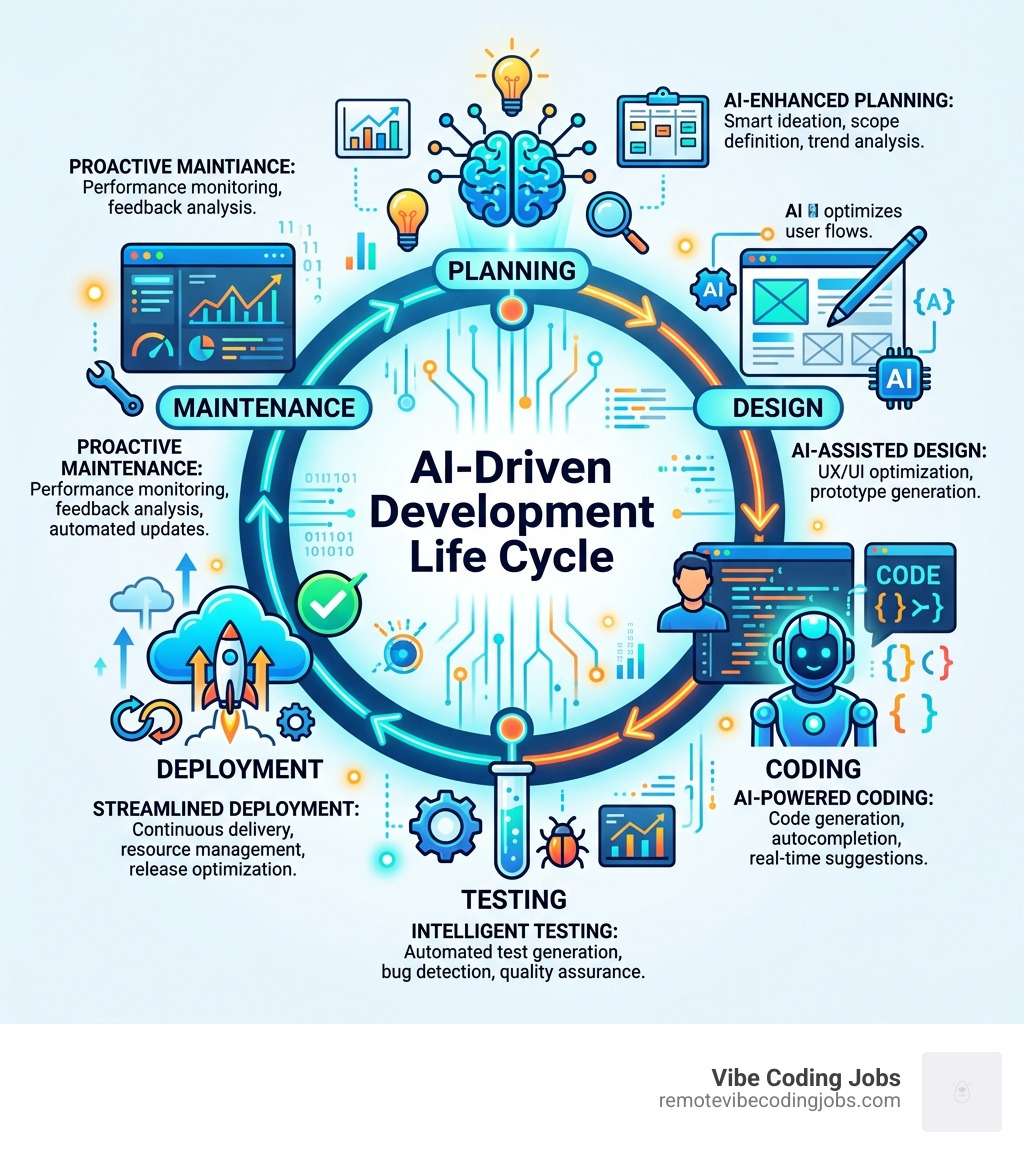
We’ve moved beyond simple “assistance” to a full AI-Driven Development Life Cycle (AI-DLC). This methodology reimagines software engineering as a series of high-energy “Bolts” — short, intense work cycles measured in hours or days — rather than the traditional two-week Sprints. In this new world, repetitive tasks like writing boilerplate code, unit tests, and documentation are handled entirely by AI, freeing us to focus on the “big picture” architecture and business logic.
Transforming the SDLC: From Planning to Deployment
The impact of AI powered development is felt across every single phase of the software development lifecycle. We are no longer just “writing code”; we are managing a pipeline of intelligence.
| SDLC Phase | Traditional Manual Time | AI-Driven Time | AI’s Role |
|---|---|---|---|
| Requirement Gathering | 1-2 Weeks | 2-4 Hours | Translating intent into user stories/units of work |
| Architecture Design | 3-5 Days | 1 Hour | Proposing domain models and system diagrams |
| Code Generation | 2-4 Weeks | 1-2 Days | Generating boilerplate, logic, and UI components |
| Testing & QA | 1-2 Weeks | 4-8 Hours | Automated test generation and bug detection |
| Deployment/DevOps | 2-3 Days | 30 Minutes | Generating IaC and managing CI/CD pipelines |
As we see in the table above, the velocity shift is staggering. Using Remote Developer AI Tools allows even small teams to ship features that would have previously required an entire enterprise department.
Automated Testing and Debugging
One of the most “lazy engineer” friendly aspects of this revolution is the death of manual unit testing. AI can now scan a function and automatically generate a comprehensive suite of tests with 80%+ coverage in seconds. Tools like ChaozCode use specialized agents to identify edge cases we might have missed.
Self-healing code is another breakthrough. When a build fails in the CI/CD pipeline, AI agents can analyze the error log, identify the offending line of code, and propose a fix before we even finish our morning coffee. This is especially helpful for those in entry-level AI coding roles, as the AI acts as a 24/7 senior mentor, explaining why the code failed and how to improve it.
AI-Driven Deployment and Maintenance
In 2026, maintenance is no longer a “sunk cost” of time. AI predicts errors based on historical data to avoid future outages. It manages Infrastructure as Code (IaC) and deployments based on the accumulated context of the project. If you’re looking to scale your career, understanding these remote AI growth opportunities is essential. Companies are no longer hiring just for “coding” but for the ability to maintain these complex, AI-integrated systems.
The New Engineering Paradigm: Orchestration and Vibe Coding
There’s a new term that’s taken the industry by storm: Vibe Coding. Coined by Andrej Karpathy and recognized by Merriam-Webster in 2025, vibe coding is a development style where the human acts as a “director” or “pilot.” We describe the “vibe” of the feature, and the AI handles the implementation.
This isn’t just for amateurs. Expert developers use vibe coding to stay in a state of flow, offloading the syntax-heavy “grunt work” to tools like Cursor or GitHub Copilot. This democratization means that non-technical users can now build functional prototypes, while expert engineers can focus on higher-level problem solving and critical thinking. To stay ahead, you need to master the Vibe Coding Tools Arsenal.
Scaling Your Career with AI Powered Development
The job market has fundamentally changed. We are seeing the rise of the “Agentic Engineer” — a role focused on building and maintaining AI agent infrastructure. According to our data at RemoteVibeCodingJobs, salary ranges for AI-native roles can reach up to $230,000 per year for those who can prove they move 3x to 10x faster than traditional developers.
Our AI Assisted Development Career Guide emphasizes that “product thinking” is now more important than pure syntax knowledge. Can you evaluate if an AI-generated tool is commercially viable? Can you architect a system that uses RAG (Retrieval-Augmented Generation) to give your AI agents the context they need? These are the questions that define a senior engineer in 2026.
Shifting from Coder to Orchestrator
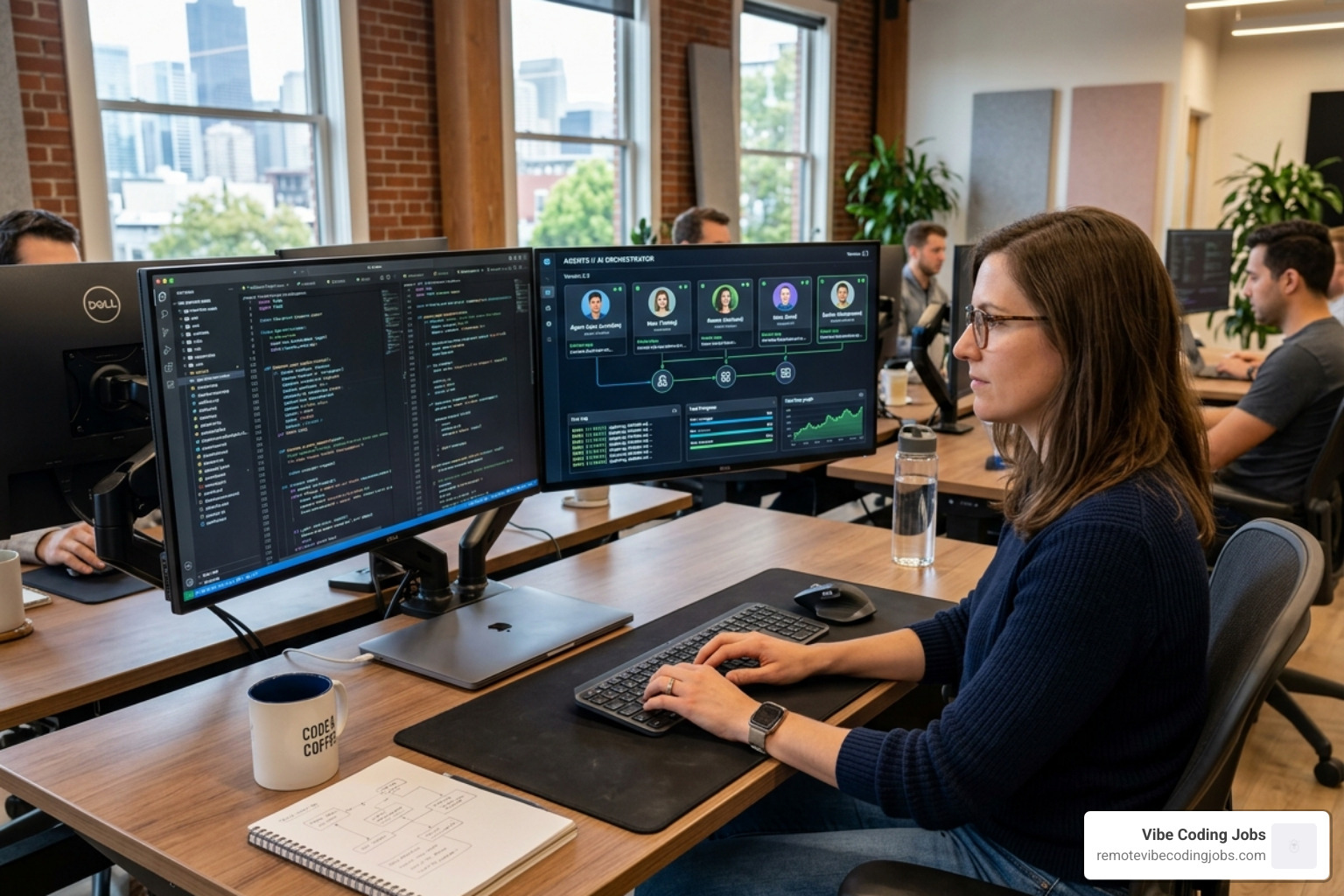
We are no longer “coders”; we are orchestrators. This means maintaining a “Human-in-the-loop” approach. While tools like Cursor can generate entire files, we are the ones who make the final technical decisions. We provide the architectural oversight and ensure that the AI’s output aligns with the business goals. This shift is a massive opportunity for entry-level growth, as it allows new developers to contribute to high-level design much earlier in their careers.

Managing Risks: Security, Bias, and Human Oversight
It’s not all sunshine and automated deployments. AI powered development introduces new risks that we must manage aggressively. The most glaring statistic? Approximately 27.3% of AI-generated code snippets contain security weaknesses. AI models are probabilistic; they don’t “know” security best practices—they just know what patterns were most common in their training data (which often includes insecure code).
Governance and Best Practices
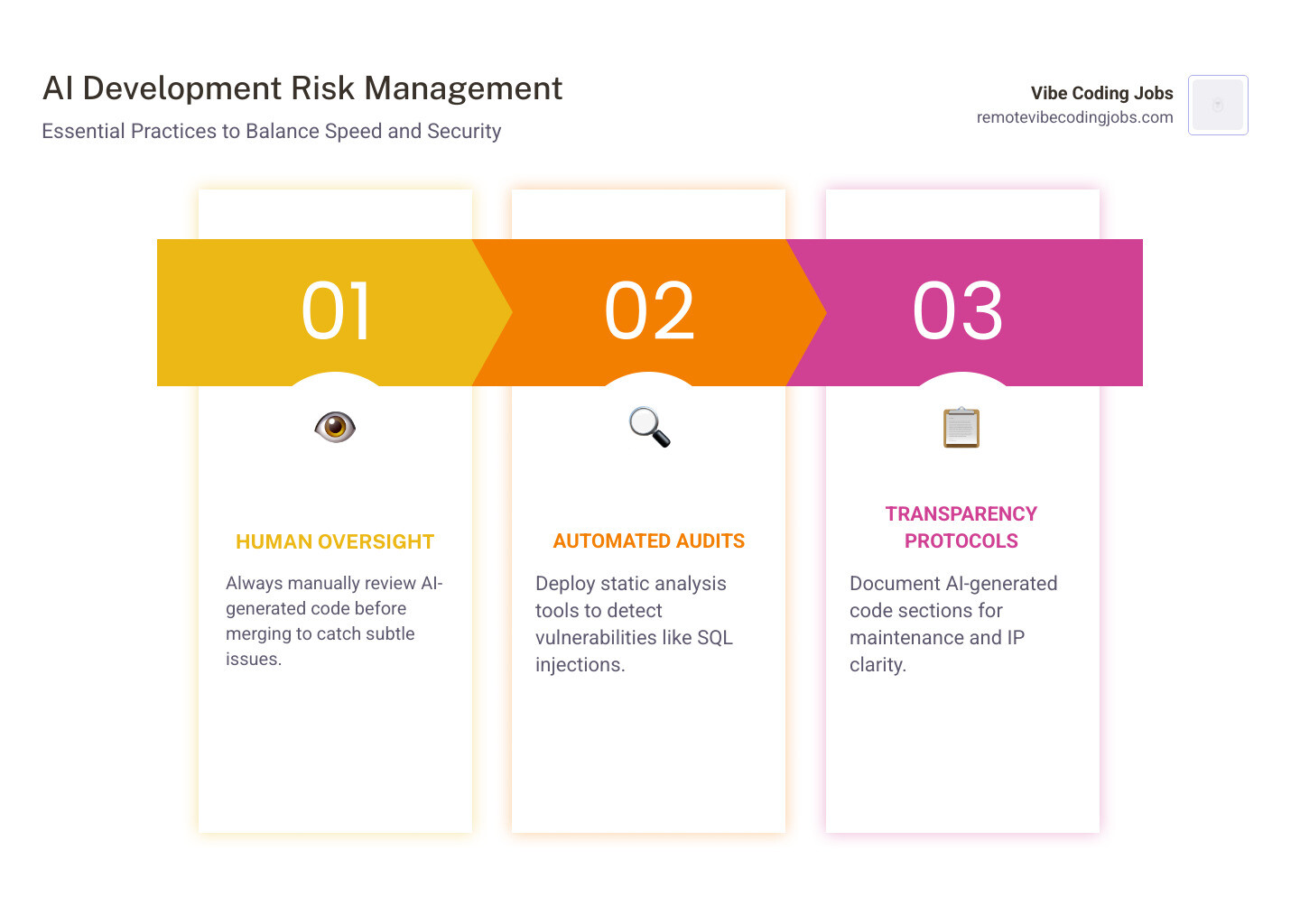
To mitigate these risks, we need robust governance. This includes:
- Human Oversight: Never merge AI-generated code without a thorough manual review.
- Automated Audits: Use AI-driven static analysis tools to catch SQL injections or cross-site scripting vulnerabilities.
- Transparency Protocols: Be clear about which parts of your codebase were AI-generated for future maintenance and IP ownership clarity.
- Bias Mitigation: Audit AI outputs for fairness and ensure your training data is representative.
For those looking at future trends in entry-level AI jobs, security auditing for AI code is becoming a massive sub-field. Getting relevant certifications in AI security can make you an invaluable asset to any team.
Avoiding Overreliance on AI
The “Lazy Engineer” trap is real. If we stop practicing our manual coding skills, we lose the engineering judgment required to spot when an AI is hallucinating a solution. Technical debt can pile up quickly if we accept “slop” code just because it works in the short term. We must maintain our growth potential by continuing to learn the fundamentals of computer science, even as we use AI to handle the execution.
Frequently Asked Questions about AI-Centric Workflows
How does AI-powered development differ from traditional methods?
Traditional methods rely on human developers to manually write every line of code, manage every dependency, and write every test case. AI powered development shifts the human role to “orchestrator,” where we provide high-level intent and oversight while AI handles the generation, debugging, and repetitive tasks. It’s the difference between building a house brick-by-brick and using a 3D printer.
What are the main tools driving the AI transformation in 2026?
The leaders in the space include:
- Cursor: An AI-native IDE built on VS Code that offers deep codebase indexing.
- GitHub Copilot: The most widely used pair programmer with deep enterprise integration.
- Claude & ChatGPT: The core LLMs that power the reasoning behind the code.
- ChaozCode: A platform with 250 specialized agents for end-to-end app building.
- Gemini Code Assist: Known for its massive 1M token context window.
Can non-technical users benefit from AI-powered development?
Absolutely. No-code and low-code platforms powered by generative AI allow non-technical founders to build functional MVPs (Minimum Viable Products) just by describing their ideas. While complex, enterprise-grade software still requires engineering oversight, the “barrier to entry” for building software has never been lower.
Conclusion
The era of AI powered development isn’t coming; it’s already here. Whether you’re a “Vibe Coder” building apps in your terminal or a Staff Engineer orchestrating a fleet of autonomous agents, the goal remains the same: shipping high-quality software faster than ever before.
At RemoteVibeCodingJobs, we believe the future of work is async-first, remote, and AI-augmented. The companies that are winning in 2026 are those that have embraced this “lazy engineer” philosophy — using the best tools available to maximize impact while minimizing burnout.
If you’re ready to stop fighting the future and start building it, we’re here to help you find your place in this new landscape. The demand for AI-native talent is skyrocketing, and your next big career move is just a prompt away.