How to get paid for vibe coding alone
The Best Vibe Coding Jobs Are Booming — Here’s Where to Find Them
The best vibe coding jobs in 2026 are no longer a niche curiosity — they’re some of the fastest-growing, highest-paying roles in tech.
Here’s a quick look at the top vibe coding job titles hiring right now:
| Job Title | Typical Salary Range | Remote-Friendly? |
|---|---|---|
| Full-Stack Vibe Coder | $90K–$150K | Yes |
| Agentic Engineer | $100K–$180K | Yes |
| AI Product Engineer | $120K–$200K | Yes |
| Vibe Coding Product Designer | $103K–$230K | Yes |
| Junior Agentic Engineer | $60K–$80K | Yes |
| Staff Developer Advocacy Engineer | $175K–$210K | Yes |
| Prompt Engineer | $90K–$160K | Yes |
| Freelance Vibe Coder | $32–$100+/hr | Yes |
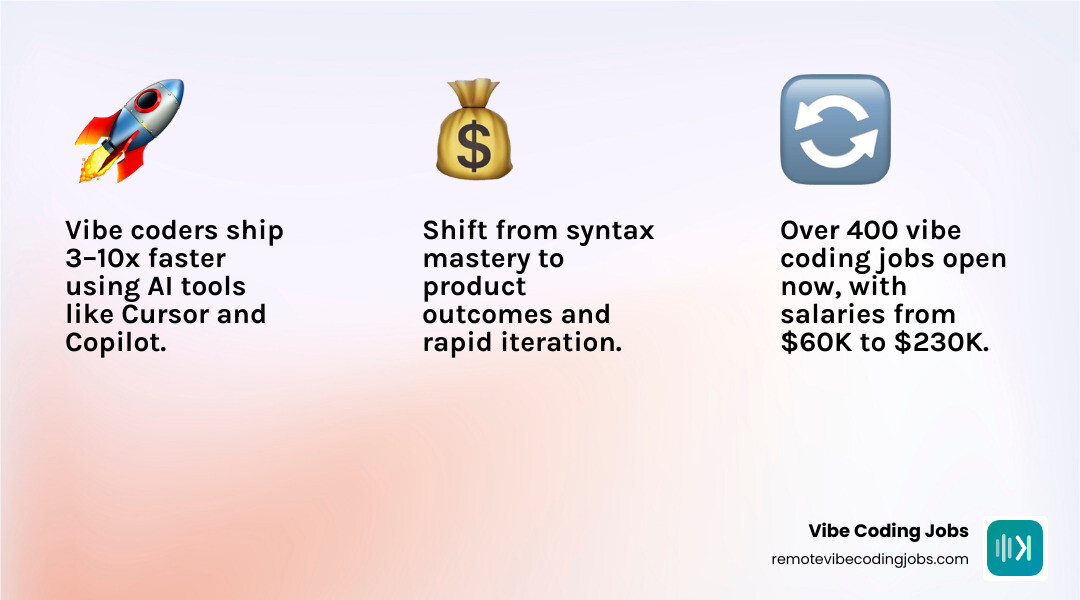
The concept is simple: instead of writing every line of code by hand, vibe coders use AI tools like Cursor, Claude Code, and GitHub Copilot to ship faster — often 3–10x faster than traditional development. The focus shifts from syntax mastery to product outcomes.
And the market has taken notice. Platforms built on this approach are scaling at a remarkable pace — one vibe coding platform reached $100 million in annual recurring revenue in just eight months. Meanwhile, over 400 vibe coding roles are actively listed across job boards right now, spanning startups, enterprise teams, and everything in between.
Whether you’re a seasoned engineer looking to go AI-native, or a builder just getting started, the opportunity is real — and it’s moving fast.
I’m the RVCJ Editorial team at Remote Vibe Coding Jobs, and we’ve spent years tracking the rise of AI-assisted development, curating the best vibe coding jobs across remote-first and async teams worldwide. That experience is what shapes everything you’ll find in this guide — so let’s get into it.
What Are the Best vibe coding jobs in 2026?
In simple terms, vibe coding means using AI as an active development partner. Instead of manually typing every function, component, and test from scratch, we guide AI tools with prompts, examples, architecture notes, and review loops. The work becomes less about memorizing syntax and more about shipping useful software quickly and safely.
That shift is why titles are changing so fast. We now see roles like AI-first developer, agentic engineer, full-stack vibe coder, prompt engineer, product designer with code, and AI-native analytics associate. Across the market, there are 406 active openings tied to this wave of AI-assisted development.
If you want a deeper primer, start with What Are Vibe Coding Jobs? A Guide to the Future of Remote Work and Vibe Coding vs Traditional Coding.
Best vibe coding jobs for beginners
The good news: beginner-friendly roles exist, and many employers are more portfolio-first than degree-first.
Good entry points include:
- Junior Agentic Engineer
- AI Automation Assistant
- Prompt Engineer for internal teams
- Freelance landing-page builder
- AI-first frontend junior
- QA and testing-focused vibe coder
These jobs often value proof of work over credentials. If you can show a live app, a sharp Loom walkthrough, and solid judgment around testing and debugging, you can compete. A computer science degree helps in some companies, but it is no longer the only ticket in.
Typical beginner pay from the research ranges from $60K to $80K for junior roles, with freelance work sometimes starting around $32/hour.
Best vibe coding jobs for experienced builders
Experienced builders can move into much higher-paid roles because companies want people who can use AI tools without creating a haunted house of technical debt.
The strongest senior paths include:
- Senior Full-Stack Vibe Coder
- AI Product Engineer
- Staff Developer Advocate for AI tools
- Agentic Systems Engineer
- AI-native Engineering Lead
- Data Workflow Vibe Coder
- Vibe Coding Product Designer
These roles usually require system ownership, product judgment, code review discipline, and the ability to step in manually when the AI gets overconfident. Senior compensation often starts around $150K and can reach $400K+ at top employers.
How vibe coding differs from traditional coding
Traditional coding tends to reward syntax depth and manual implementation speed. Vibe coding still needs technical skill, but the center of gravity changes.
Here is the practical difference:
- Traditional coding: write more by hand
- Vibe coding: direct, edit, validate, and ship with AI help
- Traditional coding: emphasis on syntax mastery
- Vibe coding: emphasis on product outcomes and iteration speed
- Traditional coding: longer implementation cycles
- Vibe coding: faster prototype-to-production loops
- Traditional coding: individual coding output
- Vibe coding: prompt design, context management, and review quality
That does not mean standards disappear. In fact, the opposite is true. The best teams add stronger testing, security checks, observability, and architecture docs because AI-generated code can be fast and weird at the same time. Think “turbocharger,” not “autopilot.”
12 Best vibe coding jobs you can apply for right now
If your goal is to find real opportunities quickly, browse Companies Hiring Vibe Coders & AI Developers and Remote Vibe AI Coding Jobs. Below are the 12 strongest job categories we see right now.
1) Full-Stack Vibe Coder
This is one of the clearest and most in-demand titles in the market. These roles usually blend React, TypeScript, Python, backend APIs, and AI-native IDEs.
Employers want people who can:
- Ship frontend and backend features quickly
- Use tools like Cursor and Claude Code well
- Review and refactor AI-generated output
- Own features from idea to deployment
One real-world example is a Genesis -style role focused on AI-assisted product building across modern data and app stacks.
Typical salary: $90K-$150K, with more for senior talent.
2) AI-First Frontend Developer
Frontend is a natural fit for vibe coding because AI can help move from idea to interface very fast. These roles focus on Next.js, design systems, fast iteration, and conversion-friendly UI.
Best for people who enjoy:
- Building polished interfaces
- Turning prompts into working prototypes
- Improving UX fast
- Collaborating closely with product and design
Typical salary: $90K-$160K.
3) Agentic Engineer
This title is rising fast. Agentic engineers build AI systems that use tools, call APIs, retrieve information, and complete multi-step workflows.
Common skills include:
- MCP and tool orchestration
- RAG pipelines
- Workflow automation
- Prompt and evaluation design
- Python and backend systems
Typical salary: $100K-$180K for many roles, with higher bands at senior levels.
4) Prompt Engineer for Product Teams
Prompt engineering is no longer just “write a clever prompt and hope.” In mature teams, it means designing repeatable prompt systems, testing outputs, creating guardrails, and improving reliability.
This role fits builders who enjoy language, systems thinking, and experimentation.
Typical salary: $90K-$160K.
5) AI Product Engineer
If we had to pick one of the best vibe coding jobs for long-term growth, this would be near the top. AI product engineers live close to users. They build MVPs, test features, gather feedback, and improve fast.
They usually combine:
- Full-stack development
- Product sense
- Analytics
- AI workflow design
- Strong prioritization
Typical salary: $120K-$200K+.
6) Vibe Coding Product Designer
This is where design and engineering start sharing the same desk. These roles involve prototyping, shipping UI, and using AI tools to go from wireframe to working experience much faster.
The research showed one of the highest salary bands here: $103,680-$230,280.
This role is ideal if you can:
- Design interfaces
- Build clickable prototypes
- Polish UX details
- Communicate product decisions clearly
7) AI Automation Developer
These roles focus on business workflows rather than consumer apps. Think internal tools, operations automation, lead enrichment, and sales process tooling.
Employers love candidates who can automate repetitive work and prove ROI.
Typical salary: often $80K-$150K depending on complexity and ownership.
8) Data Workflow Vibe Coder
This niche is especially interesting because AI-assisted development is now showing up in data engineering environments too. Some roles combine Python with dbt, Airflow, BigQuery, Redshift, Snowflake, or Databricks.
The work can include:
- Building autonomous data pipelines
- Creating AI-assisted data tools
- Orchestrating analysis workflows
- Improving operations for data teams
Typical salary: often mid to senior level, generally $100K-$180K+.
9) AI Security Vibe Coder
AI speed is useless if the output is insecure. That is why we are seeing specialized roles around red teaming, secure coding, model risk, and enterprise compliance.
These jobs suit builders who enjoy asking, “What could go wrong?” which is not always fun at parties, but it is very employable.
Typical salary: often $110K-$190K+.
10) Developer Advocate for AI Tools
Not all vibe coding jobs are pure shipping roles. Developer advocates teach, demo, write, and support adoption of AI tools and workflows.
Typical responsibilities include:
- Creating tutorials
- Recording demos
- Speaking with developer communities
- Helping product teams understand user pain points
The research showed staff-level compensation around $174,986-$209,983.
11) Freelance Vibe Coder
Freelancing is one of the fastest ways to get paid for vibe coding alone, especially if you can build:
- Landing pages
- Internal dashboards
- MVPs
- Automations
- AI-enabled prototypes
Research showed freelance rates starting around $32/hour, with experienced specialists charging much more. The key is narrowing your offer and showing outcomes, not just screenshots.
12) AI-Native Growth Technologist
This is a strong hybrid role for people who like experimentation more than pure software engineering. It blends analytics, no-code, code, automation, and growth testing.
You may work on:
- Funnel experiments
- Event tracking
- Lead routing
- Analytics dashboards
- Growth automations
Typical salary: broad range, often $80K-$160K depending on scope.
Salary, hiring companies, and where the demand is strongest
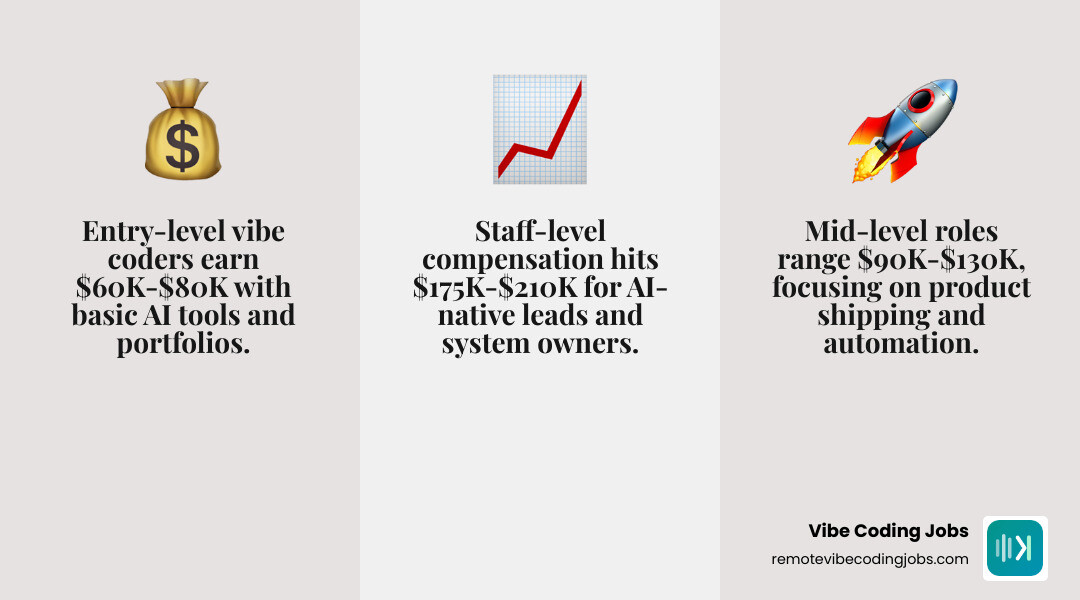
The salary picture for vibe coding is strong, but ranges vary by seniority, company type, and ownership.
| Level | Typical Salary Range | What Employers Expect |
|---|---|---|
| Entry-level | $60K-$80K | Basic coding, strong AI tool use, portfolio, fast learning |
| Mid-level | $90K-$130K | Independent shipping, debugging, testing, product collaboration |
| Senior | $150K-$400K+ | System ownership, architecture, review standards, strategy |
For more detail, see Vibe Coding Salary Guide: Remote Compensation Trends & Benefits and State of Vibe Coding 2026.
Highest-paying vibe coding employers and teams
The highest-paying employers tend to fall into a few buckets:
- Big tech teams experimenting with AI-native product development
- High-growth startups building core AI products
- Unicorn-scale companies hiring AI-first product and design talent
- Developer tooling teams
- Data platforms and AI labs
The market context matters too. Vibe coding startups have raised massive funding, with valuations in the billions across the category. We have also seen rapid revenue growth from AI-native builders, which helps explain why hiring is moving so aggressively.
Real-world examples of vibe coding jobs
Real-world examples now span startups and enterprise teams. The research pointed to roles associated with companies like Pinterest and Walmart, plus large enterprises piloting AI-native workflows.
Common patterns include:
- Startup MVP teams using AI to compress build cycles
- Enterprise internal tools teams adopting AI-assisted coding
- Product design teams moving from mockups to code faster
- Data organizations automating pipelines with agentic workflows
- Async-friendly teams standardizing AI development practices
Top locations and remote hotspots
The biggest pattern is not one city. It is remote-friendly hiring.
Most vibe coding jobs are:
- Remote-first
- Hybrid-flexible
- Async-friendly
- Global or distributed
That matters because the workflow itself supports distributed work well. Clear prompts, written architecture, recorded walkthroughs, and shared docs all fit remote collaboration naturally.
Skills, tools, and portfolio assets employers actually want
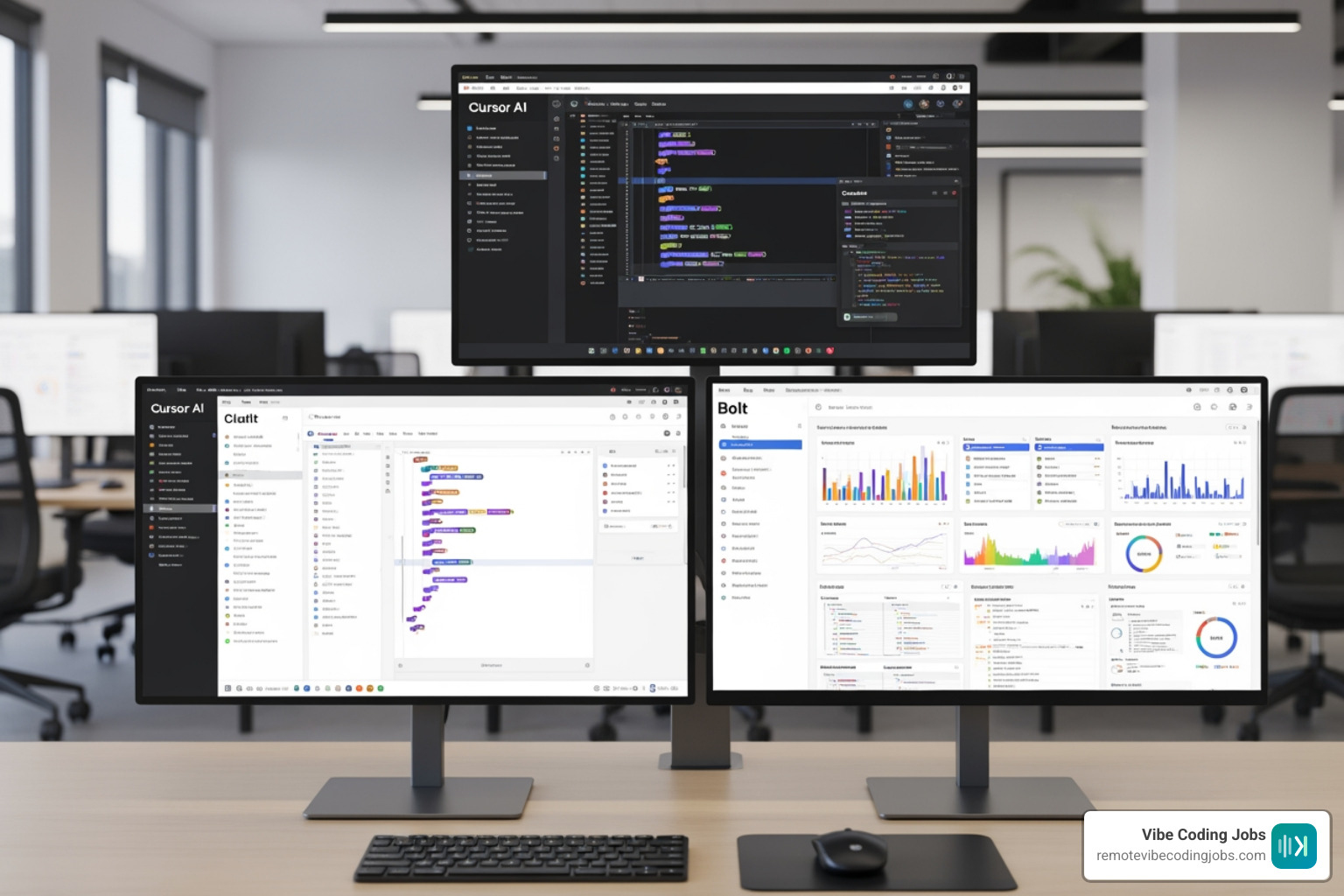
The best employers are not hiring people just because they can prompt an LLM. They want builders who can turn AI speed into reliable outcomes.
Useful resources here include How to Land a Remote Vibe Coding Job: Essential Skills, Must-Have Vibe Coding Tools, and Vibe Coder Tools: Copilot vs Cursor. For a broader overview of how AI coding assistants fit into modern software development, see GitHub Copilot on Wikipedia.
Best vibe coding jobs require these core skills
The most valued skills in 2026 are:
- Product thinking
- Prompt engineering
- Debugging and bug triage
- Code review
- Testing and QA
- Security awareness
- Communication in async teams
- Ability to manage AI context well
The most cited tools include:
- Cursor
- Claude Code
- GitHub Copilot
- Bolt.new
- Windsurf
The most useful technical stack skills include:
- React
- Next.js
- TypeScript
- Python
- FastAPI
- HTML, CSS, JavaScript
- APIs and integrations
- Testing frameworks
Advanced teams also value artifacts like:
- SKILL.md
- ARCHITECTURE.md
- reusable prompt chains
- evaluation docs
- observability notes
These documents help AI tools stay useful across larger projects and help teams keep code quality from drifting.
Do you need a degree or prior coding experience?
Usually, no. You do not always need a computer science degree to get started.
What you do need is proof that you can:
- Build something useful
- Use AI tools responsibly
- Fix broken output
- Explain your decisions
- Ship with reasonable quality
Self-taught builders, bootcamp grads, designers who learned frontend, analysts who learned automation, and junior developers all have a path in. That said, complete beginners still need fundamentals. If you cannot read HTML, CSS, JavaScript, or basic Python, AI will eventually drag you into a ditch and leave you there.
How to build a portfolio that stands out to recruiters
The strongest portfolio is not a pile of repos. It is evidence.
Include:
- 3 to 5 live projects
- short case studies for each
- before-and-after screenshots
- Loom walkthroughs
- GitHub links
- measurable outcomes where possible
Great portfolio project examples:
- An AI-assisted dashboard with user auth and analytics
- A lead enrichment or ops automation tool
- A product prototype shipped in a weekend
- A frontend redesign with measurable conversion improvements
- An agent workflow that uses tools or retrieval
For each project, explain:
- the problem
- your stack
- which AI tools you used
- how you tested it
- what broke
- how you fixed it
- what you would improve next
Recruiters love clarity. “Built with vibes” is cute for a meme. “Shipped a Next.js app with Cursor, added tests, reduced manual support work by 40%” gets interviews.
How to find and land the Best vibe coding jobs faster
Finding the best vibe coding jobs is partly about speed and partly about signal. We recommend starting with Vibe Coding Jobs: Remote AI Assistant Careers, Vibe Coding Tools, and the Companies directory.
At RemoteVibeCodingJobs, we focus on curated remote roles filtered by culture, stack, and AI tools, which saves time if you want async-first companies instead of random keyword soup.
Best vibe coding jobs application strategy
A strong application usually includes:
- Resume language that matches the role
- Clear mention of AI tools used
- Shipped projects, not just responsibilities
- Quantified outcomes
- Short, tailored outreach
We suggest putting these keywords on your resume when relevant:
- Cursor
- Claude Code
- GitHub Copilot
- AI-assisted development
- prompt engineering
- agentic workflows
- React
- Next.js
- FastAPI
- testing
- architecture
- remote collaboration
And always lead with outcomes:
- Shipped MVP in 5 days
- Cut manual workflow time by 70%
- Built internal tool used by 4 teams
- Increased conversion rate by 12%
Interview prep for AI-native roles
Expect interviews to test judgment, not just syntax.
Common interview formats include:
- Prompt walkthroughs
- Live editing with AI tools
- Bug fixing in AI-generated code
- Architecture tradeoff discussions
- Safety and security checks
- Portfolio reviews
Prepare by practicing:
- explaining why you prompted a tool a certain way
- spotting hallucinated code
- tightening architecture
- adding tests
- improving maintainability
Common challenges vibe coders face and how to overcome them
The biggest challenges are predictable:
- Hallucinated code
- Messy abstractions
- Context window limits
- Weak test coverage
- Inconsistent team standards
- Burnout from high-speed shipping
How to deal with them:
- Review every meaningful AI-generated change
- Keep architecture docs current
- Break work into smaller tasks
- Add tests before celebrating
- Create team standards for prompts and reviews
- Use observability and logs early
- Protect focus time so “fast” does not become “fried”
Frequently Asked Questions about Best vibe coding jobs
Are vibe coding jobs mostly remote?
Yes, many are remote-first or hybrid-flexible. The workflow fits async work especially well because so much of the process depends on written context, documentation, prompts, and recorded demos. If remote work matters to you, start with Remote Vibe AI Coding Jobs.
What career path can a vibe coder grow into?
A vibe coder can grow into:
- Senior engineer
- AI product engineer
- Automation lead
- Developer advocate
- Engineering manager
- Founder or indie builder
The long-term winners will be the people who combine AI speed with product judgment and engineering discipline.
What are the best resources for ongoing learning?
We recommend learning from a mix of playbooks, tool guides, company profiles, and market reports, including Grafana Labs. The best ongoing education is still hands-on: ship projects, review failures, improve your prompts, and tighten your testing loop.
Conclusion
The best vibe coding jobs in 2026 are not hype-only titles. They are real, growing, and increasingly well-paid roles across product, design, automation, data, and developer tooling.
If you want to move quickly, focus on three things:
- Learn the core tools
- Build a portfolio with live proof
- Apply through curated, remote-friendly channels
That is exactly why we built RemoteVibeCodingJobs: to help builders find better-fit roles faster, with curated listings, quick applications, and practical guidance for AI-assisted careers.
For your next step, check out RemoteVibeCodingJobs Cursor Copilot Developer Jobs.