
The No-Meeting Life: Understanding Asynchronous Work Culture
What “Asynchronous Jobs” Actually Means (And Why It Matters in 2026)
The asynchronous jobs meaning is simpler than it sounds:
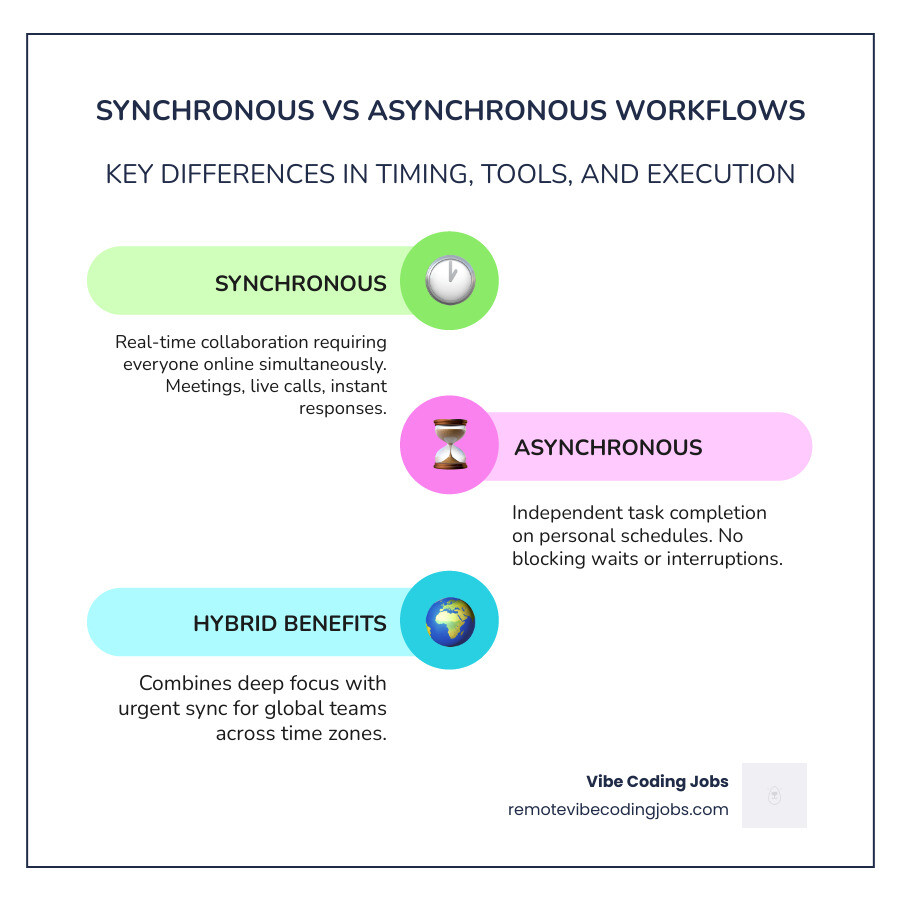
Asynchronous work means you complete your tasks on your own schedule — without needing to be online at the same time as your teammates.
Here’s a quick breakdown:
| Term | Simple Definition |
|---|---|
| Asynchronous job | Work done independently, with no expectation of an immediate response |
| Synchronous job | Work done in real time, with colleagues online simultaneously (meetings, calls) |
| Async communication | Email, recorded video, Slack threads — replied to when ready |
| Sync communication | Live meetings, phone calls, instant back-and-forth chat |
Nearly 60% of Americans can now work remotely at least part of the time. And as distributed teams spread across time zones, the old model of “everyone online at 9am” simply doesn’t work anymore.
Think of it like email vs. a phone call. You write the email, send it, and go back to your work. Your colleague reads it when they’re ready. No interruption. No waiting. That’s async in a nutshell.
This isn’t just a cultural shift — it’s a technical one too. In software development, “asynchronous jobs” also refers to background tasks that run independently without blocking other processes. Both meanings matter for developers building at AI-first companies in 2026.
We’re the RVCJ Editorial team at Remote Vibe Coding Jobs, where we cover async culture, remote developer hiring, and AI-assisted workflows — making asynchronous jobs meaning a topic we live and breathe every day. Let’s break down everything you need to know.
Defining the Asynchronous Jobs Meaning in 2026

As we navigate through 2026, the traditional “9-to-5” is becoming a relic of the past. To truly grasp the asynchronous jobs meaning, we have to look at it through the lens of autonomy. In an async environment, the “when” of work is decoupled from the “who.” You aren’t tethered to a colleague’s active status light on Slack.
The Asynchronous – Glossary | MDN defines the term as two or more events that do not happen at the same time. In a professional setting, this translates to a workflow where communication and task execution are independent of real-time presence. You might submit a pull request at 11:00 PM in New York, and your teammate in Berlin reviews it during their morning coffee while you’re fast asleep.
This model is built on trust. According to Asynchronous Work: Meaning & Benefits | Rippling Glossary, async work emphasizes documentation as the “organizational memory.” Instead of relying on a quick verbal chat that disappears into the ether, every decision and instruction is written down, making it accessible to anyone at any time.
The Comparison: Sync vs. Async
To help visualize how this changes your daily life, we’ve put together this comparison:
| Feature | Synchronous Work | Asynchronous Work |
|---|---|---|
| Response Time | Immediate (seconds/minutes) | Deliberate (hours/day) |
| Primary Tool | Zoom, Google Meet, Phone | Notion, GitHub, Loom, Email |
| Focus Style | Reactive, fragmented | Proactive, deep work |
| Scheduling | Set hours, shared calendar | Flexible, results-oriented |
| Documentation | Often verbal/lost | Written/permanent |
The Technical Side: How Asynchronous Jobs Function in Software

While the cultural asynchronous jobs meaning focuses on people, the technical meaning focuses on code. If you’re a developer, you’ve likely dealt with “jobs” that don’t happen right away.
In software architecture, an asynchronous job is a task that is offloaded to a background process so the user doesn’t have to wait for it to finish. Imagine clicking “Export PDF” on a website. If the site freezes while it generates the file, that’s synchronous (and annoying). If the site says “We’ll email you when it’s ready” and lets you keep browsing, that’s an asynchronous job.
Frameworks like Active Job Basics — Ruby on Rails Guides provide a standard way to declare these jobs and run them on various queuing backends. This ensures that heavy lifting—like sending mass emails or processing images—doesn’t slow down the main application.
Every job follows a Job Lifecycle | async-endpoints. It starts as Queued, moves to InProgress, and ideally ends in Completed. If something goes wrong, it might be Scheduled for a retry using “exponential backoff”—a fancy way of saying the system waits a bit longer each time it tries again before giving up.
Background Processing and Asynchronous Jobs Meaning
In high-scale environments, managing these tasks requires robust tools like Sidekiq or Working with Asynchronous Java Jobs. The goal is to ensure that the physical Java object or thread isn’t held in memory for long-running tasks, which saves system resources.
Technical async jobs are often stateless. They trigger an external mechanism—like an AI agent or a cloud function—and then “return” immediately, waiting for a callback to signal they are done. This mirrors the human async workflow: you send a message, stop thinking about it, and wait for the notification to pop up later.
Cloud Infrastructure and Asynchronous Jobs Meaning
When we talk about the cloud, the asynchronous jobs meaning expands to batch processing. Services like Oracle allow for Creating Async Jobs that process massive amounts of unstructured text data without requiring the developer to write complex code to split or merge datasets.
This scalability is why async is the backbone of modern AI. When you ask an AI to generate a complex codebase or a high-resolution video, it’s rarely a real-time “sync” interaction. It’s an async job being processed by a cluster of GPUs in the background, notifying you once the “vibe” has been successfully coded into reality.
The Benefits of an Async-First Culture
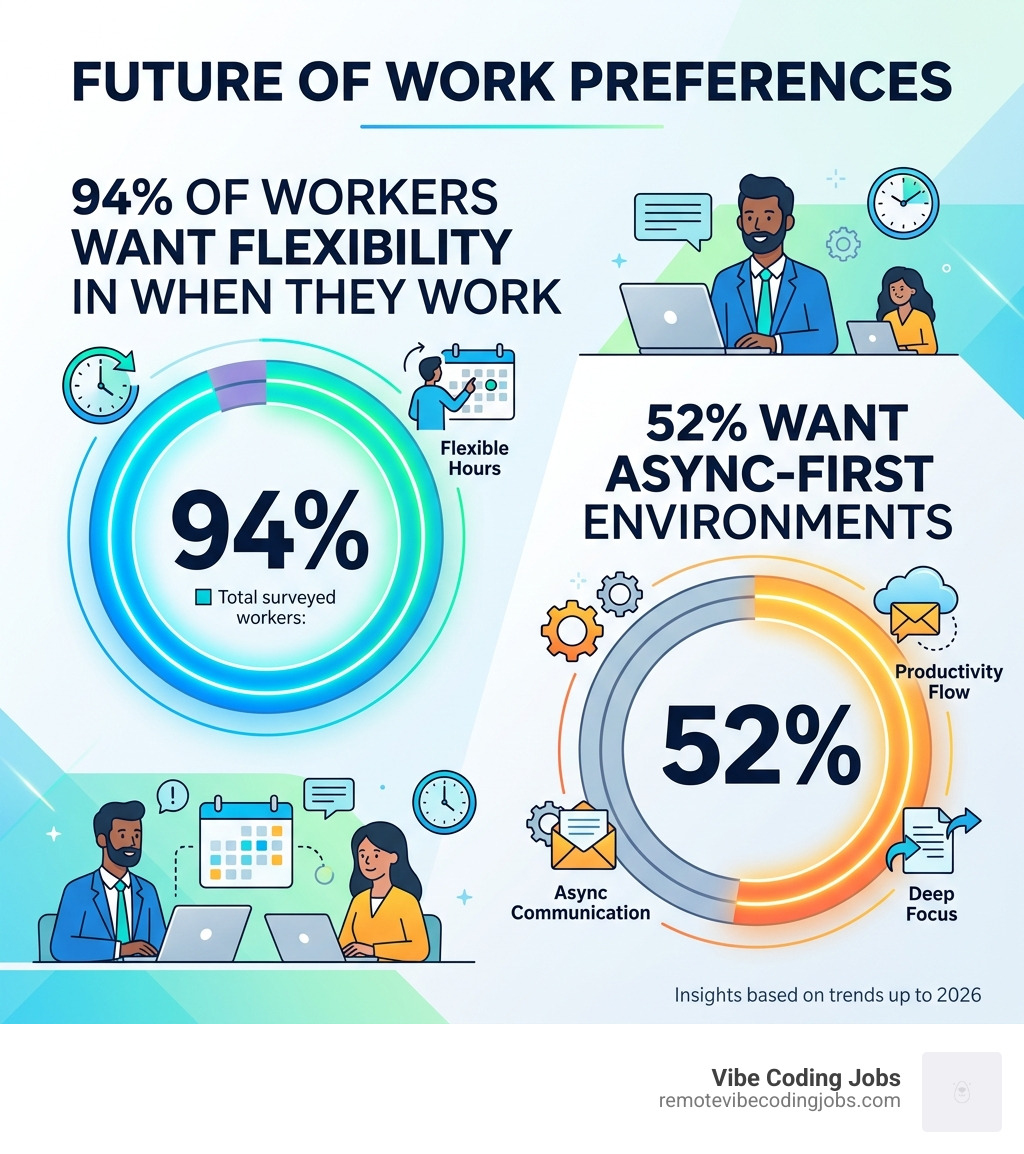
Why are so many companies—especially in the “vibe coding” and AI space—moving toward an async-first model? The answer lies in productivity and mental health.
The average employee today is interrupted up to 15 times per hour. We spend a staggering 80% of our time communicating rather than doing. By embracing the asynchronous jobs meaning, we reclaim that time for Remote Work Deep Focus Productivity.
Here are the heavy hitters when it comes to benefits:
- Deep Focus: Without the constant ping of Slack or the “do you have five minutes?” Zoom call, developers can enter a flow state. This is where the best code is written. Async First Remote Developer Jobs Productivity Benefits are real—productivity often sky-rockets when meetings are replaced by clear documentation.
- Global Talent Pools: When you don’t require everyone to be online at the same time, you can hire the best talent in the world, whether they are in Tokyo, London, or Buenos Aires. As noted by Why You Should Be Working Asynchronously – Remote, async work allows companies like GitLab to operate with over 1,300 members across 65+ countries.
- Inclusion for Introverts: Synchronous meetings often favor the loudest person in the room. Async communication allows “slow thinkers” and introverts to digest information and provide more thoughtful, deliberate contributions.
- Automatic Documentation: Because async communication is written or recorded, you get a built-in audit trail. New hires can read through old Slack threads or GitHub issues to understand why a decision was made, rather than asking someone to remember a conversation from six months ago.
Overcoming the Challenges of Asynchronous Work
We won’t sugarcoat it: transitioning to an async-first culture isn’t as easy as just deleting your Zoom account. It requires a massive shift in how you think about collaboration.
The biggest hurdle is often the “communication gap.” Without the nuance of tone and body language, text-based messages can sometimes be misinterpreted. That’s why Async First Remote Developer Jobs Culture Workflow Communication emphasizes over-communication. You have to provide more context than you think is necessary.
Then there’s the human element. A shocking 82% of workers admit they’ve felt lonely at work. When you don’t see your teammates’ faces every day, that sense of isolation can creep in. To combat this, successful async companies use Async First Remote Developer Jobs Benefits Communication Teamwork strategies like:
- Non-work channels: Slack channels for pets, gaming, or “vibe” sharing.
- Recorded updates: Using tools like Loom to show your face and voice without requiring a live meeting.
- Intentional social syncs: Having one or two optional “coffee chats” per week where work talk is forbidden.
Finally, there’s the “always-on” trap. In an async world, work is always happening somewhere. If you aren’t careful, you might feel the need to check messages at 11:00 PM just because your teammate in another time zone is active. As Asynchronous Work | How to Make it Work – ADP suggests, setting clear response expectations (e.g., “all non-urgent messages will be answered within 24 hours”) is vital to preventing burnout.
Frequently Asked Questions about Asynchronous Work
How does async work differ from remote work?
Remote work is about where you work (your home, a cafe, a co-working space). Asynchronous work is about when you work. You can be a remote worker but still be stuck in eight hours of synchronous Zoom meetings every day. Truly Async Remote Developer Jobs Flexible Communication means you have control over both your location and your clock.
What tools are best for async communication?
The “Async Stack” usually involves:
- Documentation: Notion, GitHub Wiki, or Coda for “the source of truth.”
- Project Management: Linear, Trello, or Asana to track what needs to be done.
- Video: Loom or Descript for walking through code or designs.
- Messaging: Slack or Twist, but used with threads and the understanding that “instant” isn’t required.
- AI Tools: Cursor and Claude for “vibe coding,” allowing you to generate and iterate on code independently.
Check out Async First Remote Developer Jobs Benefits for more on how these tools empower a no-meeting lifestyle.
When is synchronous communication still necessary?
Even the most hardcore async companies still use sync moments. You should jump on a call for:
- Sensitive Feedback: Performance reviews or difficult conversations.
- Urgent Pivots: When a production server is down or a deadline moved up by three weeks.
- Complex Brainstorming: Sometimes, the high-bandwidth energy of a live session is better for “blue sky” thinking.
- Team Bonding: Building rapport is often faster when you can actually laugh together in real time.
For more on balancing these roles, see Async First Remote Developer Jobs Companies Roles.
Conclusion
Understanding the asynchronous jobs meaning is your first step toward a more balanced, productive, and modern career. Whether you are a developer looking for “deep work” blocks or a manager trying to build a global team, the async-first model is the future of the knowledge economy.
In 2026, the most exciting frontier of this movement is “vibe coding”—the ability to use AI agents and high-level intent to build software at 10x speed. This type of work is inherently suited for async environments. You prompt your AI, let it run its background jobs, and review the results when they’re ready.
At RemoteVibeCodingJobs, we specialize in connecting talented developers with companies that actually “get it.” We curate daily listings of remote jobs at async-first companies that embrace tools like Cursor, Claude, and GitHub Copilot.
If you’re ready to trade your 62 monthly meetings for a life of deep focus and AI-assisted creativity, come find your next role at https://remotevibecodingjobs.com. Let’s build the future, one async job at a time.