
The Mystery of the Rising Software Engineer Posting
The Software Engineer Posting in May 2026: What the Data Actually Shows
Quick answer for job seekers and hiring managers:
| Metric | Current Value (May 2026) |
|---|---|
| Indeed Job Posting Index | 72.44 (baseline: 100 in Feb 2020) |
| Total US Software Engineer Jobs | 62,000+ |
| Remote Roles Available | 15,422 |
| New Postings in Past 24 Hours | 4,232 |
| Top Hiring Company | Google (955 open roles) |
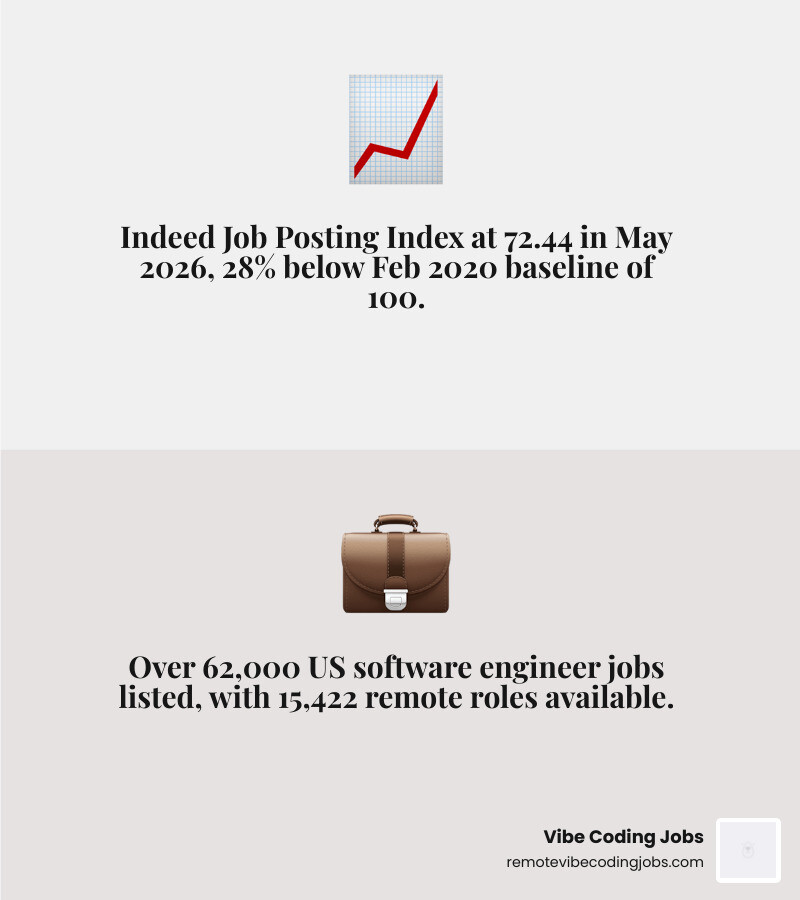
The software engineer posting landscape in 2026 tells a story full of contradictions. There are over 62,000 open roles on LinkedIn alone. Yet the Indeed hiring index sits at just 72.44 — meaning job posting volume is still nearly 28% below pre-pandemic levels from February 2020.
So what gives?
More jobs than ever seem available. But the market has fundamentally changed who gets hired, what skills are required, and what kind of engineer companies are actually looking for.
This is not a simple recovery story. It’s a restructuring.
I’m part of the RVCJ Editorial team at Remote Vibe Coding Jobs, where we track software engineer posting trends across AI-first and async-first companies every day. We’ve watched this market shift from volume-driven hiring to precision hiring — and the patterns are worth paying close attention to.
The Paradox of the Software Engineer Posting Index

When we look at the data today, we see a massive gap between the “vibe” on the ground and the hard economic indicators. As of March 27, 2026, the Indeed Hiring Lab index for software development job postings in the US stood at 72.44. To put that in perspective, the index uses February 1, 2020, as a baseline of 100.
At first glance, this looks like a permanent decline. We are still significantly lower than the pre-pandemic levels, and light-years away from the hiring frenzy of 2021. However, the sheer number of vacancies tells a different story. Across major platforms, there are over 62,000+ open positions for software engineers in the United States.
The paradox lies in the fact that while the volume of postings has decreased from the historical highs, the specific demand for certain roles is skyrocketing. If you are looking for a Software Engineer Role on Vibe Coding Jobs, you’ll notice that companies aren’t just “hiring engineers” anymore—they are hunting for specialists who can navigate a post-AI world.
The market has shifted toward High-Growth Software Engineer Postings 2026 that emphasize efficiency and output over headcount. We are seeing a stabilization, but it’s a stabilization at a higher level of technical expectation.
Market Correction vs. Real Demand
Is the market “down,” or is it just more efficient? We believe it’s the latter. While the aggregate index is lower, the quality of a software engineer posting in 2026 is much higher. For instance, Randstad USA currently lists over 3,044 software engineer jobs, and even niche sectors are seeing steady growth.
Global hiring trends suggest that companies have moved past the “growth at all costs” phase. Today, a Pine Park Health Senior Software Engineer role is focused on real-world impact and sustainable development. The demand is real, but it is no longer being driven by speculative venture capital; it’s being driven by the need to integrate AI into every facet of business.
The Evolution of the Software Engineer Posting: From Syntax to Strategy
The biggest shift we’ve seen in our daily curation is the rise of “Vibe Coding.” This isn’t just a catchy term; it’s a fundamental change in how software is built. Modern engineers are spending less time fighting with syntax and more time architecting solutions using AI-native tools like Cursor, Claude, and Windsurf.
A modern software engineer posting now frequently looks for “AI-fluent” professionals. This means the candidate isn’t just expected to write Java or Python; they are expected to manage an AI agent that writes the bulk of the boilerplate. Roles like the Supabase AI Tooling Engineer are perfect examples of this trend—where the “tooling” is just as important as the code itself.
The Rise of the Vibe Coder in a Software Engineer Posting
The “Vibe Coder” is an engineer who thrives in ambiguity, using prompt engineering and agentic workflows to move 3x to 10x faster than traditional developers. In our listings, we see more companies specifically asking for experience with AI Copilots.
For example, the Grafana Labs Staff AI Engineer position highlights the need for engineers who can bridge the gap between traditional infrastructure and emerging ML models. These “vibe coding” practices allow smaller, highly autonomous pods to ship products that used to require entire departments.
Shifting From Code Typist to Architect
We are witnessing the death of the “code typist.” If your primary value is knowing where the semicolons go, the market is getting smaller for you. However, if you can act as a software architect and strategist, the market is wide open.
Modern roles, such as the Mistral AI Mistral Cloud Software Engineer Backend Golang, require deep product thinking. You aren’t just implementing a ticket; you are designing systems that integrate LLMs into high-scale production environments. The focus has shifted from “How do I write this?” to “What should we build, and how does it scale?”
Salary and Location Trends in a Hybrid World
The compensation for a software engineer posting in 2026 remains highly competitive, though the distribution has changed. While the “middle” of the market has felt some pressure, the ceiling for specialized talent has actually risen.
| Role Level | Base Salary Range (2026) | Common Perks |
|---|---|---|
| Entry-Level / Vibe Coder | $70,000 – $110,000 | Remote-first, Learning stipends |
| Senior Software Engineer | $170,000 – $260,000 | Equity, 401(k) match, Health |
| Staff / Principal Engineer | $210,000 – $285,000+ | Significant Equity, Leadership roles |
In major hubs like San Francisco and New York, base salaries for a Senior Software Engineer can reach as high as $285,800. However, the real story is the persistence of remote work. Despite “return to office” headlines, over 15,000 remote roles are currently active, proving that the async-first culture we champion at Remote Vibe Coding Jobs is here to stay.
The Premium on Specialized Talent
Companies are willing to pay a massive premium for engineers who can handle high-leverage infrastructure. A Senior Software Engineer – Release Engineering | Everlaw | Oakland can expect a base salary up to $251,000 plus equity. Why? Because they aren’t just maintaining tools; they are evolving release infrastructure to support AI agents and ensuring deterministic, audit-ready deployments in regulated environments.
Geographic Hubs vs. Async-First Cultures
While San Francisco (2,920 jobs) and New York (2,805 jobs) remain the top physical hubs, the “location” of a software engineer posting is increasingly becoming “anywhere with good Wi-Fi.” Companies like Cortex and Mistral AI are proving that you can raise Series C funding and build world-class tech with a fully remote team.
Positions like the Headway Senior React Native Developer highlight this flexibility. The focus is on finding the best talent, whether they are in Seattle, Austin, or a small town in Georgia.
Decoding the Modern Software Engineer Posting Requirements
What does it actually take to get hired in 2026? The “standard” tech stack has expanded. It’s no longer enough to know a frontend framework and a backend language. You need to understand the plumbing.
A typical software engineer posting today often includes:
- Languages: Java, Python, Go, and TypeScript remain dominant.
- Cloud: AWS, Azure, and Google Cloud are non-negotiable.
- Orchestration: Kubernetes and Terraform are standard for senior roles.
- AI Integration: Experience with OpenAI, Claude, and Gemini APIs is the new “must-have.”
Take the Salesloft Senior Data Engineer role, for example. It requires a blend of traditional data engineering with the ability to manage high-scale, event-driven architectures that power AI-driven insights.
Essential Skills in a Modern Software Engineer Posting
Full-stack capability is more valuable than ever because AI tools allow a single developer to handle both the UI and the database with ease. We are also seeing a surge in demand for engineers who understand “Data In Flight.” The Grafana Labs Staff Backend Engineer Databases Tempo role is a great example of the specialized backend skills needed to manage the observability of modern, distributed systems.
Emerging Security and Infrastructure Needs
As AI agents begin to participate in deployments, security has become a primary concern. Every software engineer posting now has an implicit (or explicit) security requirement. Roles like the Replit Product Security Engineer focus on protecting the software development lifecycle itself, ensuring that as we move faster with AI, we don’t leave the door open for vulnerabilities.
The Seniority Gap: Why Senior and Staff Roles Dominate
One of the more sobering trends in the 2026 market is the “Seniority Gap.” If you look at the total 62,000+ jobs, a disproportionate number are for Senior, Staff, or Principal levels.
Companies are looking for “Force Multipliers”—engineers who can mentor others, set technical strategy, and own entire systems. The GitLab Staff Backend Engineer Knowledge Graph role is a classic example. GitLab isn’t just looking for someone to write code; they want someone to lead the evolution of complex data structures that impact the entire product.
The Decline of Traditional Entry-Level Roles
The traditional “Junior Developer” role is being disrupted by AI. When an AI can write basic CRUD apps and unit tests, the “entry-level” bar moves up. This is why we see a decline in traditional new grad postings but an increase in “Vibe Coding” roles where even a junior is expected to ship polished, AI-assisted products.
Leadership roles, such as the Grafana Labs Director of Engineering Loki Databases, are more critical than ever to manage these high-velocity, AI-augmented teams.
Frequently Asked Questions about Tech Hiring
What is the current market index for software development?
As of March 27, 2026, the Indeed index for software development job postings is 72.44. This index uses February 1, 2020 (pre-pandemic), as a baseline of 100. While this is lower than the 2021 peak, the market has stabilized and is showing signs of high-quality growth in specialized AI and infrastructure sectors.
How much do senior software engineers earn in 2026?
The salary range for a senior software engineer posting typically falls between $170,000 and $285,000 annually. This varies based on location (with SF and NYC offering the highest premiums) and the tech stack. Roles involving AI integration, distributed systems, or specialized security often command the top end of this range, plus significant equity packages.
What are the top skills required in 2026 job postings?
The most in-demand skills include:
- AI Integration: Prompt engineering and working with LLM APIs.
- Cloud Infrastructure: Mastery of AWS, Kubernetes, and Terraform.
- Backend Proficiency: Java, Python, and Go are still the heavy hitters.
- Product Thinking: The ability to understand the “why” behind the code and design scalable systems.
Conclusion
The “Mystery of the Rising Software Engineer Posting” isn’t really a mystery once you look at the shift in quality over quantity. We are no longer in a market that rewards “butts in seats.” We are in a market that rewards AI-fluent talent—engineers who can leverage the latest tools to ship better software, faster.
At Remote Vibe Coding Jobs, we believe the future of work is async, remote, and AI-assisted. The old career ladder might be changing, but for those who embrace the “vibe,” the opportunities have never been more exciting.
Whether you are an engineer looking to level up or a company ready to Post your next high-velocity role, the 2026 market is ready for you. Don’t just code—vibe.